

Summary
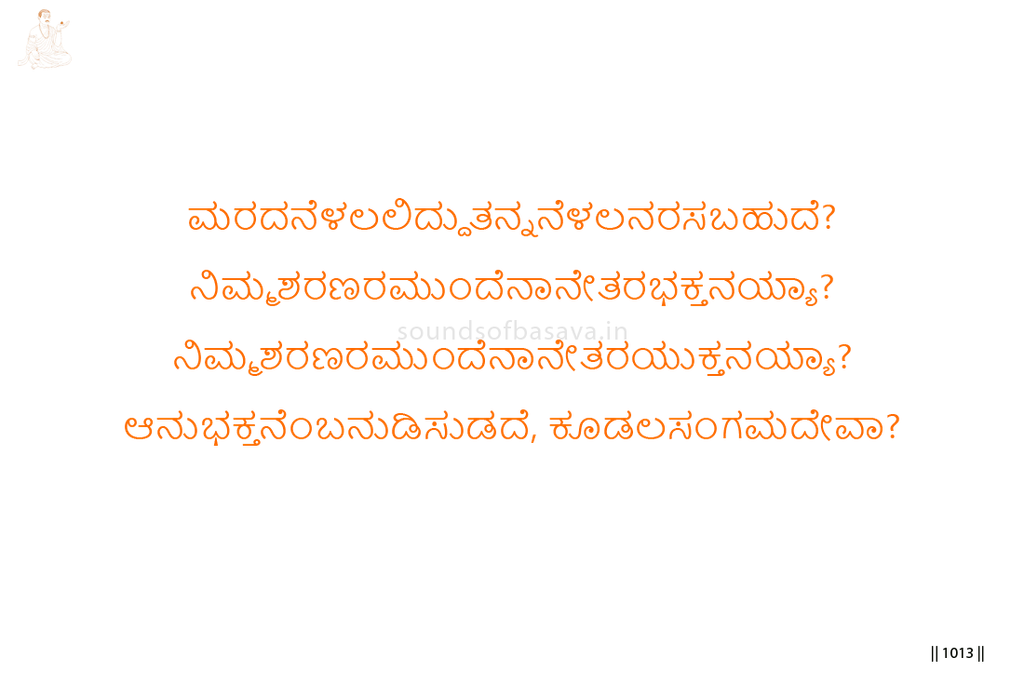
Basavanna uses the image of a person sitting under a tree and claiming its shade as his own. The shade is received freely; it is not produced or possessed by the one who sits beneath it.
From this image, he turns to the presence of Kudalasangama Deva’s Sharanas. Before them, he cannot claim, “I am a bhakta.” He cannot claim, “I am fit” or “I am spiritually qualified.” The very presence of the Sharanas exposes the subtle ego that tries to own devotion.
The Aikya source states that this vachana reveals the danger of ego claiming ownership over devotion itself. The thought “I am devoted” introduces separation and pride, corrupting the purity of devotion before Kudalasangama Deva.
Imagery & Symbolic Relevance
The tree is the first image. It stands as the source of shade. The one who sits beneath it does not create the shade.
The shade is the second image. It is received, enjoyed, and sheltered under, but it cannot be owned. Basavanna uses this simple image to show that grace, devotion, and spiritual nearness cannot be turned into personal property.
The question “Can one sitting in the shade of a tree claim the shade as his own?” gives the central correction. The answer is implied: no. The shade belongs neither to possession nor to personal achievement.
The line “Before Your Sharanas, what kind of bhakta am I?” turns the image inward. Basavanna does not measure himself by his own claim. He stands before the Sharanas and sees that the word “bhakta” cannot be lightly taken.
The Sharanas become the living measure. Their presence does not flatter the seeker; it removes false self-estimation. Before those who truly live devotion, the speaker cannot claim devotion as his own possession.
The line “Before Your Sharanas, what kind of yukta am I?” deepens the humility. It is not only the title “bhakta” that becomes questionable; even spiritual fitness or qualification cannot be claimed before the Sharanas.
The final line, “May the word ‘I am a bhakta’ not burn,” gives the sharpest warning. The danger is not devotion itself, but the “I” that enters devotion and turns it into self-identity.
The burning image shows that spiritual claim is not harmless. The Aikya source states that ego does not merely weaken devotion; it consumes it from within. When the statement “I am the devotee” becomes self-claim, devotion loses its purity.
The final address to Kudalasangama Deva places the whole confession before the Lord. Basavanna does not say that bhakti is absent; he says that it must not be claimed. It must remain received like shade.
Together, the lines move from shade, to Sharana-presence, to the refusal of self-claim. The teaching is clear: one may rest in grace, but one must not say, “This is mine.”
Lingayoga
In Lingayoga, this vachana teaches that devotion must remain free from ownership. The seeker may stand under grace, receive guidance from Sharanas, and live in sacred nearness, but must not turn any of these into personal achievement.
The practice-point is direct: do not claim bhakti. Do not certify oneself as bhakta or yukta before Kudalasangama Deva’s Sharanas. Let the presence of the Sharanas expose the hidden “I” that seeks to possess devotion.
The source states that true bhakti begins only when individual ownership dissolves into humility and surrender before Kudalasangama Deva.
Editorial Commentary
This vachana should be read as a correction of spiritual self-ownership. Basavanna does not reject devotion. He rejects the ego that says, “I am the devotee.”
The shade image must remain central. Shade shelters, but it cannot be possessed. In the same way, bhakti may be received, lived, and sheltered under, but it cannot be owned as personal greatness.
Related Vachana
Supporting Vachana
Sharana Sthala Vachana 783 — Not Mine, Not My Doing
Sharana Vachana 783 supports this Aikya vachana by warning that even offering can become self-claim. Its source states that what is brought and given must not become personal claim, and that the seeker must stand in servant-conduct before the Karta. It also says that even surrender can become self-possession, service can become spiritual pride, and devotion can be turned into a statement of personal achievement.
Aikya Vachana 334 carries this same correction into the identity of the devotee. In Sharana Vachana 783, the danger is saying, “I gave” or “I have done this for You.” In Aikya Vachana 334, the danger becomes still subtler: saying “I am a bhakta” before Kudalasangama Deva’s Sharanas. Both vachanas refuse the claimant who rises inside devotion.
Advancing Vachana
Aikya Sthala Vachana 335 — The Witness of Humility
Aikya Vachana 335 advances this teaching within Aikya Sthala. The Aikya source states that Vachana 334 reveals devotion cannot be possessed or claimed by the ego, and that Vachana 335 advances this realization into complete humility, where even comparison dissolves before the Sharanas.
Thus Vachana 334 removes the claim “I am a bhakta,” while Vachana 335 carries that removal further into stable humility before the devotees of Shiva. The shade that cannot be owned becomes the humility that no longer compares, claims, or seeks spiritual height before Kudalasangama Deva’s Sharanas.
