

Summary
Basavanna places himself in the lowest position and places Shiva-bhaktas in the highest. This is not self-hatred or weakness. It is the removal of comparison, superiority, and spiritual pride.
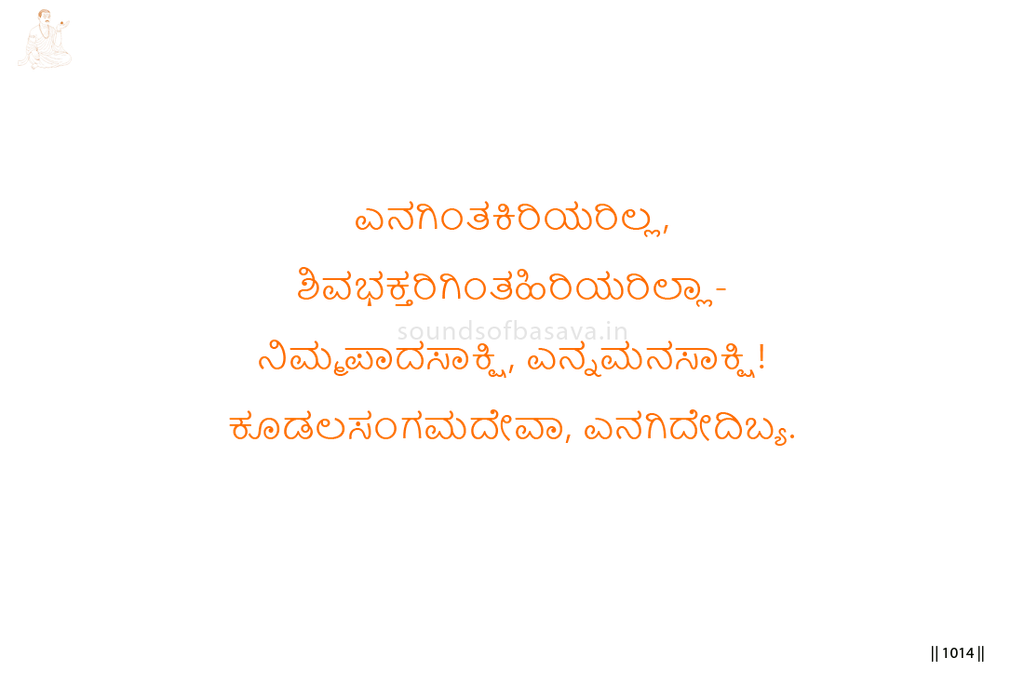
The humility of this vachana is witnessed in two ways: by Kudalasangama Deva’s feet and by Basavanna’s own mind. The outer divine witness and the inner witness of conscience agree. The Aikya source explains that this humility is not psychological self-rejection, but the dissolving of the subtle ego that survives even after practice, knowledge, and devotion arise.
The final statement, “This alone is truth,” makes humility the settled ground of realization. Before Kudalasangama Deva, the seeker does not rise by claiming greatness; the seeker becomes true by letting all self-importance fall away.
Imagery & Symbolic Relevance
The first line, “There is none smaller than I,” gives the central posture of humility. Basavanna does not measure himself upward. He deliberately refuses the ego’s need to stand above anyone.
This statement should not be read as despair or self-condemnation. The source clarifies that it is a spiritual discipline aimed at dissolving the subtle ego. The “smallness” is not weakness; it is freedom from the need to be spiritually important.
The second part of the first line, “there is none greater than the devotees of Shiva,” gives the positive side of the same humility. Basavanna does not merely lower himself; he raises the Shiva-bhaktas in reverence.
The devotees of Shiva are not honored because of caste, status, scholarship, or worldly standing. They are honored because the divine presence shines through their lives. To bow before them is to bow before the living presence of Shiva.
The line “Your feet are witness” gives the first witness. Kudalasangama Deva’s feet stand as the foundation before which the statement is made. Basavanna does not rely on public praise or personal argument; he places his humility before the Lord’s own feet.
The line “my mind is witness” gives the second witness. The statement is not outward politeness. His own mind confirms it. The inner witness agrees with the divine witness.
The joining of these two witnesses is important. Humility is not performed before others while the mind secretly claims greatness. What is spoken before Kudalasangama Deva is also affirmed inwardly by the mind.
The final line, “This alone is truth,” gives the conclusion. Basavanna does not present humility as one virtue among many. Here, humility becomes the truth by which the seeker stands rightly before Shiva-bhaktas and Kudalasangama Deva.
Together, the lines remove comparison. The self does not claim height; the Shiva-bhaktas are honored as greater; Kudalasangama Deva’s feet witness it; the mind confirms it; and this humility is declared as truth.
Lingayoga
In Lingayoga, this vachana teaches that spiritual practice must remove the ego that compares. The seeker should not ask, “Am I higher?” or “Am I worthy?” The proper movement is reverence before Shiva-bhaktas and truthfulness before Kudalasangama Deva.
The practice-point is direct: let the mind itself become witness to humility. Do not speak humility outwardly while preserving superiority inwardly. Let the feet of Kudalasangama Deva and the mind’s own witness agree.
The Aikya source states that Basavanna overturns the structure of higher and lower by placing himself beneath all devotees, thereby removing the hierarchy through which ego sustains itself.
Editorial Commentary
This vachana should be read as the continuation and completion of Vachana 334. In Vachana 334, Basavanna refuses the claim “I am a bhakta.” In Vachana 335, that refusal ripens into stable humility: none is smaller than he is, and none greater than Shiva’s devotees.
The force of the vachana lies in its simplicity. No metaphor is needed beyond the witness of the Lord’s feet and the witness of the mind. When both testify to humility, self-claim has no place.
Related Vachana
Supporting Vachana
Sharana Sthala Vachana 1257 — A Blade of Grass Among the Paddy of Sharanas
Sharana Vachana 1257 supports this Aikya vachana by placing Basavanna among the realized Sharanas as nothing more than a blade of grass in a field of nourishing grain. There, he does not seek recognition for himself; he seeks only to become worthy of serving those through whom the living presence of Kudala Sangama Deva shines.
Aikya Vachana 335 carries this humility into an even more direct declaration. In Sharana Vachana 1257, Basavanna rejects the claim “I am a bhakta” and seeks only fitness before the Sharanas. In Aikya Vachana 335, he states the principle plainly: none is smaller than he is, and none greater than the devotees of Shiva.
Advancing Vachana
Aikya Sthala Vachana 941 — See the Sahaja Sharana
Aikya Vachana 941 advances this teaching within Aikya Sthala by revealing the mature Sharana whom Basavanna honors. There, the Sharana is not bound by birth and death, doubt, form or formlessness, nor by escape from embodied life; he stands in uninterrupted Sahaja before Kudalasangama Deva.
Thus Vachana 335 establishes Basavanna’s humility before Shiva-bhaktas, while Vachana 941 shows the depth of the realized Sharana’s state. The humility of Vachana 335 is not social modesty; it is reverence before the living Sahaja presence of Kudalasangama’s Sharana.
