

Summary
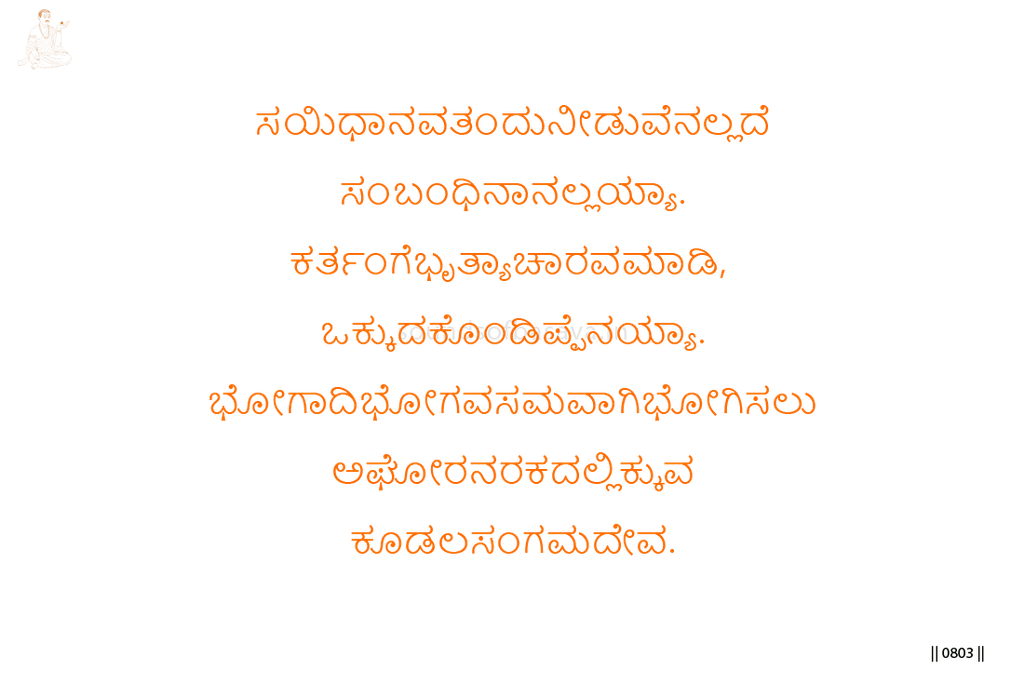
In this vachana, Basavanna removes ownership from giving, relation, and enjoyment.
He says that he is not a sambandhi — not a claimant or related possessor — in what is brought and given. The act may pass through him, but it does not become his possession. He does not stand as owner of the gift or as one who can claim the relation created by giving.
He then defines his proper position before the Karta, the Master. He must perform bhṛtyāchāra, the conduct of a servant. The servant does not become the owner of what belongs to the Master. His duty is service, not claim.
The final warning is severe. If one enjoys bhoga and adhibhoga as one’s own, treating enjoyment and possession as personal entitlement, one falls into Aghora Naraka before Kudalasangama Deva.
The teaching is direct: do not claim what is brought, given, or enjoyed. Do not turn service into ownership. Stand as servant before the Karta. What comes and goes belongs to Kudalasangama Deva, not to the ego that claims relation, action, or enjoyment.
Imagery & Symbolic Relevance
Bringing and giving are the first actions. Basavanna does not deny that something may be brought and given through him. He denies the ownership that the mind may attach to the act.
Sambandhi is the first key term. It refers to relation, connection, or claim. Basavanna says he is not the sambandhi in what is brought and given. He refuses to become the one who says, “This is mine because it passed through me.”
The Karta is the second key term. Karta means the Master, the true Lord, the one before whom the servant stands. Basavanna places himself before the Karta, not above the act.
Bhṛtyāchāra is the central discipline. It is servant-conduct. The servant does not claim authorship, ownership, or entitlement. He serves according to the Master’s relation to the act.
The contrast between Karta and bhṛtya gives the structure of the vachana. Kudalasangama Deva is the Karta; Basavanna stands as bhṛtya. The act of giving is therefore not converted into personal status.
Bhoga and adhibhoga form the danger-image. Enjoyment itself becomes binding when it is taken as one’s own. To enjoy what belongs to the Master as personal entitlement is to fall from servant-conduct.
Aghora Naraka is the final image. Basavanna does not treat this as a small lapse. Claiming enjoyment and possession against the discipline of servant-conduct becomes terrible downfall.
The movement of the vachana is therefore from bringing and giving, to refusal of sambandha-claim, to servant-conduct before the Karta, to the danger of self-owned enjoyment, and finally to Aghora Naraka before Kudalasangama Deva.
Lingayoga
In Lingayoga, this vachana teaches the purification of action from claim.
The seeker should ask: when I bring or give, do I become the claimant? Do I use giving to create relation, status, or ownership? Do I stand before Kudalasangama Deva as servant, or do I enjoy bhoga and adhibhoga as though they belonged to me?
For Sharana Sthala, the practice-point is clear: let action pass without claim. Let giving remain free from ownership. Let the Karta remain Karta, and let the seeker remain in bhṛtyāchāra. Do not convert what belongs to Kudalasangama Deva into personal enjoyment.
Editorial Commentary
The word sambandhi should remain central. The vachana is not only about inner psychology; it is about refusing the claim that arises through relation, exchange, giving, and enjoyment.
The Karta-bhṛtya relation should also remain central. Basavanna does not present himself as independent giver or owner. He places himself as servant before the Master.
The final warning about bhoga, adhibhoga, and Aghora Naraka should not be softened. The danger is not action itself, nor even giving itself. The danger is self-appropriation — turning what belongs to the Karta into one’s own enjoyment and claim.
Related Vachana
Supporting Vachana
Pranalingi Sthala Vachana 788 — The Tremor and the Steadying
Pranalingi Vachana 788 supports this teaching by showing Basavanna holding a substance in the hand and facing the act of giving it to Kudalasangama Deva. The act of giving becomes a test, because fear and unsteadiness arise when the held object must be offered to the Lord. This supports Vachana 783 directly. Vachana 783 says that what is brought and given must not become personal claim, and that one must stand in servant-conduct before the Karta; Vachana 788 gives the supporting inner condition, where the act of giving itself requires Kudalasangama Deva’s protection and steadying.
Advancing Vachana
Aikya Sthala Vachana 1162 — The Giver and the Receiver Are Kudalasanga
Aikya Vachana 1162 advances this teaching by declaring that Kudalasangayya alone gives to the three worlds, and by dissolving the separate claim of giver and receiver. This is the natural advancement from Vachana 783. Vachana 783 refuses personal claim in bringing, giving, relation, and enjoyment, and places the seeker in bhṛtyāchāra before the Karta; Aikya Vachana 1162 carries that refusal into completion, where giving itself is known as Kudalasangama Deva’s act, and no separate giver remains to claim merit, relation, or enjoyment.
