

Summary
In this vachana, Basavanna exposes the incompleteness of divided offering.
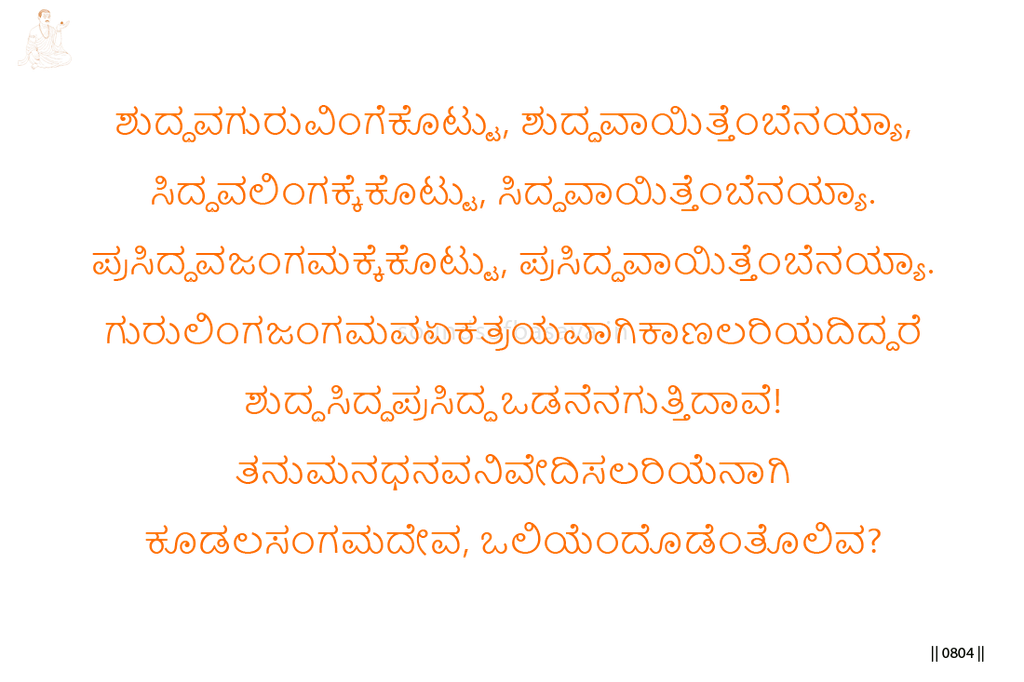
He says: I gave to the pure Guru and said, “I have become pure.” I gave to the accomplished Linga and said, “I have become accomplished.” I gave to the renowned Jangama and said, “I have become renowned.”
Each act appears devotional. Guru, Linga, and Jangama are all honored. Yet Basavanna shows the fault: they are still being approached separately, and each separate act produces a separate claim.
He then gives the correction. If Guru, Linga, and Jangama are not seen as one, then the claims of “pure,” “accomplished,” and “renowned” become laughable. The laughter is not casual mockery; it exposes the contradiction between sacred offering and divided seeing.
The final question gives the real measure. If body, mind, and wealth cannot be offered, then how can Kudalasangama Deva be pleased? Partial offerings do not complete the path. True offering must gather Guru, Linga, and Jangama as one, and must offer body, mind, and wealth without division.
The teaching is direct: do not divide Guru, Linga, and Jangama and then claim spiritual completion. Do not turn offering into separate spiritual identities. Offer body, mind, and wealth into the one field of Guru-Linga-Jangama before Kudalasangama Deva.
Imagery & Symbolic Relevance
The pure Guru is the first image. Basavanna does not deny the Guru’s purity. He questions the devotee’s claim that giving to the Guru alone has made him pure.
The accomplished Linga is the second image. The Linga is complete and established, but the devotee’s claim of becoming accomplished through a separate act remains under examination.
The renowned Jangama is the third image. Jangama carries living sacred presence, but giving to Jangama separately and then claiming personal renown still leaves division intact.
The repeated statement “I gave” is important. Basavanna shows how the ego can enter even sacred giving. The act of offering becomes a ground for self-description: “I am pure,” “I am accomplished,” “I am renowned.”
The triad of shuddha, siddha, and prasiddha forms the false completion. Each word sounds spiritually weighty, but when Guru, Linga, and Jangama are divided, the words become hollow.
The laughter is the central exposure. Basavanna says that shuddha, siddha, and prasiddha laugh when Guru-Linga-Jangama are not seen as one. The laughter reveals the absurdity of divided spiritual claims.
The unity of Guru-Linga-Jangama is the corrective image. These are not to be handled as disconnected recipients of separate offerings. They must be seen as one sacred reality in the path.
Body, mind, and wealth form the final offering-field. The body is the field of action. The mind is the field of intention and awareness. Wealth is the field of possession and practical extension. Unless all three are offered, the offering remains incomplete.
The final question to Kudalasangama Deva completes the movement. Basavanna does not ask how one may claim attainment; he asks how the Lord can be pleased when body, mind, and wealth are not truly offered.
The movement of the vachana is therefore from separate offering, to separate claims, to the laughter of contradiction, to the unity of Guru-Linga-Jangama, and finally to the total offering of body, mind, and wealth before Kudalasangama Deva.
Lingayoga
In Lingayoga, this vachana teaches integration of offering.
The seeker should ask: do I treat Guru, Linga, and Jangama as separate religious compartments? Do I give to each and then claim purity, accomplishment, or renown? Have I offered body, mind, and wealth together, or do I keep some part of life outside the offering?
For Sharana Sthala, the practice-point is clear: see Guru, Linga, and Jangama as one. Do not claim completion from divided acts. Offer body, mind, and wealth wholly, and let the offering be tested before Kudalasangama Deva.
Editorial Commentary
The repetition should remain central. Basavanna deliberately repeats the pattern: giving to Guru, giving to Linga, giving to Jangama, and then claiming a spiritual result. The repetition exposes how divided devotion can produce self-claim rather than surrender.
The laughter should not be softened. It is the laughter of exposed contradiction. To speak of shuddha, siddha, and prasiddha while failing to see Guru-Linga-Jangama as one is spiritually incoherent.
The final question is the governing line. The issue is not offering an item to each sacred form. The issue is whether body, mind, and wealth have been offered into the undivided reality of Guru-Linga-Jangama. Without that, how can Kudalasangama Deva be pleased?
Related Vachana
Supporting Vachana
Pranalingi Sthala Vachana 820 — Time Arises in the Linga
Pranalingi Vachana 820 supports this teaching by bringing Guru, Jangama, conduct, experience, Samayachara, and Linga into one integrated field. Guru is joined with Sadachara; Jangama is joined with Anubhava and Samayachara; and both become clear in the Linga. This supports Vachana 784 directly. Vachana 784 says that Guru, Linga, and Jangama must be seen as one, otherwise claims of purity, accomplishment, and renown become laughable; Vachana 820 gives the supporting structure, where Guru-guided conduct and Jangama-experience must be gathered and clarified in Linga before Kudalasangama Deva.
Advancing Vachana
Aikya Sthala Vachana 1183 — Behold the One Ripened in the Dense Reality
Aikya Vachana 1183 advances this teaching by showing the ripened one who has known the Dense Reality, installed the Great Guru within, offered body, mind, and wealth into Guru, Linga, and Jangama, and become established in Kaya-Prasada. This is the natural advancement from Vachana 784. Vachana 784 asks how Kudalasangama Deva can be pleased if body, mind, and wealth are not offered and if Guru-Linga-Jangama are not seen as one; Aikya Vachana 1183 shows that question fulfilled, where body, mind, and wealth have been offered into Guru, Linga, and Jangama, and the devotee stands ripened in Kaya-Prasada before Kudalasangama Deva.
