

Summary
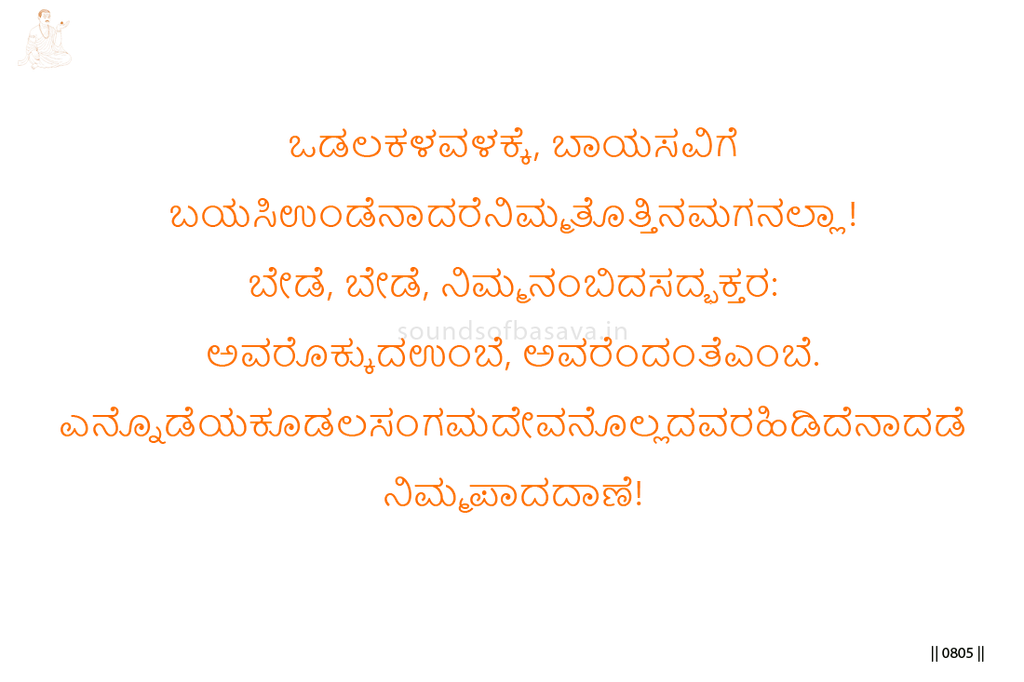
In this vachana, Basavanna makes a strict vow against desire-led receiving and wrong attachment.
He says that if, for the body’s agitation or for the mouth’s taste, he desires and eats, then he is not the son of the Lord’s servant. The issue is not food alone. It is eating governed by bodily disturbance, tongue-craving, and personal desire.
He then refuses that path: “No, no.” Instead, he turns toward Kudalasangama Deva’s trusted Sadbhaktas. Their way becomes the measure of how he should move.
The next line gives the discipline of association and receiving. Basavanna says he will conduct himself according to those Sadbhaktas, as one who receives in their way and does not follow private appetite.
The final oath is severe. If he holds to those whom his Lord Kudalasangama Deva does not love, he stands under the oath of the Lord’s feet. This makes the vow complete: appetite must not govern him, and wrong company must not hold him.
The teaching is direct: do not live for the body’s agitation or the mouth’s taste. Do not eat through desire. Follow the trusted Sadbhaktas. Do not hold to those who are not pleasing to Kudalasangama Deva.
Imagery & Symbolic Relevance
The body’s agitation is the first image. The body can press, disturb, demand, and pull the seeker toward immediate satisfaction. Basavanna does not let that agitation become the measure of conduct.
The mouth’s taste is the second image. Taste is small, but powerful. It can turn receiving into self-indulgence. The tongue becomes a test of whether the seeker lives by Prasada or by craving.
Desiring and eating form the central danger. Basavanna does not condemn eating as such. He condemns eating that arises from desire, bodily unease, and taste-seeking.
The phrase “not Your servant’s son” is severe. Basavanna measures belonging by conduct. If he lives by bodily agitation and tongue-craving, he refuses to call himself truly born in the servant-line of Kudalasangama Deva.
The repeated “No, no” gives the vow its force. This is not hesitation or mild preference. It is a decisive refusal.
The trusted Sadbhaktas are the positive counter-image. Basavanna does not merely reject appetite. He turns toward those who are trusted by Kudalasangama Deva. Their way becomes the corrective field.
Walking according to them means conduct shaped by the Sadbhaktas, not by private desire. The Sharana does not invent a separate measure for himself when the Lord’s true devotees stand as living measure.
The final oath at the Lord’s feet gives the vachana its boundary. To hold to those whom Kudalasangama Deva does not love would be betrayal. Basavanna places that possibility under the Lord’s own feet.
The movement of the vachana is therefore from bodily agitation, to mouth-taste, to desire-led eating, to refusal, to the trusted Sadbhaktas, to conduct according to them, and finally to an oath of non-attachment to those outside Kudalasangama Deva’s pleasure.
Lingayoga
In Lingayoga, this vachana teaches disciplined receiving and disciplined association.
The seeker should ask: do I receive through Prasada, or through the body’s agitation and the tongue’s taste? Do I call myself the Lord’s servant while still allowing appetite to govern conduct? Do I walk according to the trusted Sadbhaktas, or according to private craving? Do I hold to those whom Kudalasangama Deva does not love?
For Sharana Sthala, the practice-point is clear: refuse desire-led eating. Do not let the mouth’s taste become the measure. Follow the trusted Sadbhaktas. Let association be governed by Kudalasangama Deva’s pleasure, and remain under the vow of His feet.
Editorial Commentary
The words concerning the body and mouth should remain concrete. This vachana is not primarily about pleasing speech or social diplomacy. It speaks of bodily agitation, the taste of the mouth, desiring, eating, and the discipline of following the Lord’s trusted Sadbhaktas.
The phrase “not Your servant’s son” should not be softened. Basavanna makes spiritual belonging conditional upon conduct. One who lives for bodily agitation and taste-craving cannot claim the servant’s lineage before Kudalasangama Deva.
The final oath must remain central. The vow is not only about food. It is also about association. Basavanna swears by the Lord’s feet that he must not hold to those whom Kudalasangama Deva does not love.
Related Vachana
Supporting Vachana
Pranalingi Sthala Vachana 797 — The Inseparable Abidance in the Linga
Pranalingi Vachana 797 supports this teaching by saying that after receiving Prana-Linga, one cannot walk, speak, enjoy the five senses, or perform even a small bodily act apart from Linga. It directly includes sense-enjoyment under the discipline of Linga-awareness. This supports Vachana 785 closely. Vachana 785 refuses eating for the body’s agitation and the mouth’s taste; Vachana 797 gives the supporting Pranalingi ground, where even the five senses cannot be enjoyed in separation from Kudalasangama Deva.
Advancing Vachana
Aikya Sthala Vachana 488 — The Dissolution of the Witness
Aikya Vachana 488 directly advances this teaching by carrying disciplined fidelity into complete freedom from every competing attachment. In Sharana Vachana 785, Basavanna refuses food governed by bodily agitation and the tongue’s taste, follows the trusted Sadbhaktas, and vows not to associate with those whom Kudalasangama Deva does not love. In Aikya Vachana 488, bodily association itself has become Nissaṅga; Basavanna knows no other association, is wholly inclined toward Kudalasangama Deva, and can no longer separate from Him. Thus the Sharana-stage vow of uncompromising fidelity advances into Aikya as settled non-attachment, where no bodily craving, alternative refuge, or independent direction remains apart from Kudalasangama Deva’s intention.
