

Summary
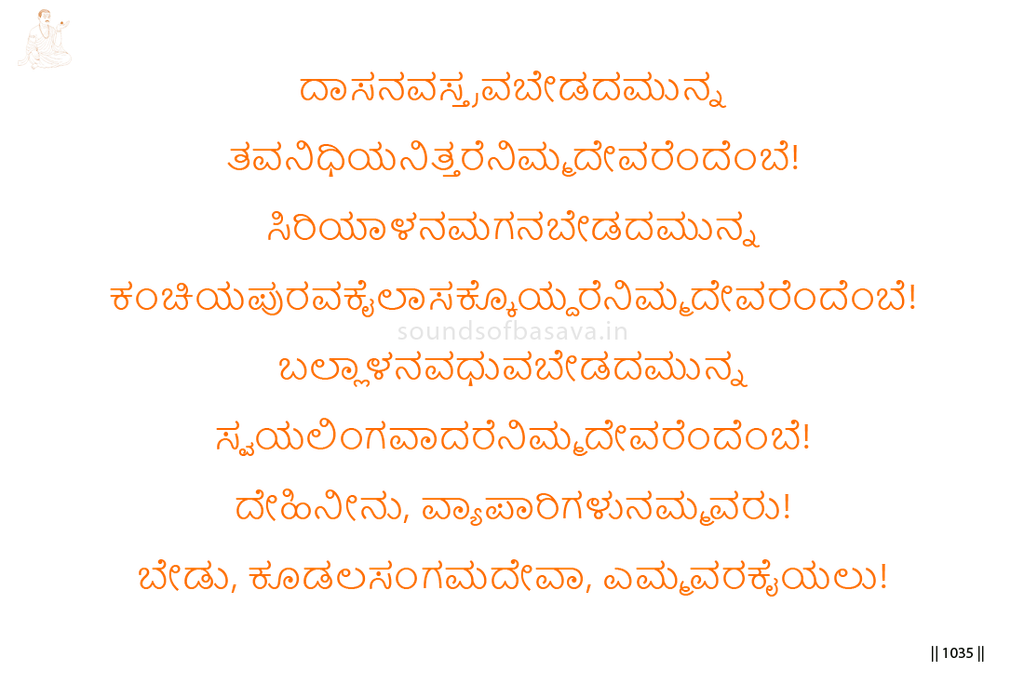
Basavanna remembers three acts of offering associated with Dasayya, Siriyala, and Ballala. Yet he turns the attention away from the visible offering and toward Kudalasangama Deva’s prior giving.
Before Dasayya’s garment is asked, the treasure is already given. Before Siriyala’s son is asked, Kanchipura is already lifted toward Kailasa. Before Ballala’s bride is asked, the self-Linga is already made. The movement of the vachana is therefore not from human gift to divine reward, but from Divine giving before the human act.
The final correction is severe. Kudalasangama Deva is the giver, while those who turn sacred relation into exchange become traders. Basavanna asks not to be left in the hands of such bargaining, but to remain in Kudalasangama Deva’s own hands.
Imagery & Symbolic Relevance
Dasayya’s garment is the first image. A garment belongs close to the body, yet it is still an object that may be given. Basavanna does not dwell on the garment as achievement; he asks us to see what was already given before it was asked.
The treasure given before the garment is the first reversal. The usual thought is that the devotee gives first and receives later. Basavanna reverses this: Kudalasangama Deva’s giving precedes the offering.
Siriyala’s son is the second image. The son represents what is deeply one’s own and most difficult to release. The image intensifies the field of offering beyond ordinary possession.
Kanchipura being taken to Kailasa gives the answering image. Before the son is asked, the sacred elevation has already occurred. Basavanna again places Divine action before human sacrifice.
Ballala’s bride is the third image. The bride brings the offering into the field of intimate human relation. The example is not used to glorify pain, but to test whether even the dearest relation becomes a field of sacred surrender.
The making of the self-Linga before Ballala’s offering gives the third reversal. What matters is not merely the outer act of giving, but the prior sacred formation already worked by Kudalasangama Deva.
The line “You are the giver” gathers the three examples. Basavanna names Kudalasangama Deva as the one from whom giving truly begins. The devotee’s act is not the origin of grace.
The image of traders gives the warning. A trader measures, bargains, and expects return. Basavanna uses this image to expose the corruption of devotion when offering is turned into calculation.
The final appeal to remain in Kudalasangama Deva’s hands completes the vachana. The hands are the place of holding, protection, and belonging. Basavanna does not want devotion to fall into the hands of bargaining minds; he asks to be held by the giver whose grace comes first.
Lingayoga
In Lingayoga, this vachana teaches that offering must not become transaction. The seeker must not think, “I gave, therefore I must receive.”
The practice-point is direct: see the prior grace before the act of surrender. The garment, son, and bride are not the final measure. The deeper measure is whether the seeker recognizes Kudalasangama Deva as the giver before all giving.
This also protects the practitioner from spiritual bargaining. If devotion becomes trade, the sacred relation is distorted. Practice matures when the seeker allows offering to arise from being already held in Kudalasangama Deva’s hands.
Editorial Commentary
This vachana should be read as a correction of transactional devotion. Basavanna does not belittle the offerings of Dasayya, Siriyala, or Ballala. He shifts the center from the human act to the Divine giving that precedes it. The decisive contrast is between the giver and the trader: Kudalasangama Deva gives before asking, while the trader calculates after giving.
Related Vachana
Supporting Vachana
Sharana Sthala Vachana 321 — The Poverty of Devotion Before Grace
Sharana Vachana 321 supports this Aikya vachana by remembering the same three fields of offering. Dasideva gives his garment and receives treasure-prasada; Siriyala gives his son and receives prana-prasada; Ballaladeva gives his bride and receives samate-prasada. Aikya Vachana 444 carries this further by placing Kudalasangama Deva before the act of offering itself. What Sharana Vachana 321 remembers as offering and sacred receiving becomes, in Aikya Vachana 444, the recognition that the Lord is already the giver before the giving.
Advancing Vachana
Aikya Sthala Vachana 1380 — One Vessel, One Offering
Aikya Vachana 1380 advances this teaching by showing fulfilled offering as undivided life before Guru, Linga, and Jangama. In Vachana 444, Basavanna rejects the trader’s mind and asks to remain in Kudalasangama Deva’s hands. In Vachana 1380, offering deepens until artha, prana, and self-regard are no longer held separately, and the devotee, Guru, Linga, and Jangama are no longer divided. Thus the refusal of sacred bargaining in Vachana 444 advances into the state where offering itself has become one shared vessel before Kudalasangama Deva.
