

Summary
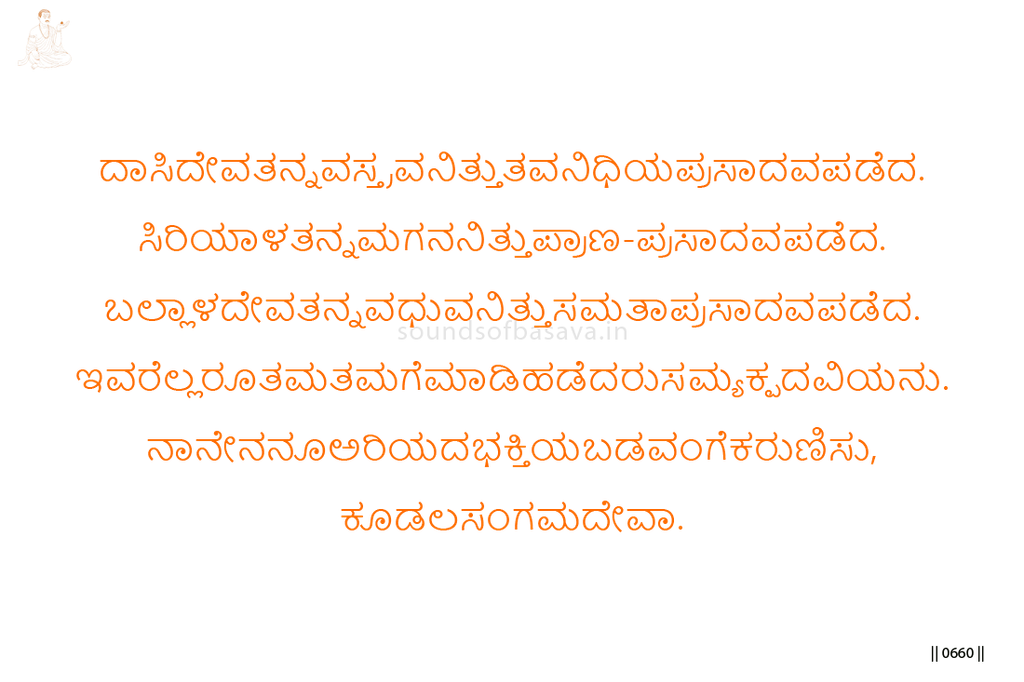
In this vachana, Basavanna remembers three earlier Sharanas and their offerings.
Dasideva gave his garment and received treasure-prasada. Siriyala gave his son and received prana-prasada. Ballaladeva gave his bride and received samate-prasada.
Each did what belonged to his own path and attained samyak-padavī. Basavanna then turns to himself: knowing nothing, poor in Bhakti, he asks Kudalasangama Deva for compassion.
Imagery & Symbolic Relevance
Dasideva’s garment is the first offering. The image is simple and concrete: what covered him was given.
Siriyala’s son is the second offering. This is a more severe surrender, involving what is deeply one’s own.
Ballaladeva’s bride is the third offering. The image brings surrender into the field of intimate relationship.
The three forms of Prasada correspond to the three offerings: treasure-prasada, prana-prasada, and samate-prasada. What is received is not ordinary reward, but sacred receiving.
Samyak-padavī gives the result. Their offerings reached the right state because they were not held back.
Basavanna’s poverty in Bhakti gives the final turn. He does not place himself among them by claim. He stands before Kudalasangama Deva asking for compassion.
Lingayoga
In Lingayoga, this vachana tests the depth of offering.
The practice-point is direct: do not imitate the outer act and miss the inner surrender. See what is still held as one’s own, and place that poverty before Kudalasangama Deva.
For Sharana Sthala, this is humility before the measure of those who offered fully.
Editorial Commentary
The named Sharanas should not be treated as decorative examples. Each name carries a specific offering and a specific Prasada. The closing line is essential: Basavanna does not claim their measure, but confesses poverty in Bhakti and asks for compassion.
Related Vachana
Supporting Vachana
Pranalingi Sthala Vachana 320 — The Measure of True Offering
Pranalingi Vachana 320 supports this teaching by testing whether speech, feeding, clothing, and giving become dharma or remain exchange. Vachana 321 carries that same measure into Sharana Sthala through Dasideva, Siriyala, and Ballaladeva: offering is not counted by outer size, but by whether it releases what is truly held as one’s own before Kudalasangama Deva.
Advancing Vachana
Aikya Sthala Vachana 444 — The Giver Before the Giving
Aikya Vachana 444 advances this teaching by returning to the same field of Dasayya, Siriyala, and Ballala, but placing Kudalasangama Deva before the offering itself. Vachana 321 honors the Sharanas who gave and received Prasada; Aikya Vachana 444 shows that the Lord is already the Giver before any act of giving, so surrender matures beyond exchange into prior grace.
