

Summary
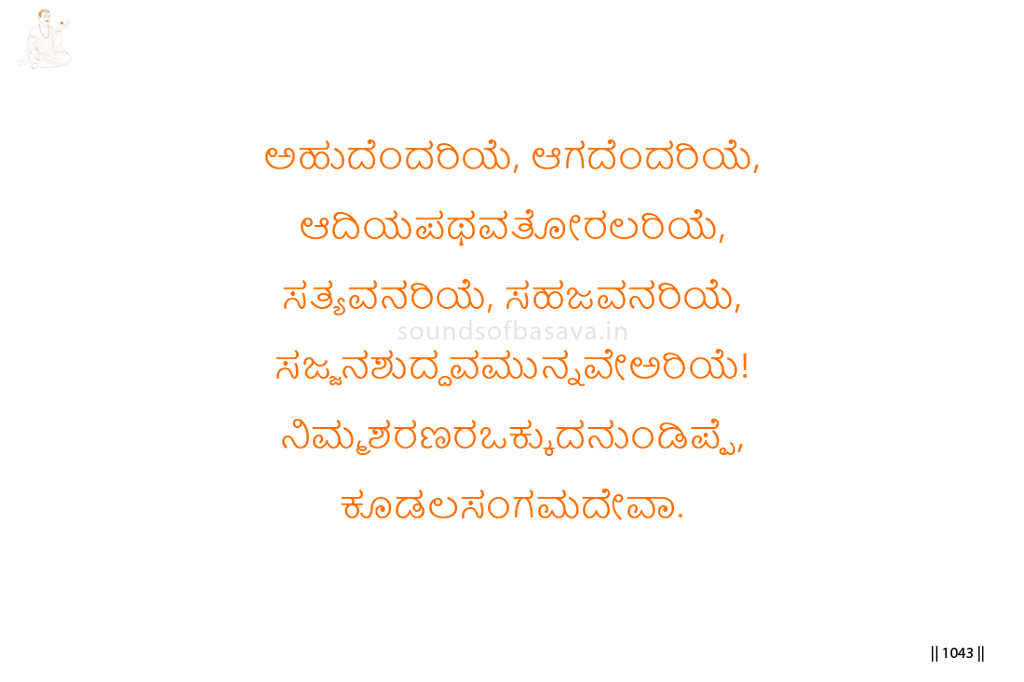
Basavanna refuses both assertion and denial. He does not say, “It is,” and he does not say, “It is not.” The truth before him cannot be held by either affirmation or negation.
He then says that he cannot show the primal path, cannot speak of truth, cannot explain the natural state, and cannot declare purity before the noble ones. The movement of the vachana is therefore a steady withdrawal from self-certifying speech.
The final line gives the only ground that remains. Basavanna abides by partaking in the gathered grace of Kudalasangama Deva’s Sharanas. Where claim, explanation, and declaration fall away, living participation in Sharana-sanga remains.
Imagery & Symbolic Relevance
The first image is “I cannot say it is.” This refuses the mind’s desire to possess truth through affirmation. Basavanna does not turn realization into a statement to be held.
The second image is “I cannot say it is not.” This refuses negation as well. Truth is not secured by denial any more than by assertion.
Together, “it is” and “it is not” form the first pair of limits. Basavanna places truth beyond the grasp of these two verbal positions.
The primal path is the next image. Basavanna says he cannot show it. A path that can be displayed outwardly becomes an object before others, but the source teaches that this path is not something to be demonstrated in that way.
Truth is then named. Basavanna says he cannot speak it. The point is not ignorance, but restraint before what cannot be reduced to speech.
Sahaja, the natural state, is then named. Basavanna says he cannot explain it. The natural state is not produced by explanation or possessed through description.
The purity of the noble ones is the next image. Basavanna says he cannot declare it. Purity is not made true by proclamation.
The final image is partaking in the gathered grace of the Sharanas. This is the turning point of the vachana. After refusing assertion, denial, display, speech, explanation, and declaration, Basavanna rests in the living field of Kudalasangama Deva’s Sharanas.
The closing address to Kudalasangama Deva gathers the whole movement. The seeker does not stand as one who claims, proves, defines, or declares. He abides through Sharana-sanga before the Lord.
Lingayoga
In Lingayoga, this vachana teaches restraint before the limits of speech and self-assertion. The practitioner must not hurry to say what truth is, what it is not, or how the primal path can be displayed.
The practice-point is direct: let realization become abidance rather than declaration. Do not claim the natural state. Do not proclaim purity. Do not turn truth into a possession of speech.
The final discipline is Sharana-sanga. When assertion falls away, the seeker remains sustained by the gathered grace of Kudalasangama Deva’s Sharanas. Practice matures as participation in lived truth, not as self-certification.
Editorial Commentary
This vachana should be read as a correction of spiritual assertion. Basavanna does not speak from confusion, but from humility before what cannot be held by statement, denial, display, or explanation. The final line is essential: silence here is not emptiness or withdrawal. It is abiding in the gathered grace of the Sharanas before Kudalasangama Deva.
Related Vachana
Supporting Vachana
Sharana Sthala Vachana 965 — Union of Body and Linga—Can It Be So Declared?
Sharana Vachana 965 supports this Aikya vachana by warning against declaring union before difference has actually fallen away. There, Basavanna teaches that true union is not achieved by speech, imagination, or bodily self-elevation, and that the seeker should remain silently like an unopened bud in Kudalasangama Deva. Aikya Vachana 463 carries the same restraint further: even truth, the primal path, sahaja, and purity are not to be claimed through assertion. The Sharana warning against premature declaration prepares the Aikya silence of assertion.
Advancing Vachana
Aikya Sthala Vachana 1415 — One Moment of Living Experience
Vachana 463 ends assertion, explanation, and self-certification, and rests instead in the gathered grace of Kudalasangama Deva’s Sharanas.
Vachana 1415 advances this into direct Sharana-Anubhava, declaring that one moment of living experience with the Sharanas surpasses prolonged austerity, worship, Guru-service, and Jangama-service.
Thus silence before truth matures into direct participation in the realised experience of the Sharanas.
