

Summary
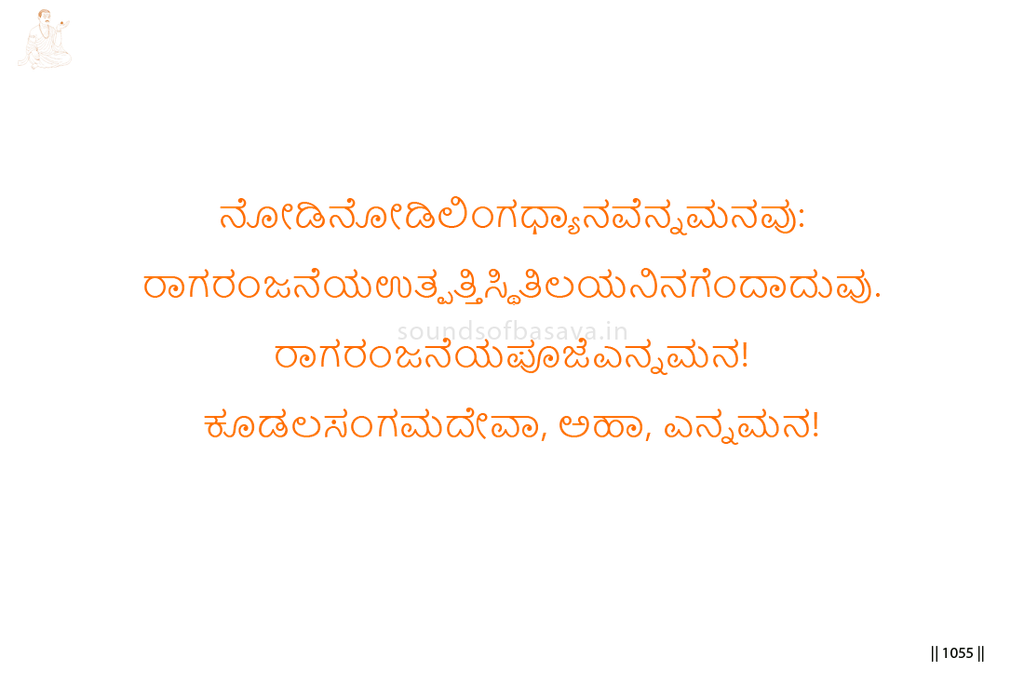
Through continued seeing, Basavanna’s mind becomes Linga-dhyāna itself. Meditation is no longer merely an act performed by the mind.
An inward harmony arises, abides, and dissolves in Kudalasangama Deva. That harmony itself becomes worship.
The vachana closes in wonder before a mind in which meditation and pūjā arise naturally.
Imagery & Symbolic Relevance
The repetition “seeing, seeing” indicates sustained beholding. Attention does not break into scattered movement.
The mind becoming Linga-dhyāna is the central transformation. The mind does not merely hold meditation temporarily; its condition becomes meditative.
Rāga-rañjane expresses the inward melody or harmony arising within this state.
Its arising, abiding, and dissolving are placed in Kudalasangama Deva. Basavanna does not claim authorship over any phase of the movement.
The harmony becoming pūjā removes separation between inward resonance and worship.
The final exclamation, “Ah, my mind!”, expresses wonder at the transformed condition.
Lingayoga
In Lingayoga, meditation ripens from deliberate practice into a settled condition of the mind.
The mind no longer remains divided between the one who meditates and the Linga upon which it meditates. It becomes the field of Linga-dhyāna.
The practice-point is to remain in steady beholding until meditation is no longer merely performed and the mind itself becomes worship.
Editorial Commentary
Rāga-rañjane should not be reduced to ordinary musical enjoyment or an external performance. In this vachana it belongs to the transformed mind and becomes pūjā. The imagery concerns inward harmony arising, abiding, and dissolving in Kudalasangama Deva.
Related Vachana
Supporting Vachana
Sharana Sthala Vachana 1231 — The Sword of Silence and the Discipline of Jangama
Sharana Vachana 1231 prepares this teaching by exposing ego within meditation. Basavanna says that silence is the proper instrument of dhyāna, but he grasped the sword of ego and asks the Jangama to remove that error.
Aikya Vachana 489 shows the ripened condition after self-assertion has lost its hold. Meditation is no longer wielded by ego; the mind itself becomes Linga-dhyāna.
Advancing Vachana
Aikya Sthala Vachana 490 — When Time Dissolves
Vachana 489 shows the mind itself becoming Linga-dhyana, with inward harmony becoming worship.
Vachana 490 advances this into uninterrupted worship, where week, day, night, and daylight no longer create divisions in remembrance.
Thus the mind that has become meditation matures into continuous worship beyond temporal interruption.
