

Summary
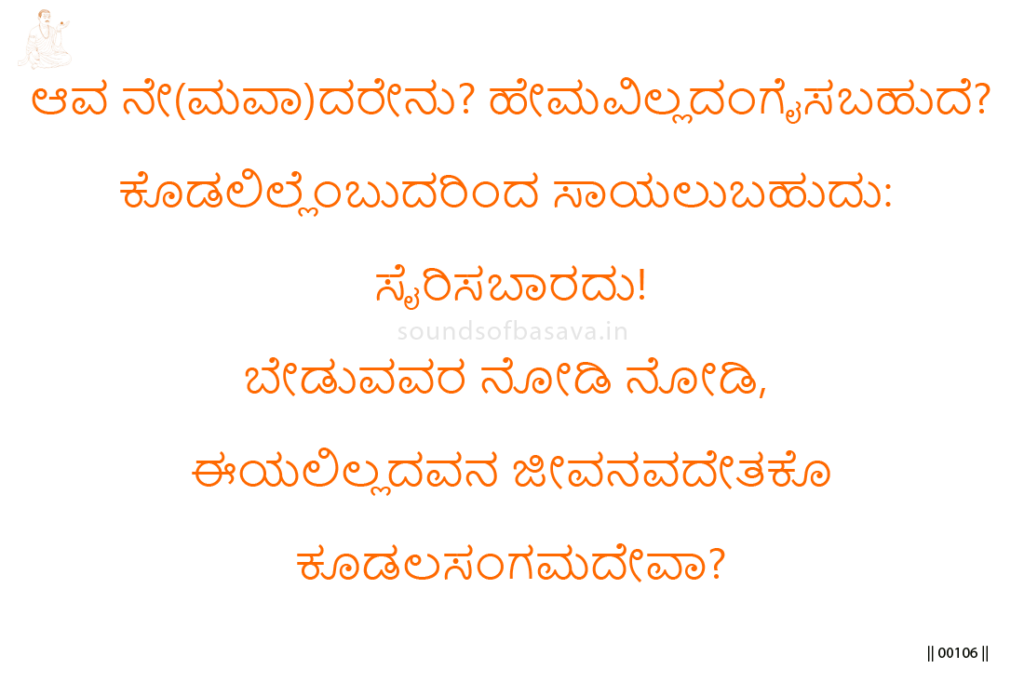
In this vachana, Basavanna asks what worth life has if it cannot respond to those who ask.
If one truly has nothing to give, that condition may be borne. But to have the capacity to give and still refuse cannot be endured.
He looks again and again at those who come in need. If life remains closed before them, what is the meaning of such life before Kudalasangama Deva? The vachana teaches that devotion must become compassion in action.
Imagery & Symbolic Relevance
The hand that can give is the central image. It represents capacity, responsibility, and moral readiness.
Basavanna distinguishes poverty from withholding. To lack the means to give is one condition; to possess the means and still refuse is another.
The one who asks stands as the visible test. Need is not hidden or distant. It appears directly before the seeker.
The repeated act of seeing intensifies the teaching. Basavanna does not speak of accidental ignorance. He speaks of seeing need again and again, and still failing to respond.
Life itself becomes the final question. A life that cannot give when giving is possible has lost its spiritual meaning.
Before Kudalasangama Deva, possession becomes worthy only when it turns into help.
Lingayoga
In Lingayoga, the Anga must not close around its own preservation.
The body lives, works, earns, and receives. But what is received must not remain locked in self-protection.
Kayaka finds its fulfillment in Dasoha. The hand that labors must also become the hand that gives.
Seeing need is itself a spiritual summons. If awareness is awake, compassion cannot remain only inward feeling.
Practice matures when the seeker’s life becomes responsive before Kudalasangama Deva.
Editorial Commentary
This vachana makes compassion practical.
Basavanna does not measure devotion by feeling alone, but by whether the hand opens when another stands in need.
Related Vachana
Supporting Vachana
Vachana 426 — The Fidelity of the Heart
Vachana 426 teaches that the devotee must not abandon the true bond after entering the path. Vachana 439 continues this fidelity by showing that devotion must remain faithful in action when need appears before the seeker.
Advancing Vachana
Maheshwara Vachana 544 — Without Touching the Essence
Vachana 439 shows compassion as the test of life. Maheshwara Vachana 544 advances this into steadiness, where the flame of response must not flicker before Kudalasangama Deva.
