

Summary
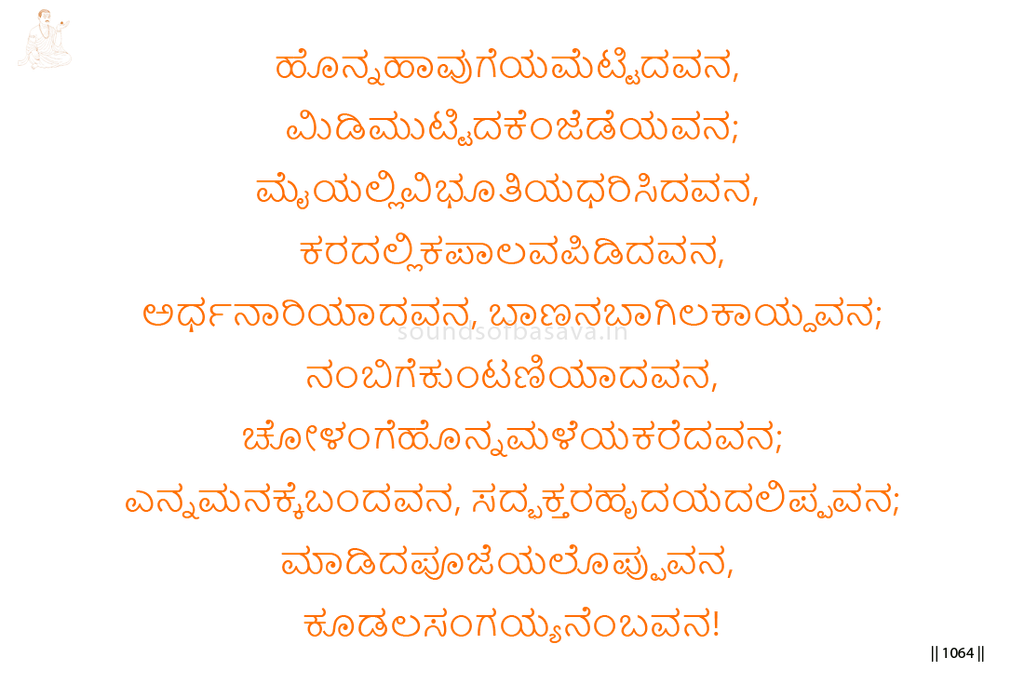
Basavanna praises Kudalasangama Deva through a succession of forms, marks, and remembered acts: the golden serpent, matted locks, sacred ash, skull, Ardhanari form, and deeds associated with Bāṇa, Nambi, and the Chola.
The movement then turns inward. The Lord described through these many expressions is the One who has entered Basavanna’s mind, dwells in the hearts of true devotees, and accepts the worship offered to Him.
The Aikya concern is the gathering of outer recognition into inward presence. The Lord known through sacred form and action is now known within the devotee.
Imagery & Symbolic Relevance
The golden serpent is the opening image. It presents the Lord through a powerful and luminous sacred mark.
The matted locks continue this visible description. They identify the ascetic form through which the Lord is recognized.
The sacred ash covering the body indicates purification and the passing nature of bodily form.
The skull held in the hand brings mortality directly into the Lord’s appearance. Death is not hidden or avoided; it is carried openly.
The Ardhanari form joins male and female within one form. It presents wholeness without dividing the Divine into separate principles.
The references to guarding Bāṇa’s gate, the act connected with Nambi, and the rain of gold for the Chola move the vachana from sacred appearance to remembered action. The Lord is praised not only through form, but through deeds known in devotional memory.
The declaration that He entered Basavanna’s mind is the decisive inward turn. What had been described through marks and deeds becomes immediate presence within.
The Lord’s dwelling in the hearts of true devotees widens that inward recognition. His presence is not confined to one individual but is known in the devotional heart.
The final statement that He accepts the worship performed completes the movement. Form, action, inward presence, the devotee’s heart, and worship all gather in Kudalasangayya.
Lingayoga
In Lingayoga, sacred symbols and remembered deeds must lead toward inward recognition of Linga.
The Anga does not remain at the level of describing the Lord’s appearance or recalling His acts. Kudalasangama Deva enters the mind and becomes living presence within the heart.
The statement that He dwells in true devotees also prevents inward realization from becoming private possession. The same Linga-presence is recognized in the hearts of the devotees.
Worship is therefore no longer directed only toward a Lord imagined at a distance. It is offered to the One who has entered, abides within, and receives it.
The practice-point is direct: let sacred recognition move from description into inward presence, and let worship arise from that established relation.
Editorial Commentary
The many opening descriptions should not be separated into unrelated portrayals of the Lord. They form one continuous praise that moves from sacred appearance and remembered action toward inward presence. The decisive line is that Kudalasangayya has entered the mind; the earlier images are gathered into that recognition rather than left as external description.
Related Vachana
Supporting Vachana
Sharana Sthala Vachana 138 — The Mark Beyond All Marks
Sharana Vachana 138 prepares this teaching by declaring that, after Linga-deva has been worshipped, clan and outer marks no longer govern recognition. Its decisive statement is that the devotee’s body is Kudalasangama Deva’s own body.
Aikya Vachana 502 carries this teaching inward. The Lord is no longer related to the devotee only through an outer mark or act of worship; He has entered the mind and abides in the hearts of true devotees.
The Sharana-stage recognition of the devotee’s body as belonging to the Lord thus ripens into Aikya as indwelling Divine presence.
Advancing Vachana
Aikya Sthala Vachana 503 — You Alone Are Mine
Vachana 502 reveals Kudalasangama Deva entering the mind, dwelling in the hearts of true devotees, and receiving their worship.
Vachana 503 advances this indwelling presence into undivided belonging. No other Lord can enter the mind, for Kudalasangama Deva alone has remained the heart’s companion from childhood through maturity.
Thus Divine presence within the heart deepens into continuous and exclusive union with Kudalasangama Deva.
