

Summary
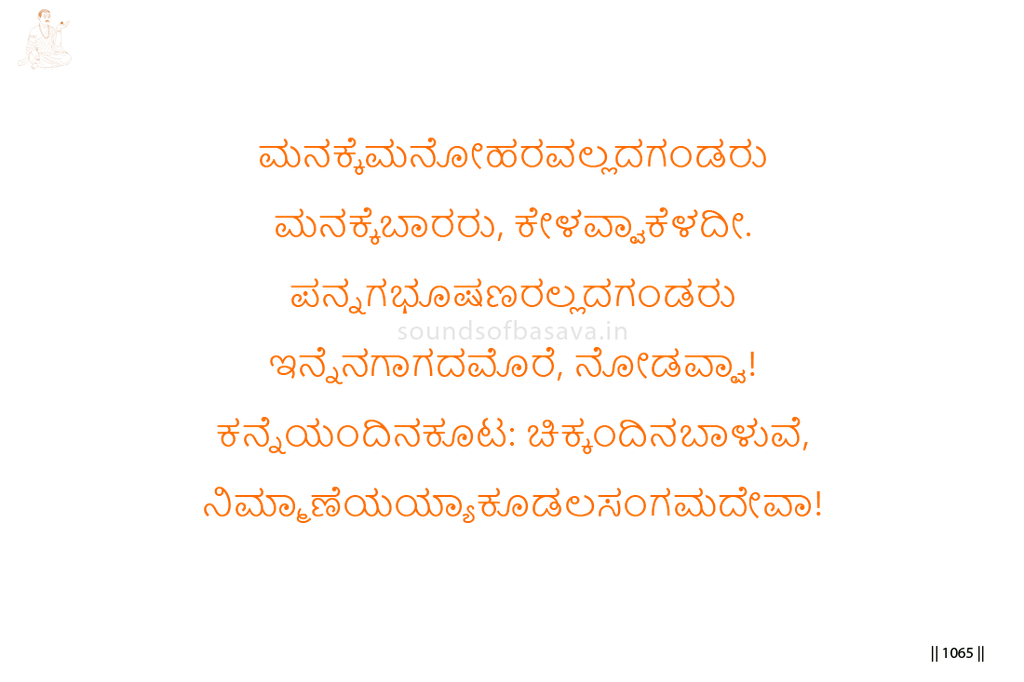
Basavanna declares that no lord other than the heart-captivating Kudalasangama Deva can enter his mind. The One adorned with the serpent alone answers his inward longing; no other relation is possible for him.
He then traces this belonging through the continuity of life—from childhood into maidenhood and mature companionship. Kudalasangama Deva has not become his Lord only at the present moment; the relation has remained through every period remembered in the vachana.
The Aikya concern is undivided and continuous belonging. The heart no longer searches among alternatives, because Kudalasangama Deva alone has always been its inward companion.
Imagery & Symbolic Relevance
The statement that no other lord enters the mind gives the first movement. Basavanna does not describe a struggle between several attractions. The mind has already become exclusive in its orientation.
The word Manohara, the One who captivates or delights the mind, identifies the Lord through inward attraction. Kudalasangama Deva is not accepted merely through duty; He alone draws and holds the heart.
The appeal “Listen” gives the vachana an intimate, confiding tone. Basavanna speaks as one declaring a settled relation rather than presenting an abstract teaching.
The serpent-adorned Lord is the next identifying image. Basavanna asks what other lord could be his if that lord were not the One bearing the serpent ornament. The serpent adornment distinguishes the Divine beloved toward whom the heart is directed.
The question “Who else can there be for me?” removes the possibility of another inward claim. The issue is not comparison between several lords; it is the impossibility of divided belonging.
The reference to companionship from maidenhood expresses the intimacy and receptivity of the devotional relation. The heart stands wholly turned toward Kudalasangama Deva.
The reference to life from childhood carries the relation further back. Devotion is not presented as a recent condition arising only in maturity.
The closing appeal “by Your assurance” places the continuity of this relation before Kudalasangama Deva Himself. Basavanna grounds his declaration not merely in personal memory, but in the Lord before whom that lifelong belonging is affirmed.
Together, the lines move from exclusive inward attraction, to recognition of the serpent-adorned Lord, to the denial of any other relation, and finally to continuity from childhood through maidenhood and mature companionship.
Lingayoga
In Lingayoga, the mind must cease moving among competing centers and become firmly established in Linga.
The first line shows this gathered condition: no other lord enters the mind. The heart’s attraction, remembrance, and belonging have one direction.
The continuity from childhood through later life shows that the relation to Kudalasangama Deva is not confined to an isolated devotional moment. Awareness recognizes the same Divine nearness across changing stages of embodied life.
The devotional stance of companionship expresses complete receptivity. Anga no longer approaches Linga as an occasional external support, but lives through an established and intimate relation.
The practice-point is direct: let the mind remain with Kudalasangama Deva alone, and recognize the continuity of that relation through every changing condition of life.
Editorial Commentary
The language of lord, maidenhood, and companionship should be read as the vachana’s devotional mode of complete inward receptivity. It does not require a literal social or biographical interpretation. Its purpose is to express exclusive belonging and the recognition that Kudalasangama Deva’s presence has continued from childhood through maturity without interruption.
Related Vachana
Supporting Vachana
Sharana Sthala Vachana 829 — The Algebra of Surrender
Sharana Vachana 829 prepares this teaching by declaring that once the mind is known as belonging to Kudalasangama Deva, no separate mind remains. Body, mind, and wealth are all released from private possession, leaving no independent concern outside the Lord.
Aikya Vachana 503 carries that surrendered mind into intimate and continuous belonging. What Vachana 829 establishes as the removal of a separate mind becomes, in Vachana 503, the heart in which no other lord can enter and Kudalasangama Deva alone remains the lifelong companion.
Advancing Vachana
Aikya Sthala Vachana 504 — I Have No Other
Vachana 503 declares that no other lord can enter the mind and that Kudalasangama Deva has been the heart’s companion from childhood through maturity.
Vachana 504 deepens this relation into fulfilled certainty: Basavanna has one Lord, is joined to Him, is fulfilled, and has no other apart from Kudalasangama Deva.
Thus the lifelong exclusive belonging of Vachana 503 advances into the completed and irreversible relation of Vachana 504.
