

Summary
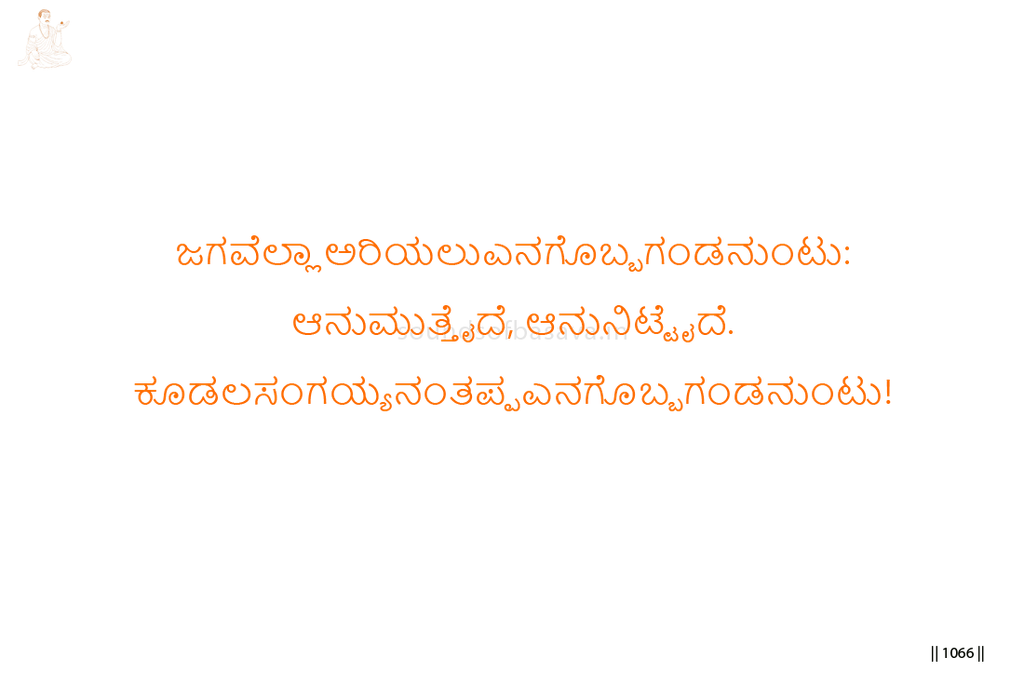
Basavanna asks the whole world to know that he has one husband: Kudalasangama Deva.
Speaking in the devotional voice of a wife, he declares that he is married and firmly established in that relationship. There is no uncertainty, division, or search for another.
The vachana is a brief and public affirmation of single belonging. Kudalasangama Deva alone holds the place of the Divine husband.
Imagery & Symbolic Relevance
The opening appeal to the whole world makes the declaration public. Basavanna does not keep this relationship hidden or present it as a private feeling. He asks that it be known openly.
The statement “I have one husband” gives the central image. The word “one” is decisive. The relationship is not shared among competing sacred centres.
The declaration that he is married shows that the relationship has been entered and accepted. The speaker does not merely long for Kudalasangama Deva from a distance.
The following declaration strengthens this condition as settled and complete. The bridal relationship is not temporary, uncertain, or awaiting fulfilment.
The closing line identifies the one husband directly as Kudalasangama Deva. What was first announced before the world is completed by naming the Lord to whom the speaker belongs.
The repetition of having one husband gives firmness to the whole vachana. It begins with public declaration and ends with direct identification of Kudalasangama Deva.
Lingayoga
The opening appeal to the whole world makes the declaration public. Basavanna does not keep this relationship hidden or present it as a private feeling. He asks that it be known openly.
The statement “I have one husband” gives the central image. The word “one” is decisive. The relationship is not shared among competing sacred centres.
The declaration that he is married shows that the relationship has been entered and accepted. The speaker does not merely long for Kudalasangama Deva from a distance.
The following declaration strengthens this condition as settled and complete. The bridal relationship is not temporary, uncertain, or awaiting fulfilment.
The closing line identifies the one husband directly as Kudalasangama Deva. What was first announced before the world is completed by naming the Lord to whom the speaker belongs.
The repetition of having one husband gives firmness to the whole vachana. It begins with public declaration and ends with direct identification of Kudalasangama Deva.
Editorial Commentary
The opening phrase means “let the whole world know.” It should not be interpreted as a claim to know the whole world or to possess all knowledge.
The language of husband and wife is the vachana’s devotional language of exclusive fidelity. It should not be expanded into unsupported metaphysical claims. The Kannada itself emphasizes public acknowledgment, established relationship, and one Divine husband.
Related Vachana
Supporting Vachana
Sharana Sthala Vachana 616 — The Self-Dug Pit of Duality
Sharana Vachana 616 asks whether a woman who calls every man her husband can be considered faithful. It then warns that one who receives Linga-Prasada but turns toward other sacred centres creates the condition of one’s own fall.
This directly prepares Aikya Vachana 504. Sharana Vachana 616 rejects divided marital and devotional allegiance; Vachana 504 gives the fulfilled declaration of fidelity: the speaker has one husband and names Him as Kudalasangama Deva.
What is protected as discipline in Sharana becomes openly affirmed as settled belonging in Aikya.
Advancing Vachana
Aikya Sthala Vachana 505 — Guard This Mind of Mine
Vachana 504 publicly declares one established Divine relationship. Vachana 505 carries that declaration inward by asking Kudalasangama Deva to guard the mind from straying elsewhere.
There the speaker says that the mind rests in the Lord’s contemplation, that the hand has been placed in His hand, and that the speaker is the bride while Kudalasangama Deva is the husband.
Thus, the settled fidelity declared in Vachana 504 advances into the prayer that this undivided relationship be guarded continuously within the mind.
