

Summary
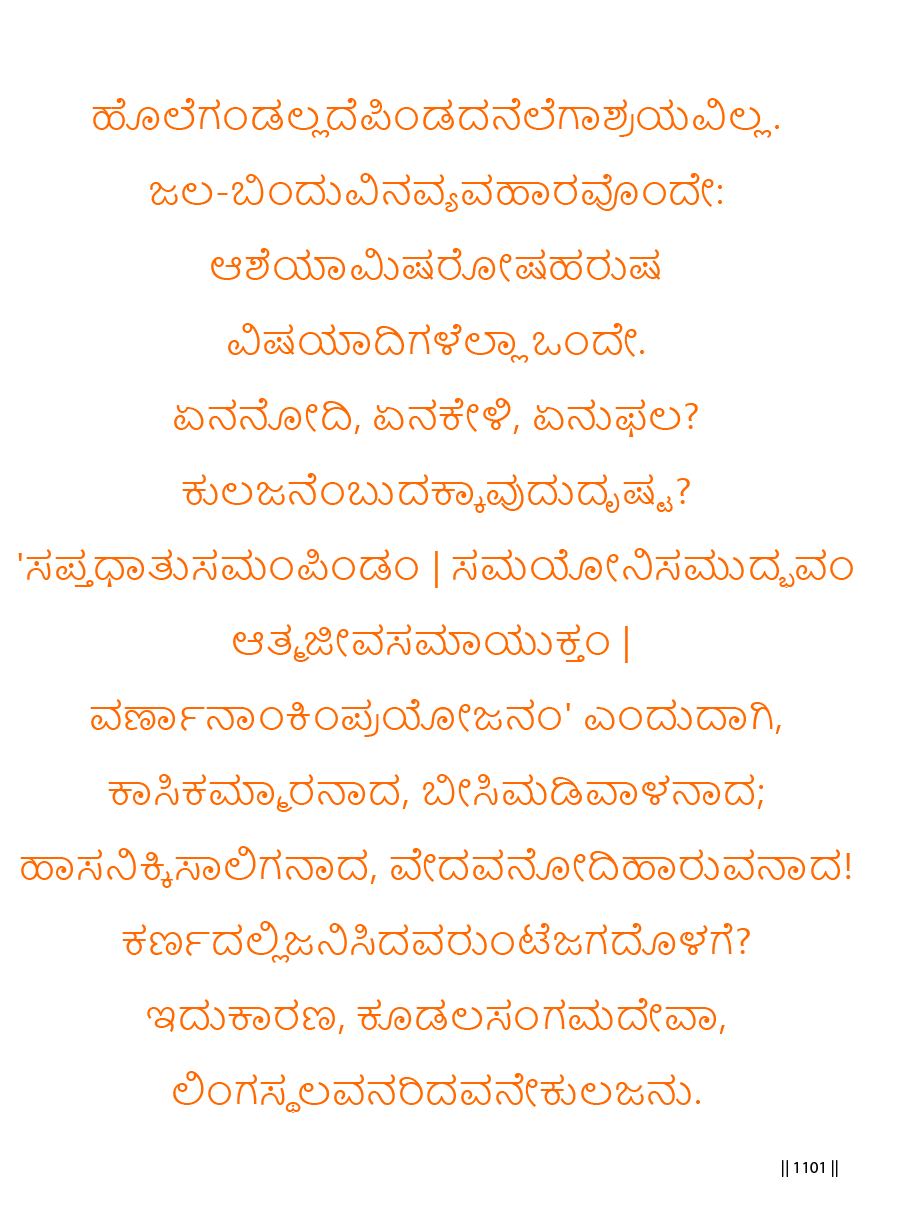
Basavanna begins with the common ground of embodied birth. The body has no separate foundation apart from the womb, and the process of the fluid-drop is the same.
Desire, enticement, anger, joy, and engagement with sense-objects are also common. He therefore asks what lasting fruit comes from reading and hearing if one still claims inherited nobility.
A blacksmith, washerman, weaver, and Brahmin are known through their respective activities. No one is born from the ear. Before Kudalasangama Deva, the one who knows Linga-sthala alone is truly Kulaja.
Imagery & Symbolic Relevance
The opening statement places every body upon the same ground. Basavanna denies that one embodied person possesses a fundamentally different support of birth from another.
The womb is the shared place of bodily formation. Birth does not preserve the social distinctions later imposed upon the person.
The fluid-drop gives the next common process. Its operation is one; Basavanna does not provide separate bodily origins for different castes or professions.
He then names desire, enticement, anger, joy, and the sense-objects. These movements are common across embodied life. No inherited claim exempts one person from them or gives another person a different human constitution.
The questions “What was read? What was heard? What fruit came?” test learning. Reading and hearing cannot establish true nobility while inherited superiority remains unquestioned.
Basavanna then asks what evidence exists for calling someone Kulaja merely through birth. The claim must be examined rather than accepted through custom.
The blacksmith becomes known through heating and working metal. The occupation is identified through activity.
The washerman becomes known through beating and washing cloth. Again, work gives the occupational designation.
The weaver becomes known through setting and working the loom. The name follows the practiced work.
The one who reads the Veda becomes known as the Brahmin. Basavanna places this designation in the same sequence as the occupational names rather than treating it as proof of a separate bodily origin.
The question “Has anyone in the world been born through the ear?” exposes the impossibility of using exceptional birth-claims to establish inherited superiority.
The concluding declaration gives the true criterion: the one who knows Linga-sthala is Kulaja. Nobility is not proved by bodily origin, occupational designation, learning, or inherited account, but by knowing the Linga-sthala before Kudalasangama Deva.
Lingayoga
In Lingayoga, the seeker must not carry caste, profession, learning, or ancestry into the relation with Linga as claims of spiritual superiority.
All embodied persons share birth, bodily processes, emotional movements, and engagement with the senses. These cannot become measures of nearness to Kudalasangama Deva.
Work may give a person an occupational name, and learning may give social recognition, but neither by itself establishes knowledge of the Linga.
The practical direction is clear: do not seek Kulaja-status through inherited identity. Know the Linga-sthala and allow that knowing to become the measure of life.
Editorial Commentary
The opening should remain close to the bodily images actually given: the common support of the body, the fluid-drop, and the shared movements of desire, anger, joy, and the senses.
The professions should not be treated as inferior. Basavanna’s point is that occupational names arise through activities; they do not prove separate human origins or spiritual ranks.
The ear-birth question is a direct rejection of exceptional lineage-claims. It should not be expanded into a detailed discussion of particular mythological births unless the Kannada itself names them.
Kulaja in the final line is explicitly redefined. The true Kulaja is not the person who claims noble descent, but the one who knows Linga-sthala.
Related Vachana
Supporting Vachana
Sharana Sthala Vachana 589 — The Lineage of Realization
Sharana Vachana 589 rejects caste-pride by naming revered figures whose attributed origins do not support rigid claims of inherited superiority. It asks why caste should be sought and why anyone should claim precedence through birth.
Its final declaration directly prepares Vachana 590: even one called Shvapacha, when that person is a Shiva-bhakta, is truly Kulaja.
In Sharana, Bhakti replaces inherited birth as the measure of true lineage. In Aikya Vachana 590, the teaching is carried further: bodily origin, occupation, Vedic learning, and exceptional birth-claims are all removed, and the one who knows Linga-sthala is declared Kulaja.
Advancing Vachana
Aikya Sthala Vachana 1064 — Beyond the Threefold Impurity
Vachana 590 declares that inherited caste and occupational designation cannot establish true nobility; the one who knows Linga-sthala alone is Kulaja.
Vachana 1064 carries this recognition into Linga-Aikya. There, former caste, former stage of life, and ritual impurity no longer apply, because Shiva-bhakti itself has become the body.
The criterion stated in Vachana 590 therefore advances into completed freedom from inherited identity in Vachana 1064. Knowledge of Linga-sthala no longer merely corrects the meaning of Kulaja; life itself ceases to be governed by the former measures of caste, status, and ritual distinction.
