

Summary
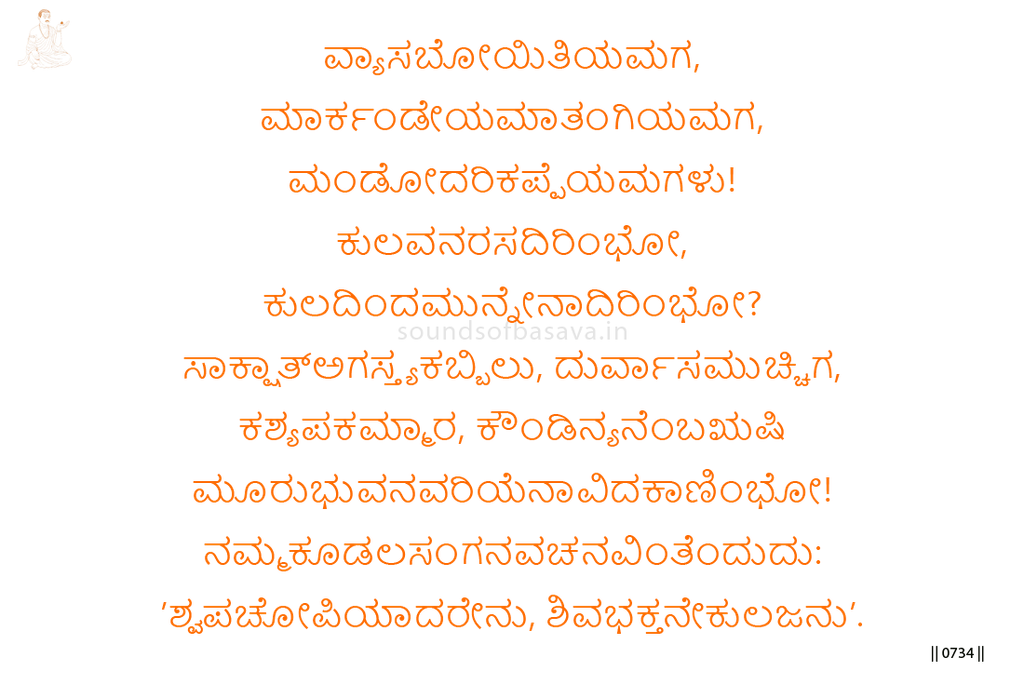
In this vachana, Basavanna rejects caste-pride by pointing to revered figures whose greatness cannot be contained by ordinary claims of birth and lineage.
He names Vyasa, Markandeya, Mandodari, Agastya, Durvasa, Kashyapa, and Kaundinya. The point is not to give a full biography of each figure. The point is to show that spiritual greatness has never been safely confined within rigid ideas of caste-origin.
Basavanna then asks directly: why speak of caste, and why claim superiority through birth? The question is meant to cut through inherited pride. Sacred worth is not decided by genealogy.
The final declaration gives the teaching: even if one is called Shvapacha, if that person is a Shiva-bhakta, he is truly Kulaja. For the reader, Shvapacha means one placed at the lowest edge of social judgment. Kulaja means one of noble lineage. Basavanna reverses the measure: devotion to Shiva, not birth, establishes true lineage before Kudalasangama Deva.
Imagery & Symbolic Relevance
Vyasa is the first example. He is revered as a great transmitter of sacred knowledge, yet Basavanna invokes his birth to unsettle caste-pride.
Markandeya gives the next example. His greatness is not measured by social origin, but by devotion and spiritual standing.
Mandodari is named to widen the argument. Basavanna includes a figure whose origin cannot be used to defend rigid purity claims.
Agastya, Durvasa, Kashyapa, and Kaundinya extend the same logic. The honored names themselves do not support a narrow theory of birth-based worth.
The repeated question about caste and birth is the center of the vachana. Basavanna does not ask for a better caste-ranking. He asks why caste should be used as the measure at all.
The Shvapacha image gives the decisive reversal. One whom society calls low becomes truly noble if Shiva-bhakti is present.
Shiva-bhakti is therefore the true lineage. It is not inherited through the body; it is known through devotion, realization, and living relation to Kudalasangama Deva.
The movement of the vachana is clear: revered examples weaken caste-pride, the question rejects birth-boasting, and the final line establishes Shiva-bhakti as the true noble lineage.
Lingayoga
In Lingayoga, this vachana teaches that spiritual identity is awakened, not inherited.
The practice-point is direct: do not judge a seeker by caste, birth, ancestry, or social rank. Look for Shiva-bhakti. Where devotion to Kudalasangama Deva is alive, true lineage is present.
For Sharana Sthala, this is lineage rebuilt through realization. The Sharana does not merely become “higher” within the old hierarchy. The Sharana stands by a different measure altogether: living devotion to Shiva.
Editorial Commentary
This vachana should not be reduced to a list of unusual births. The list serves a precise purpose: it removes the authority of caste-pride by showing that revered spiritual figures themselves cannot be confined by rigid lineage claims. The final sentence governs the whole vachana: even one called Shvapacha becomes truly Kulaja when Shiva-bhakti is present.
Related Vachana
Supporting Vachana
Pranalingi Sthala Vachana 606 — The True Mark — Beyond Birth, Beyond Death
Pranalingi Vachana 606 supports this teaching by placing Linga above birth and learned status. It teaches that one may be learned in the four Vedas and still lack true standing without Linga, while one called Shvapacha becomes worthy when Linga is present.
This directly supports Vachana 589. Basavanna says that even one called Shvapacha is truly Kulaja if that person is a Shiva-bhakta. Pranalingi Vachana 606 gives the prior ground: Linga, not caste or learned identity, is the true spiritual mark.
Advancing Vachana
Aikya Sthala Vachana 1348 — All Are the Children of Chennayya
Aikya Vachana 1348 advances this teaching by expanding the rejection of birth-pride into a universal vision. There, worlds, beings, deities, sages, celestial beings, and those like “me” and “you” are all declared children of Chennayya.
Vachana 589 says that Shiva-bhakti, not caste-origin, makes one truly noble. Aikya Vachana 1348 carries this into Aikya: the whole hierarchy of higher and lower birth dissolves into one realized kinship. Before Kudalasangama Deva, true lineage is no longer biological ancestry or caste-status; it is shared belonging in the living family of realization.
