

Summary
In this vachana, Basavanna contrasts outer purification with true knowledge of Kudalasangama Deva.
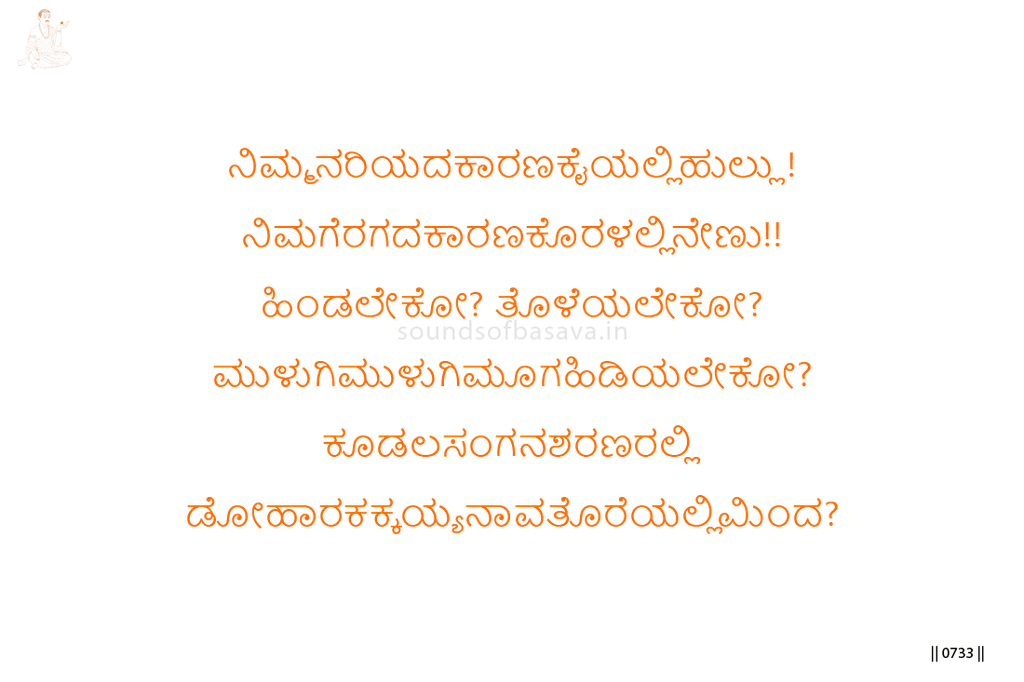
He says that because people do not know the Lord, they hold grass in the hand. Because they do not truly turn to Him, they wear a cord or noose around the neck. They wash, scrub, plunge again and again, and hold the nose as though bodily effort could produce inner purity.
For the reader, these images point to ritual offering, external religious sign, bathing, and breath-control. Basavanna’s concern is not with water, grass, or discipline by themselves. His concern is that they become substitutes for knowing Kudalasangama Deva.
He then gives the decisive example of Dohara Kakkayya, a Sharana of Kudalasangama Deva. Basavanna asks: in what stream did Kakkayya bathe? The meaning is clear. One established among the Lord’s Sharanas is not made pure by water, caste, or outer sign.
The teaching is direct: purity is not worn, washed, or displayed. True purity is realized through knowledge of Kudalasangama Deva and life among His Sharanas.
Imagery & Symbolic Relevance
Grass in the hand is the first image. It points to ritual offering performed without living knowledge. The object may be sacredly used, but without knowing the Lord, the act remains external.
The cord or noose around the neck is the second image. A religious sign can become bondage when it replaces realization. What is worn outwardly cannot create inward truth by itself.
Washing and scrubbing give the next images. Water can cleanse the body, but Basavanna asks whether it can cleanse ignorance.
Plunging again and again deepens the critique. Repetition does not guarantee transformation. A person may bathe many times and still remain inwardly unawakened.
Holding the nose points to disciplined physical practice or breath-control. Basavanna includes this too under the same test: technique without knowing Kudalasangama Deva is incomplete.
Dohara Kakkayya is the final and strongest image. Society may measure purity through caste, occupation, ritual mark, or bathing. Basavanna overturns that measure by invoking Kakkayya as a Sharana. His purity is not derived from a stream; it is shown through refuge in Kudalasangama Deva.
The movement of the vachana is clear: external sign, ritual act, bodily washing, and technique cannot replace realization. The true measure is the Sharana established in the Lord.
Lingayoga
In Lingayoga, this vachana teaches that purification must reach consciousness.
The practice-point is direct: do not depend on outer ritual, sign, bathing, or bodily discipline while the heart remains ignorant of Kudalasangama Deva. Let practice become inward knowing.
For Sharana Sthala, this is the rejection of caste-coded and ritual-coded purity. The Sharana is not purified by social approval or repeated washing. The Sharana is purified by refuge, realization, and living nearness to Kudalasangama Deva’s Sharanas.
Editorial Commentary
This vachana should be kept close to its images. Basavanna is not rejecting all forms of practice. He is rejecting the belief that external practice can replace knowing the Lord. The final question about Dohara Kakkayya governs the entry: if a realized Sharana stands in Kudalasangama Deva, what stream is needed to prove his purity?
Related Vachana
Supporting Vachana
Pranalingi Sthala Vachana 644 — The Unbroken Way
Pranalingi Vachana 644 supports this teaching by saying that truth, purity, and daily observance must be lived without break. It also gives the image of fish, tortoise, and frog living in water without gaining spiritual fruit merely by being in water.
This supports Vachana 588 directly. Basavanna says that repeated washing, plunging, and bodily practice cannot purify one who does not know Kudalasangama Deva. Pranalingi Vachana 644 gives the same principle: nearness to water is not realization; purity must be lived, not merely touched externally.
Advancing Vachana
Aikya Sthala Vachana 1064 — Beyond the Threefold Impurity
Aikya Vachana 1064 advances this teaching by showing the completed state in which inner impurity, human attachment, and outward entanglement are removed. In that Linga-Aikya state, Shiva-bhakti itself becomes the body, and former caste, stage of life, and ritual pollution no longer apply.
Vachana 588 rejects purity based on grass, cord, washing, plunging, and bodily discipline, and points instead to Dohara Kakkayya among Kudalasangama Deva’s Sharanas. Aikya Vachana 1064 carries this into fulfillment: the realized one no longer lives under the authority of external purity or impurity. Devotion itself has become the body, and Linga-Aikya has removed the old measures.
