

Summary
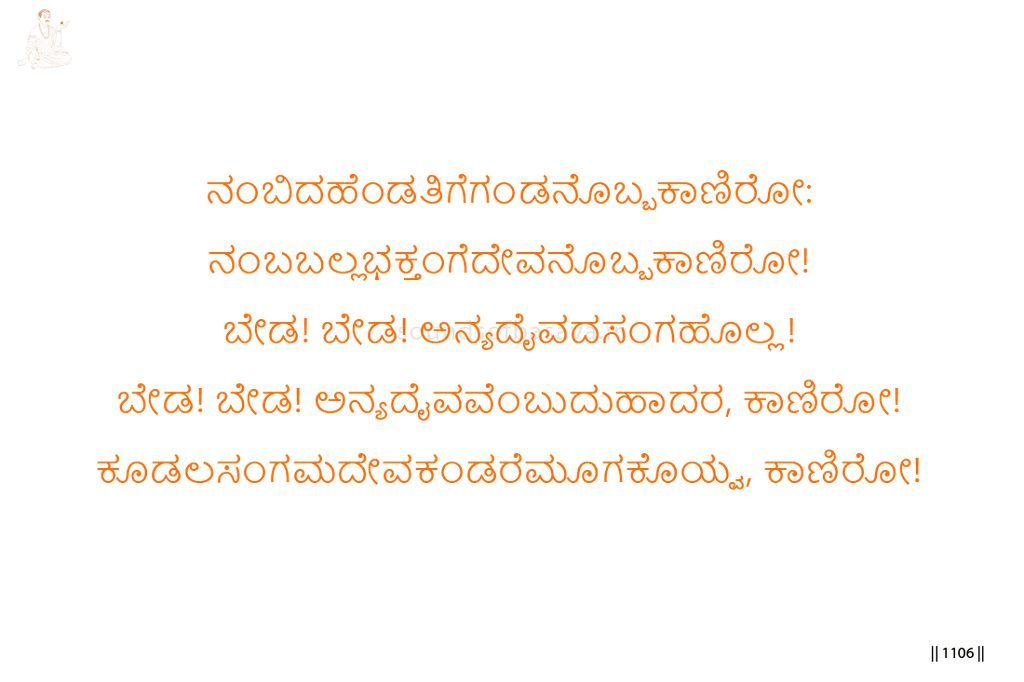
Basavanna asks the listener to see that a faithful wife knows one husband, just as a Bhakta capable of true faith knows one Deva.
He repeatedly rejects association with another or foreign deity. Such divided dependence is compared to adultery because it violates the bond already established with Kudalasangama Deva.
The final nose-cutting image gives the consequence of that broken fidelity: divided devotion brings open disgrace before the Lord.
Imagery & Symbolic Relevance
The faithful wife gives the first comparison. Her defining quality in the vachana is fidelity to one husband.
Basavanna then places the faithful Bhakta beside her. Just as marital fidelity does not divide its bond, devotion does not divide its Divine refuge.
The repeated command “See” asks for recognition. Basavanna presents the comparison as something evident in the nature of fidelity.
The repeated “Bēḍa, bēḍa”—“No, no” gives urgency to the warning. The words return three times, closing every attempt to justify divided association.
The first warning rejects the company of another deity. Devotion is weakened when refuge is distributed among competing centres.
The second rejects association with a foreign or separate deity. The wording emphasizes going elsewhere after a sacred bond has already been established.
The third names the declaration of another deity as adultery. Basavanna uses the marital comparison to describe a breach of devotional fidelity.
The final image is the cutting of the nose when Kudalasangama Deva sees. The nose is a visible part of the face, and its cutting signifies public dishonour. What begins as hidden divided loyalty becomes exposed before the Lord.
The vachana therefore moves from faithful relationship, to repeated warning, to the disgrace produced by spiritual betrayal.
Lingayoga
In Lingayoga, the relation between Anga and Linga requires undivided trust.
The seeker may perform worship outwardly while inward reliance moves toward several centres. Basavanna identifies that condition as a breach of the established Linga-relation.
One Deva means one governing refuge. Thought, remembrance, worship, and dependence remain gathered in Kudalasangama Deva.
The practical direction is clear: let the fidelity expressed in worship remain the fidelity lived in every condition.
Editorial Commentary
The marital comparison supplies the vachana’s exact measure of devotion: fidelity cannot be divided without the bond being violated.
The repeated “Bēḍa, bēḍa” creates a firm prohibition rather than a gradual argument.
The nose-cutting image represents visible disgrace and severe correction. Its force belongs to the breach of devotional fidelity described in the vachana.
Related Vachana
Supporting Vachana
Sharana Sthala Vachana 751 — The Hollow Drum
Sharana Vachana 751 compares misdirected offering to placing rice upon a drum, where it cannot fulfil its intended purpose. It concludes explicitly that one must not say another deity exists apart from Kudalasangama Deva.
This prepares Vachana 611 directly. In Sharana, offering and refuge are disciplined toward their true centre. In Aikya, that undivided direction becomes the fidelity of the Bhakta who knows one Deva and refuses every association that would divide the sacred bond.
Advancing Vachana
Aikya Sthala Vachana 80 — No Other Refuge
Vachana 611 commands the Bhakta to remain faithful to one Deva and rejects every movement toward another Divine centre.
Vachana 80 presents the inward fulfilment of that fidelity. Basavanna declares that he knows no other within his mind; “Om Namah Shivaya” has become both mantra and japa, and even the act of knowing is surrendered to Kudalasangama Deva.
The disciplined refusal of divided refuge in Vachana 611 therefore deepens into an undivided mind in Vachana 80. Another support is no longer merely rejected; it no longer arises within awareness.
