

Summary
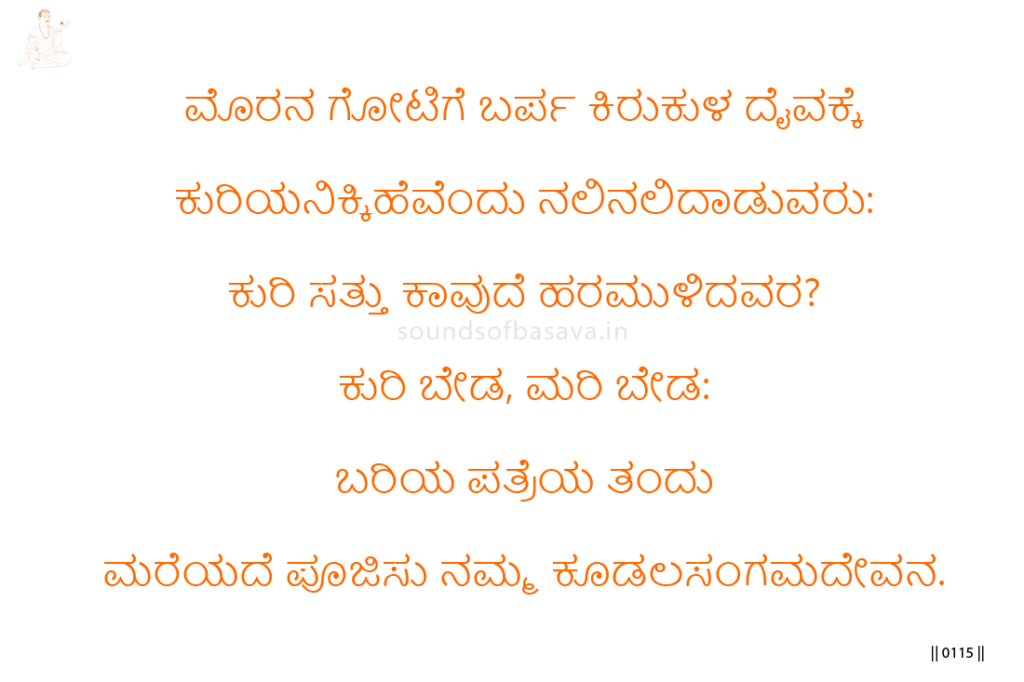
In this vachana, Basavanna rejects the sacrifice of animals before deities.
He questions those who rejoice in offering sheep or goats. If the animal dies, can that death truly please Hara?
He then gives a clear instruction: do not ask for sheep, do not ask for goats. Bring a simple leaf and worship Kudalasangama Deva without forgetting. The vachana teaches that true worship does not require violence. It requires remembrance, simplicity, and devotion.
Imagery & Symbolic Relevance
The sheep and goat are the first images. They represent the animals brought for sacrifice in ritual practice.
Basavanna does not accept the killing as sacred. He questions whether the death of the creature can ever become pleasing to Hara.
The lesser deity represents worship shaped by fear, habit, and appeasement. Basavanna turns the seeker away from this form of offering.
The plain leaf becomes the correcting image. It is simple, harmless, and sufficient when joined with true remembrance.
The instruction “worship without forgetting” is the center of the vachana. The worth of worship lies not in blood, force, or display, but in steady awareness of Kudalasangama Deva.
The contrast is therefore precise: sacrifice destroys life, while remembrance turns life toward the Divine.
Lingayoga
In Lingayoga, worship must not be separated from compassion.
The Anga cannot approach Linga through violence and still claim inward purity.
A simple leaf offered with remembrance is greater than a costly or forceful act performed in forgetfulness.
This vachana also joins Kayaka and Dasoha to non-harm. The hand that serves must not become the hand that kills in the name of worship.
Practice matures when offering becomes clean, compassionate, and inwardly remembered before Kudalasangama Deva.
Editorial Commentary
This vachana rejects violent offering.
Basavanna does not ask for a grander ritual; he asks for a truer one, free from harm and joined to remembrance.
Related Vachana
Supporting Vachana
Vachana 554 — The True Giver
Vachana 554 turns the seeker away from dependent gods who wait, obey, and receive from others. Vachana 560 continues by rejecting violent offerings made to lesser deities and directing worship toward Kudalasangama Deva.
Advancing Vachana
Maheshwara Vachana 636 — The Fallacy of the Measure
Vachana 560 teaches that worship must not be divided from compassion. Maheshwara Vachana 636 advances this into the seamless life, where devotion and conduct are no longer separated before Kudalasangama Deva.
