

Summary
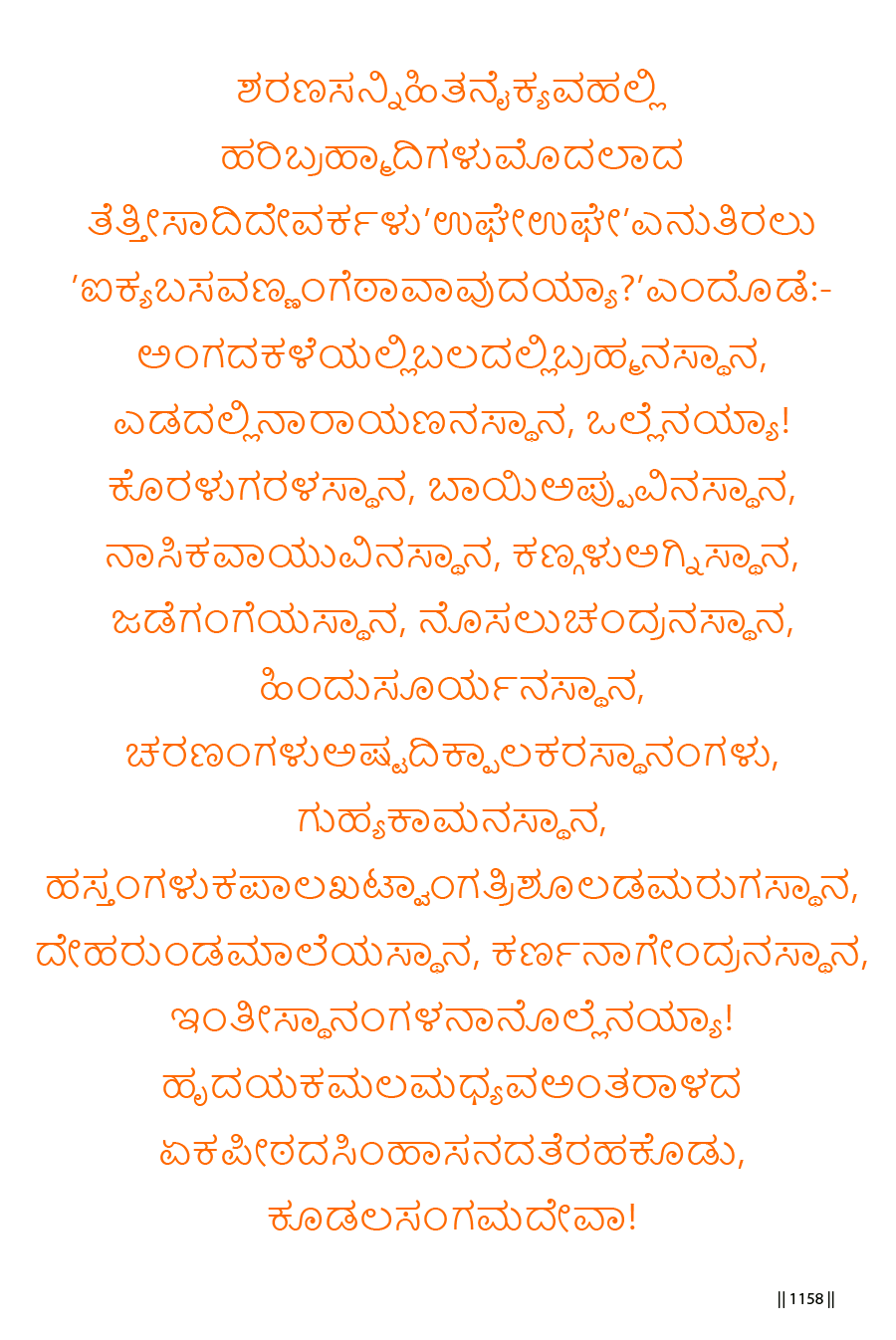
In the presence of the Sharanas established in Aikya, Hari, Brahma, and the hosts of gods acclaim Basavanna and ask where he should be seated.
Basavanna refuses every proposed position: the seats of Brahma and Narayana, the cosmic and elemental locations assigned throughout Shiva’s body, and the places associated with Divine powers, weapons, ornaments, and attendants.
He asks Kudalasangama Deva to make room only for the throne of the single seat in the innermost space of the heart. The realised condition cannot be contained within any differentiated cosmic position.
Imagery & Symbolic Relevance
The gathering of Hari, Brahma, and the hosts of gods establishes the grandeur of the scene. Basavanna is honoured in the presence of the Sharanas, and the gods seek an appropriate place for the one established in Aikya.
The question “Where shall Aikya Basavanna be seated?” begins the central movement. The gods assume that greatness must be recognised by assigning a corresponding position.
The right side is named as Brahma’s seat, and the left as Narayana’s. Basavanna refuses both. Neither creative nor preservative rank provides the place he seeks.
The vachana then maps a series of cosmic and Divine associations upon the body:
The throat is the seat of poison; the mouth, of water; the nose, of air; and the eyes, of fire. The matted locks bear Ganga; the forehead bears the moon; and the back is associated with the sun.
The feet are the seat of the eight guardians of the directions, while the hidden bodily place is associated with Kama. The hands bear the skull, khatvanga, trident, and damaru. The body carries the garland of skulls, and the ears bear the serpent king.
The catalogue moves through sides, faculties, elements, celestial powers, weapons, ornaments, and bodily locations. Every available position within the cosmic form has already been assigned.
Basavanna refuses all these seats. His refusal is not a rejection of Shiva’s form or attributes. He refuses to be located within any one differentiated office, power, element, direction, or emblem.
The final prayer turns from the distributed body to the inward centre. Basavanna asks Kudalasangama Deva to open the throne of the eka-pitha—the single seat—within the innermost space of the heart.
The many seats belong to differentiated manifestation. The one throne belongs to undivided inward establishment.
Lingayoga
In Lingayoga, spiritual maturity cannot be measured by position, title, power, or resemblance to Divine attributes.
The practitioner turns from the desire to occupy an exalted place toward inward establishment in Kudalasangama Deva. The decisive movement is from many assigned seats to the one centred abidance of the heart.
Editorial Commentary
The bodily catalogue should remain concrete. It names recognised associations of Shiva’s form and does not require a separate symbolic doctrine for every body part.
Basavanna’s refusal concerns placement within these differentiated seats. It should not be interpreted as rejection of Brahma, Narayana, the elements, or Shiva’s sacred emblems.
The heart’s inner space is the concluding sacred location. It should not be reduced to the anatomical heart or expanded into an unsupported system of subtle centres.
Eka-pitha means the single or undivided seat. The contrast is between the many cosmic placements already named and the one inward throne sought from Kudalasangama Deva.
Related Vachana
Supporting Vachana
Sharana Sthala Vachana 361 — Thrones and Titles
Sharana Vachana 361 refuses the positions of Brahma, Vishnu, Rudra, and every other exalted rank. Basavanna asks instead for the great state found at the feet of Kudalasangama Deva’s true Bhaktas.
This prepares Vachana 845 directly. Vachana 361 removes spiritual ambition by preferring humility and Sharana-nearness to Divine rank.
Vachana 845 carries that refusal into Aikya. Even when the gods themselves seek a worthy seat for Basavanna, he accepts none of the cosmic positions they offer. The rejection of rank in Sharana matures into the refusal of every differentiated seat in Aikya.
Advancing Vachana
Aikya Sthala Vachana 1275 — The Mind Finds Its Abiding in the Western Door
Vachana 845 ends by asking Kudalasangama Deva to open the throne of the single seat within the innermost heart-space.
Vachana 1275 unfolds the inward movement toward such a throne. After crossing the enclosure and entering through the Western Door, the mind reaches the Shunya-throne of Guru, Linga, and Jangama and finds its place of repose.
The continuation is direct: Vachana 845 rejects every external and differentiated placement and asks for the inward one-seat; Vachana 1275 reveals the mind arriving at that inner throne and remaining established there.
The throne first sought as the sole fitting place becomes the mind’s unwavering abode.
