

Summary
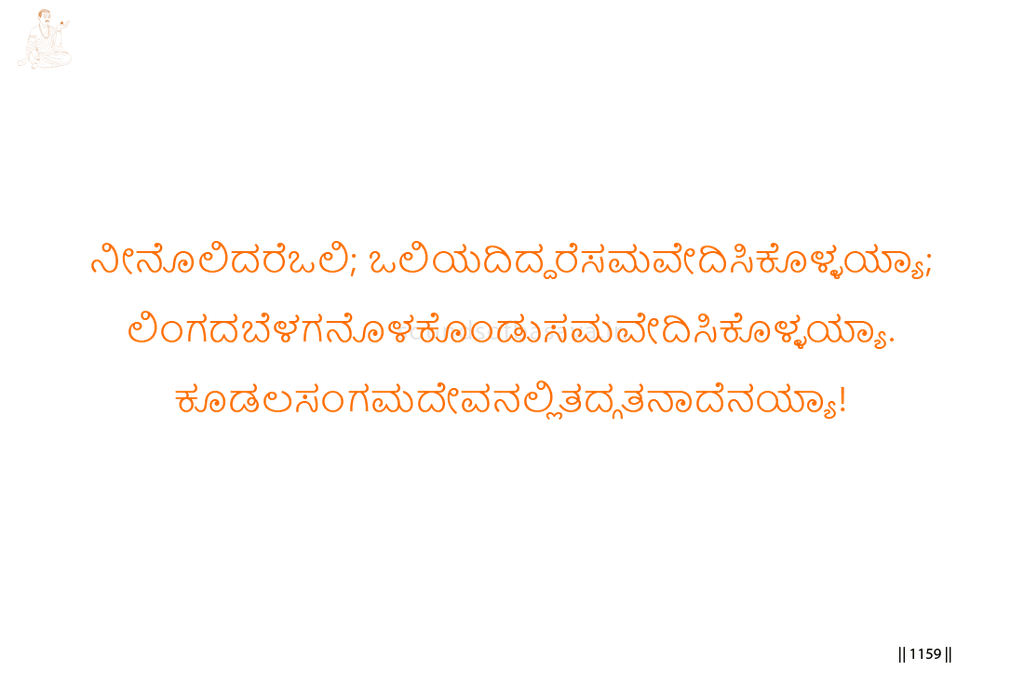
Basavanna places both possibilities before Kudalasangama Deva: the Lord may be pleased, or He may not be pleased. In either condition, Basavanna asks to be brought into sameness within the radiance of Linga.
His relation with the Lord is no longer governed by the desire to obtain a favourable response. What he seeks is absorption in Linga-light.
He therefore declares that he has become tadgata—wholly entered into and absorbed in Kudalasangama Deva.
Imagery & Symbolic Relevance
“If You are pleased, be pleased” acknowledges Divine pleasure without claiming it as a reward that the seeker can demand.
The next movement places even the absence of such pleasure before the Lord. Basavanna does not withdraw, complain, or seek another refuge. He asks to be brought into samavedi—a condition of sameness in which the distinction created by favourable and unfavourable response loses its hold.
The request is then made more precise: “Take me within the radiance of Linga and bring me into sameness.”
The Linga’s radiance is the central image. It is the field into which the seeker is received until the reactions produced by acceptance and non-acceptance no longer divide the mind.
Basavanna does not ask merely to see the light. He asks to be taken within it. The movement is from standing before Linga and awaiting response to entering the radiance in which the seeker’s separate preference is quieted.
The final word tadgata completes this movement. It means entered into That, absorbed in That, or wholly directed into That. Basavanna no longer speaks as one waiting outside for approval. He speaks from absorption in Kudalasangama Deva.
The sequence is therefore concise: Divine pleasure is accepted, its absence does not cause departure, both are brought into sameness within Linga-light, and the seeker becomes absorbed in the Lord.
Lingayoga
In Lingayoga, worship must become free from bargaining with Linga.
The practitioner cannot remain steady only when devotion brings comfort, recognition, or a felt response. Both favourable and unfavourable experience must be brought into the same Linga-centred awareness.
The practice matures when attention enters the radiance of Linga so completely that the demand for a particular outcome falls away.
Editorial Commentary
The opening does not express indifference toward Kudalasangama Deva. Basavanna remains wholly dependent upon the Lord, but no longer makes Divine pleasure a condition for fidelity.
Samavedi carries the movement of being brought into sameness or assimilation. Its repetition shows that this is the principal request of the vachana.
The Linga’s radiance should remain the field of this equalization. It is not necessary to identify it with an independent philosophical concept of witnessing awareness.
Tadgata indicates absorption in Kudalasangama Deva. It does not describe emotional numbness or passive resignation.
Related Vachana
Supporting Vachana
Sharana Sthala Vachana 1050 — I Am but the Puppet of Your Thread
Sharana Vachana 1050 compares the seeker to a puppet moved by Kudalasangama Deva’s hidden thread. Basavanna says that he has no independent freedom, does not claim devotion or action as his own, and asks the Lord to carry him safely across.
This prepares Vachana 846 by surrendering independent preference and doership. The puppet cannot determine how the thread should move, just as the Sharana cannot make Divine pleasure, approval, or response the condition of surrender.
Vachana 846 reveals the inward maturity of this dependence. Whether the Lord is pleased or not, Basavanna asks only to be taken within Linga-radiance and made one in that condition.
What appears in Sharana as surrender to the Lord’s directing thread matures in Aikya as absorption beyond the demand for acceptance.
Advancing Vachana
Aikya Sthala Vachana 851 — Where Knowing Falls Silent
Vachana 846 brings the seeker within the radiance of Linga and ends in tadgata, absorption in Kudalasangama Deva.
Vachana 851 carries that absorption into silence. When true knowing arises and the radiance of Linga is entered, nothing remains to be spoken. Meditation upon Kudalasangama Deva reaches a condition in which language is no longer required.
The continuation is direct: Vachana 846 passes beyond dependence upon Divine acceptance or non-acceptance; Vachana 851 passes beyond the need to describe the resulting state.
Absorption in Linga-radiance thus deepens into the silence of completed knowing.
