

Summary
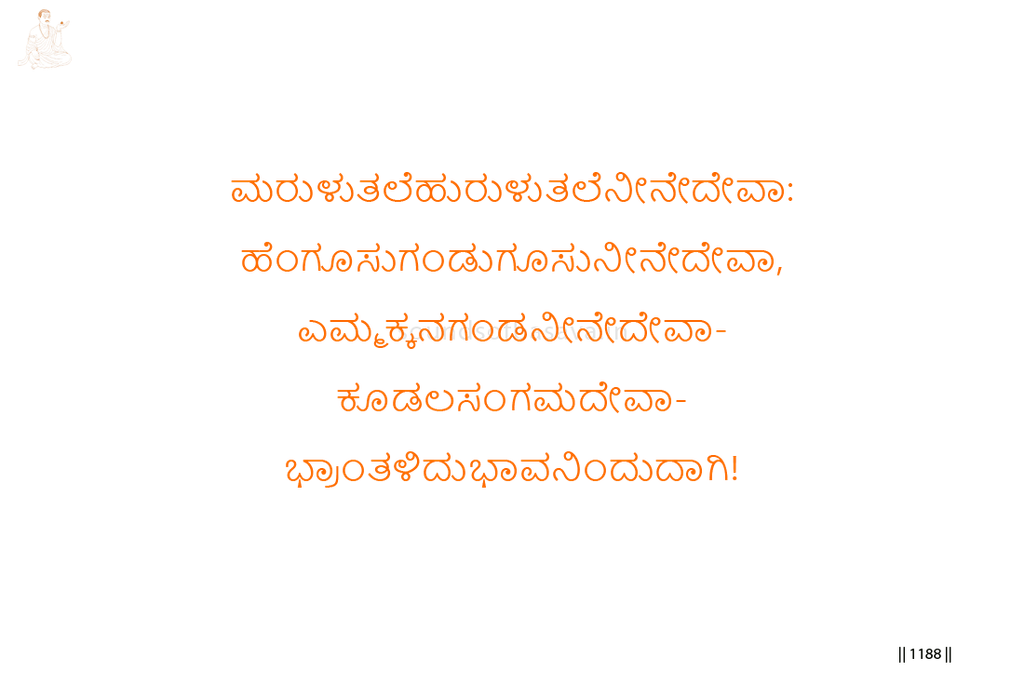
Basavanna recognizes Kudalasangama Deva through contrasting mental conditions, embodied forms, and an ordinary family relationship.
Whether the head is bewildered or possesses sense and discernment, the Lord is present. Whether the child is female or male, the Lord alone is the underlying Divine presence. Basavanna then brings the declaration into familiar household language: the husband of our elder sister is also You alone, O God.
The concluding line gives the source of this recognition. When bhranti—deluded seeing—falls away, this declaration arises from bhava. It is not merely an intellectual statement that everything is one; it is a recognition born from transformed devotional feeling.
Imagery & Symbolic Relevance
The vachana begins with the paired expressions maruḷutale and huruḷutale.
Maruḷu indicates bewilderment, delusion, or loss of right discernment. Huruḷu carries the sense of substance, meaning, sense, or discernible truth.
Basavanna places the bewildered head and the discerning head beside one another and declares, “You are God.”
The contrast must be preserved. He does not say that bewilderment and discernment are identical in value. The final line explicitly speaks of delusion being destroyed.
Rather, the Lord’s presence is not created only when clarity appears. Even the person caught in bewilderment has not fallen outside the Divine ground, though bewilderment prevents that presence from being rightly recognized.
The second pair is the girl-child and the boy-child.
The Kannada says heṅgūsu and gaṇḍugūsu—female child and male child. The image should therefore not be replaced too quickly by the more general “woman and man.”
The child-image brings the distinction close to its beginning. Before social achievement, spiritual status, authority, learning, or public identity arise, embodied difference is already named. Basavanna sees Kudalasangama Deva through both forms.
The statement does not deny bodily difference. The girl-child remains a girl-child and the boy-child remains a boy-child. What is denied is that either embodied form possesses a separate Divine source or a superior spiritual essence.
The repeated “You alone are God” gives the pair its spiritual measure. Divine presence cannot be confined to one sex or denied to the other.
The next expression is strikingly domestic: “You are the husband of our elder sister.”
Basavanna does not speak vaguely of “all relationships.” He selects a specific and familiar kinship designation.
The husband of an elder sister is known through relationship. He is not being described by an isolated individual name, but by the position he holds within the household.
By identifying Kudalasangama Deva within this concrete relationship, Basavanna brings Divine recognition into ordinary family language. The Lord is not confined to temple, ritual, meditation, or philosophical thought. Recognition enters the lived network through which people address and know one another.
The line should not be unnecessarily converted into an elaborate bridal allegory. Its immediate force lies in its familiar specificity: even the person named through this household relationship is recognized through the declaration, “You alone are God.”
The final line turns from the forms being seen to the condition of the one who sees.
Bhranti aḷidu means that delusion or mistaken perception has fallen away.
The declaration that precedes it becomes possible because seeing is no longer governed by fragmentation. The girl-child, boy-child, bewildered person, discerning person, and familiar relative are no longer treated as possessing unrelated spiritual origins.
The phrase bhāvanindudāgi indicates that this has arisen from bhava. The declaration comes from inward devotional disposition and realised feeling, not merely from verbal reasoning.
Basavanna is therefore not constructing a theory and applying it indiscriminately to the world. Deluded perception has ended, and from transformed bhava arises the repeated recognition: “You alone.”
The sequence is exact: the bewildered and discerning heads are named; the girl-child and boy-child are named; a specific household relationship is named; Kudalasangama Deva is repeatedly recognized; delusion falls away; and this recognition arises from bhava.
Lingayoga
In Lingayoga, the practitioner may unconsciously restrict Divine presence to preferred conditions.
The Lord may be sought only when the mind is quiet, understanding is clear, the environment is sacred, or another person conforms to an expected spiritual appearance.
Vachana 918 removes that restriction. Kudalasangama Deva is not produced by the practitioner’s clarity. Clarity allows the practitioner to recognize the presence that was not absent.
This does not mean that confusion should be protected or praised. Bhranti must fall away. The discipline is to distinguish between the Divine presence within a person and the delusion that prevents that presence from being rightly known.
The girl-child and boy-child also give a direct discipline of seeing. Embodied difference must not become spiritual inequality. Lingayoga centred in Linga cannot accept that one bodily form possesses greater access to the Divine than another.
The household relationship extends practice into daily life. Divine remembrance must not remain limited to formal worship. The people encountered through family, community, work, and ordinary relationship become part of the field in which one’s seeing is tested.
The mature movement is from concept to bhava. It is insufficient merely to repeat that the Lord is everywhere. The declaration becomes true in practice only when perception, conduct, and relationship cease to be governed by divisive delusion.
Editorial Commentary
Maruḷu and huruḷu should remain a contrast. The first indicates bewilderment or delusion; the second indicates sense, substance, meaning, or discernment.
The line should not be interpreted as teaching that delusion and discernment are equally truthful. The concluding bhranti aḷidu explicitly states that delusion has fallen away.
Heṅgūsu and gaṇḍugūsu mean girl-child and boy-child. Translating them only as “woman and man” loses the concrete form chosen by the vachana.
Emmakka-na gaṇḍa means “the husband of our elder sister.” This specific kinship relationship should be retained rather than dissolved into a generalized statement about every human bond.
The final line is declarative, not interrogative. Its movement is that, after delusion has ended, this recognition has arisen from bhava.
“You alone are God” does not erase the visible or functional differences among the persons named. It removes the mistaken belief that their differing forms and relations possess separate Divine foundations.
Related Vachana
Supporting Vachana
Sharana Sthala Vachana 704 — The Witness Before All Forms
Sharana Vachana 704 speaks of appearing again as man and again as woman, while placing final identity in steadfast relation to Kudalasangama Deva and His Sharanas.
It prepares Vachana 918 by refusing to make embodied form the final spiritual measure.
Advancing Vachana
Aikya Sthala Vachana 919 — Without Division
Vachana 919 carries “You alone” into lived continuity: path, word, communion, knowing, experience, wonder, and seeing become free from division.
Thus the recognition arising from bhava in Vachana 918 becomes the Sharana’s undivided way of living.
