

Summary
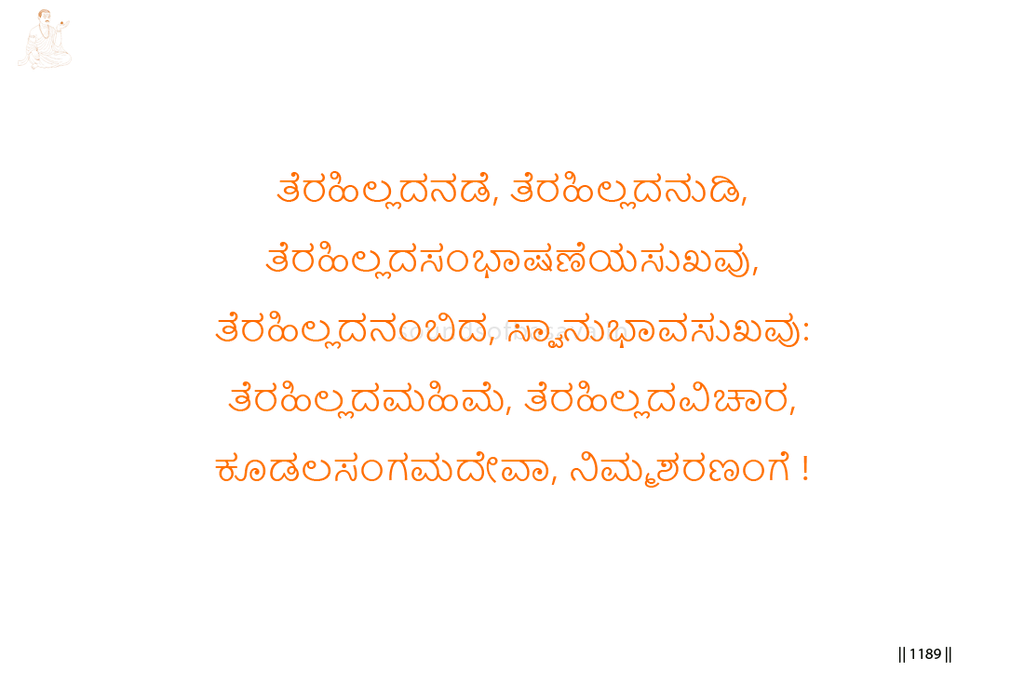
For Kudalasangama Deva’s Sharana, conduct, speech, and conversation contain no gap. This integrity is joy.
The Sharana trusts that no separation remains and knows the joy of svanubhava—direct personal experience. Glory and reflection also arise without inner division.
The vachana presents Aikya as complete coherence: what is lived, spoken, shared, trusted, experienced, and understood no longer moves in conflicting directions.
Imagery & Symbolic Relevance
The vachana uses no external object or extended comparison. Its force lies in the repeated expression terahillada—without gap, separation, or division.
The first sequence moves through three fields:
naḍe — conduct or way of living
nuḍi — speech or utterance
sambhāṣaṇe — conversation or mutual exchange
Conduct and speech are not allowed to contradict one another. Conversation extends this integrity into relationship: non-division must be present not only within the individual, but also in communication with others.
Basavanna calls such conversation joy. Joy here is not added as an external reward; it arises where no concealed gap remains between inward condition and outward expression.
The next phrase turns toward conviction: the Sharana trusts that there is no division. This is followed by svanubhava-sukha, the joy of direct experience. What is believed is no longer separate from what is personally known.
Mahime, glory or greatness, is also without division. The Sharana’s greatness does not belong to public display or a separate spiritual identity; it arises from this integrated condition.
Finally, vichara—reflection, inquiry, or consideration—is without separation. Thought does not stand apart from conduct and experience.
The closing address, “Kudalasangama Deva, for Your Sharana,” gathers the whole description. Basavanna is defining the condition of the Lord’s Sharana: undivided in living, speaking, relating, trusting, experiencing, and reflecting.
Lingayoga
In Lingayoga, practice must remove the gaps between worship and daily conduct, inward understanding and spoken word, conviction and experience.
A practitioner may speak of Linga while living from another centre. Vachana 919 gives a direct measure: speech, relationship, and reflection must express the same Linga-centred condition.
Svanubhava marks the maturation of this integrity. What began as teaching or trust becomes directly lived, so that practice is no longer divided into sacred and ordinary parts.
Editorial Commentary
Naḍe is more precisely conduct or way of living than an abstract “path.” Nuḍi is speech, while sambhāṣaṇe is conversation or exchange; the three should remain distinct.
Terahillada does not erase their different functions. It means that no contradiction or separating gap remains among them.
The phrase concerning trust should not be replaced by an unsupported claim of intellectual knowledge. The movement is from undivided conviction to the joy of svanubhava.
Related Vachana
Supporting Vachana
Sharana Sthala Vachana 441 — Words Ripen into Deeds
Vachana 441 requires the word of Bhakti to be fulfilled in conduct.
It prepares Vachana 919, where the gap between speech, conduct, and lived experience has disappeared.
Advancing Vachana
Aikya Sthala Vachana 942 — Beyond Division in the Ocean of Linga
Vachana 942 compares the ending of divided feeling to a drop entering the ocean, where separate taste no longer remains.
The lived coherence of Vachana 919 thus deepens into freedom from bhinnabhava before Kudalasangama Deva.
