

Summary
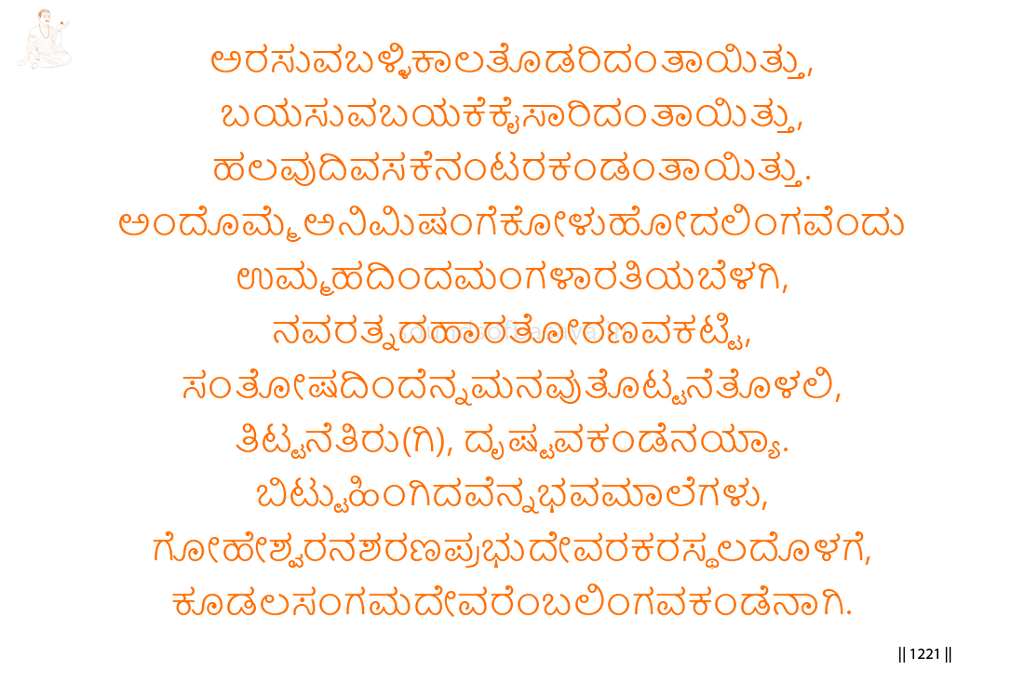
Basavanna describes a search obstructed like feet entangled by a creeper. The object of longing finally comes within reach, and after many days it is found.
In exultation, he lights the Mangalarati and adorns the occasion with a necklace and festoon of nine jewels. Touched by joy, his mind sways, turns suddenly, and beholds the vision.
His garlands of bhava recede. Within the karasthala of Sharana Prabhudeva of Goheshwara, Basavanna sees the Linga called Kudalasangama Deva.
Imagery & Symbolic Relevance
The opening image joins seeking with a creeper entangling the feet.
A creeper winds itself around what it touches. The one who wishes to move forward finds the feet caught and the journey delayed. Basavanna’s seeking is therefore presented neither as effortless progress nor as a straight path.
The image preserves both longing and obstruction. The seeker continues to search, but the very path of searching becomes entangled.
The second line brings the desired object into relation with the hand and its reach. What had remained the object of longing now appears to come within grasp.
The movement is important: the first line shows impeded feet; the second brings fulfilment near the hand. What could not be reached through prolonged movement is suddenly brought close.
Basavanna then says that it was like finding something after many days. The length of the waiting makes the moment of recognition more intense. The vision is neither casually obtained nor immediately available at the beginning of the search.
The source next invokes Animiṣa and Linga before entering the ceremonial images. The expression is compact, and Animiṣa must remain a source-given name or designation rather than being reduced automatically to a general phrase such as “unblinking awareness.”
The Mangalarati is the first act of celebration.
Light is raised before the revealed Linga. The prolonged search now becomes worshipful recognition. Basavanna does not merely say that he understood something inwardly; he responds through a concrete sacred action.
The navaratna necklace and festoon enlarge the ceremonial scene.
A necklace adorns the revealed presence, while a festoon marks and beautifies the place of celebration. The nine jewels belong to the source’s visible richness; the vachana does not separately assign a doctrine or spiritual faculty to each jewel.
The next movement takes place within Basavanna’s mind.
Joy touches it. The mind sways, then turns suddenly. These verbs preserve movement rather than static contemplation. The long search, the nearness of fulfilment, and the acts of celebration gather into a sudden change of inward orientation.
Basavanna then says that he saw the vision.
The seeing follows the exact sequence of longing, delay, celebration, joy, swaying, and turning. The vision is the culmination of the movement rather than an abstract statement placed before it.
The garlands of bhava then leave and recede.
Earlier, a garland adorned the sacred occasion. Now a different kind of garland—the garlands of bhava—falls away. The imagery therefore contains a deliberate contrast:
the navaratna garland is placed in celebration;
the garlands of becoming recede from Basavanna.
The source does not enumerate the individual bhavas. Their force lies in the image of successive formations or conditions that had hung around the speaker like garlands and now withdraw.
The final and governing image is the karasthala of Sharana Prabhudeva.
Karasthala is the palm, the immediate place in which Linga is held and revealed. The vision does not occur in an unnamed distant realm.
Prabhudeva is identified through Goheshwara. Within this Sharana’s palm, Basavanna beholds the Linga called Kudalasangama Deva.
The complete movement is therefore from obstructed seeking to nearness, from prolonged waiting to ceremonial joy, from the mind’s sudden turning to vision, from the recession of bhava-mālas to the direct seeing of Kudalasangama Deva in Prabhudeva’s palm.
Lingayoga
In Lingayoga, seeking may involve delay, obstruction, and longing. These do not become the final measure of the path.
The Mangalarati, necklace, and festoon show that embodied worship remains fully present at the moment of revelation. Outward sacred action and inward seeing are not set against one another.
The decisive relation is also mediated through the realized Sharana. Basavanna sees Kudalasangama Deva within Prabhudeva’s karasthala. Linga-vision is therefore inseparable from reverence for the living field of Sharana-realization.
As the vision becomes direct, the accumulated bhava-mālas recede. What remains is not Basavanna’s claim of attainment, but the Linga revealed in the palm of Prabhudeva.
Editorial Commentary
The opening balli means creeper or climbing vine. Together with kāla toḍari, it creates the image of the feet becoming entangled during the search.
Bayake means desire or longing. The following expression brings what is longed for into the field of the hand or immediate reach.
Animiṣa is retained as a source-given designation. The compact grammar does not justify replacing it entirely with the abstract phrase “unblinking awareness.”
Ummāha indicates exultation, enthusiasm, or overflowing devotional excitement.
Mangalarati is the auspicious offering of light.
Navaratna hāra-toraṇa refers to a necklace or garland and a ceremonial festoon of nine jewels. The nine are not individually interpreted in the Kannada.
The mind is first touched by joy, then sways and turns suddenly before the vision is seen. This order should remain intact.
Bhava-mālegalu means garlands or successive formations of bhava. The source states that they leave and recede without enumerating them.
Karasthala means the palm or the sacred field of the palm in which Linga is held.
The closing line states directly that Basavanna saw the Linga called Kudalasangama Deva within the karasthala of Sharana Prabhudeva of Goheshwara.
Related Vachana
Supporting Vachana
Sharana Sthala Vachana 892 — Where the Mind and Body Find Their True Abode
In Sharana Vachana 892, Basavanna’s former body–mind arrangement is unsettled by the presence of the great Sharanas. His body is drawn toward Allama, his mind toward Chennabasavanna, and he asks where he himself can remain before Kudalasangama Deva.
It prepares Vachana 1009 by showing the seeker losing his former independent ground before realized Sharana-presence. In Vachana 1009, that sacred disorientation ripens into direct vision: within Prabhudeva’s palm, Basavanna beholds the Linga called Kudalasangama Deva.
Advancing Vachana
Aikya Sthala Vachana 1084 — The Revelation Within the Karasthala
Vachana 1084 reverses and expands the vision of Vachana 1009. Here Basavanna beholds Kudalasangama Deva within the karasthala of Prabhudeva. Later, within the Karasthala-Linga, he beholds Allama Prabhu, Chennabasavanna, and Madivala Machideva.
The later vision removes the distinction between inner and outer and ends in repeated gratitude for the purification received through Kudalasangama Deva’s Sharanas. Thus the revelation of Linga in the Sharana’s palm advances into the revelation of the Sharanas within Linga.
