

Summary
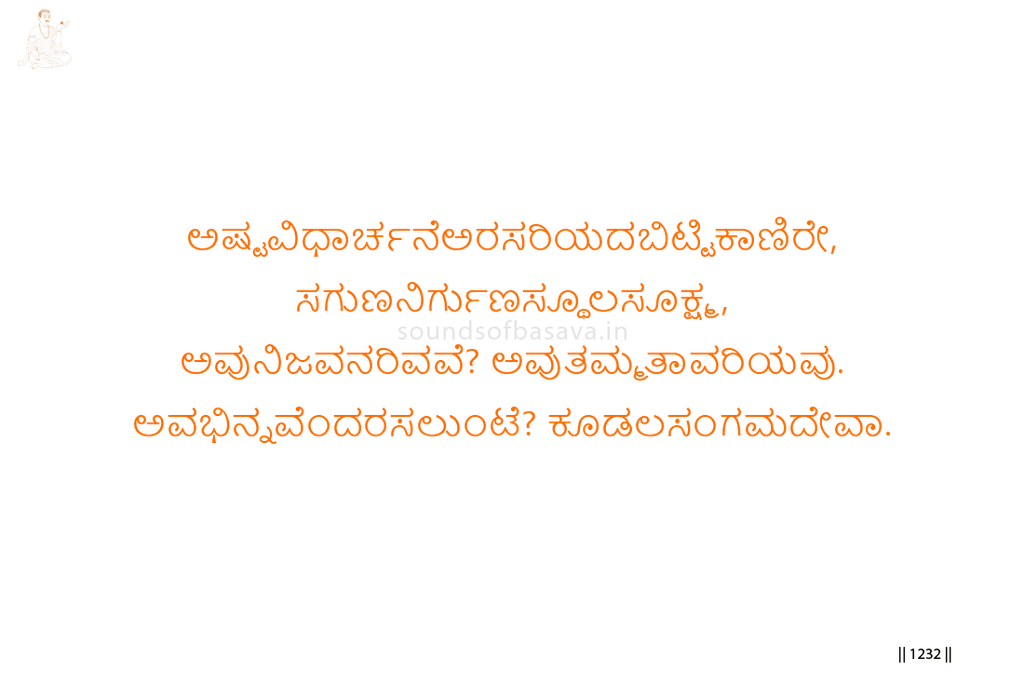
Basavanna asks the seeker not to abandon the Eightfold Worship and become occupied with arguments about Saguna and Nirguna, or gross and subtle.
These distinctions help describe different ways in which the Divine is approached and experienced. The error begins when they are treated as separate and competing realities.
Saguna is not cut off from Nirguna, nor is the subtle independent of the gross. Each is present within the other. Their apparent division disappears when their common ground is recognized in Kudalasangama Deva.
Imagery & Symbolic Relevance
The Eightfold Worship gives the practical foundation of the vachana.
Basavanna does not ask the seeker to reject worship. He asks what is gained by setting aside lived practice and becoming absorbed in classification. Worship should lead to direct understanding, not merely to debate.
Saguna refers to the Divine known through qualities, form, name, and expression. Nirguna refers to the Divine beyond limiting qualities and form.
The mind may place them against each other and ask which is true. Basavanna questions this division. The Divine with attributes does not belong to one reality while the Divine beyond attributes belongs to another.
The pair sthūla and sūkṣma gives the same teaching through gross and subtle experience. The gross is what appears in visible or embodied form; the subtle is what is inward and less directly visible.
Basavanna asks whether these categories themselves know the Real. A word or classification can describe an aspect of experience, but it cannot replace direct recognition.
The statement that “each rests within itself” shows their interrelation. The subtle is present within the gross, while the gross gives expression to the subtle. Saguna reveals Nirguna, and Nirguna is not absent from Saguna.
The final question—whether they can truly be separated—gives the conclusion. The distinctions may be useful for understanding, but they should not become divisions within the Divine.
The movement is therefore clear: retain worship, recognize the value of the categories, refuse to turn them into opposing truths, and see their common ground in Kudalasangama Deva.
Lingayoga
In Lingayoga, practice must not be replaced by argument.
The seeker may worship the Linga through visible form while recognizing that the Divine is not limited to that form. Likewise, subtle inward experience should not lead to rejection of embodied worship.
The practical discipline is to use distinctions without becoming divided by them. Form and formlessness, gross and subtle, should support recognition rather than create rivalry between paths or modes of worship.
Editorial Commentary
The Eightfold Worship is not criticized in this vachana. Basavanna’s concern is the abandonment of lived worship in favour of intellectual division.
Saguna and Nirguna, and gross and subtle, are presented as related expressions rather than mutually exclusive realities. “Each rests within itself” should therefore not be read as complete separation; the concluding question directly challenges such separation.
Related Vachana
Supporting Vachana
Sharana Sthala Vachana 1390 — Beyond the Conflict of Form and Formless
In Sharana Vachana 1390, Basavanna confesses that he searched for the Formless by assuming it was absent from Form. This divided understanding made him wander and become weary. He therefore asks to become established in true devotion, where confusion between Form and Formless ends.
This prepares Vachana 1026 directly.
Vachana 1390 reveals the personal difficulty created by separating Form from Formless. Vachana 1026 broadens that correction to Saguna and Nirguna, and to gross and subtle.
What appears in Sharana as weariness caused by divided seeking matures in Aikya as clear recognition: worship need not choose one side and reject the other, because the apparent opposites cannot finally be separated in Kudalasangama Deva.
Advancing Vachana
Aikya Sthala Vachana 1032 — Beyond Coming and Going
Vachana 1026 shows that particular divisions—Saguna and Nirguna, gross and subtle—do not divide the Real.
Vachana 1032 carries this further by refusing the broader opposing categories of perishing and remaining, presence and absence, and the two sides of every distinction. Reality is described as free from fragments and division, and it cannot be grasped merely through attachment to a sacred word or devotional feeling.
The continuation is precise. Vachana 1026 reconciles specific modes of worship and experience. Vachana 1032 moves beyond the entire habit of enclosing Reality within paired conclusions.
Thus the recognition that Saguna and Nirguna cannot be separated deepens into freedom from every framework that divides Kudalasangama Deva into opposing sides.
