

Summary
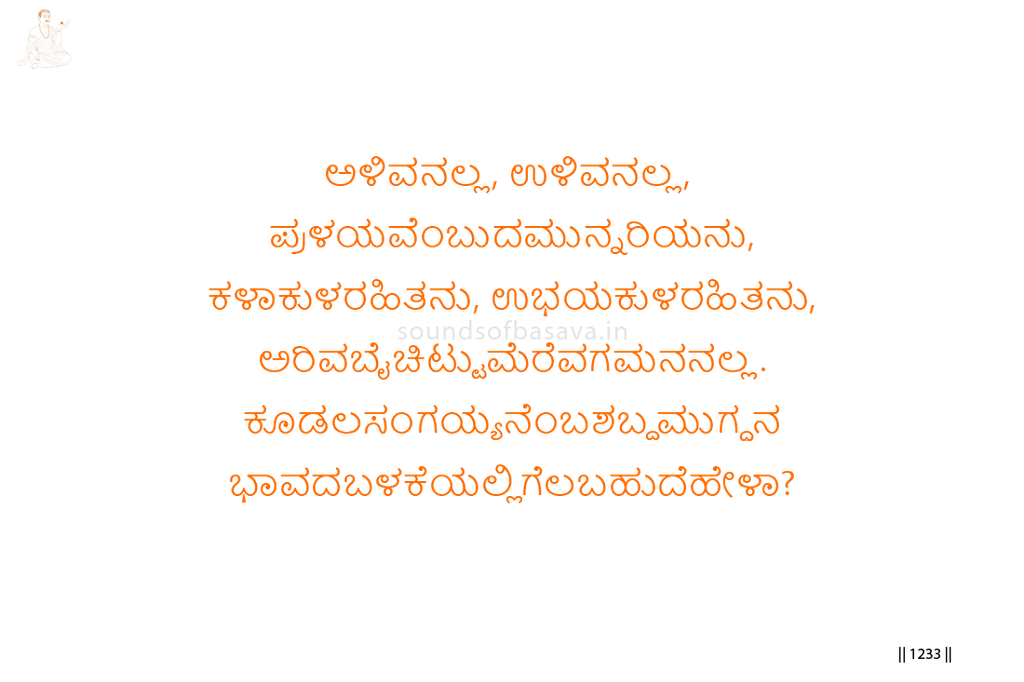
Basavanna removes the two ordinary ways of describing Reality. It cannot be called something that perishes, but neither can it be described merely as something that remains.
It stands prior even to Pralaya, the dissolution in which worlds and forms disappear. It is free from fragments, divisions, and both sides of every opposition. It is not a movement that wanders somewhere outside awareness.
The closing question gives the vachana its decisive warning. Sacred speech and devotional feeling may point toward Kudalasangama Deva, but fascination with the word “Kudalasangama” cannot itself become realization. The Name must lead beyond verbal enchantment into direct recognition.
Imagery & Symbolic Relevance
The opening statement, “It does not perish,” removes destruction as a final description of Reality. What Basavanna indicates is not something produced in time and therefore subject to disappearance.
The following statement, “It does not remain,” immediately prevents the opposite conclusion. Reality is not merely an everlasting object that continues unchanged while other things disappear.
The two statements must be read together. Basavanna does not permit the mind to choose either destruction or persistence and call that the final truth.
The reference to Pralaya deepens this movement. Pralaya is the dissolution in which manifested worlds and forms disappear. Yet the Reality indicated here is not simply something that survives such dissolution. It is prior to the very distinction between arising and disappearing.
“Free from fragments” removes every attempt to divide Reality into separate parts. It cannot be assembled, measured, or understood as a combination of distinct elements.
“Free from both sides” removes attachment to opposing categories. Existence and non-existence, presence and absence, coming and going, creation and dissolution cannot contain it.
The statement that it is not a movement wandering outside awareness corrects the tendency to search for Reality as something distant. Basavanna does not direct the seeker toward another place or an external object. The search that moves away from awareness cannot reach what is never outside it.
The final phrase, śabda-mugdha, refers to becoming enchanted by words. The sacred Name may be repeated with devotion, and strong feeling may arise around it, but neither verbal fascination nor devotional emotion can be mistaken for realization.
The source gives a clear distinction: repeating the word “water” does not quench thirst. In the same way, speaking the Name is not identical with directly realizing the presence to which the Name points.
Basavanna therefore does not reject the Name of Kudalasangama Deva. He rejects stopping at the word. He also does not reject devotional feeling; he questions whether feeling alone can attain what lies beyond every division.
The movement of the vachana is precise: destruction and persistence are removed, opposing categories fall away, the outward search is stopped, and sacred word and feeling are tested against direct realization.
Lingayoga
In Lingayoga, remembrance of the Linga must not remain verbal repetition alone. The Name should gather awareness toward the presence it indicates.
The seeker should also avoid trying to grasp Reality through opposing conclusions such as “it exists” or “it does not exist.” Such conclusions continue the very division that the vachana removes.
The practice-point is direct: let sacred speech and devotional feeling lead into undivided awareness. The Name is honoured fully when it no longer remains merely a word, but becomes lived recognition of Kudalasangama Deva.
Editorial Commentary
“It does not perish; it does not remain” should not be read as a denial of Reality. The two statements remove inadequate and opposing descriptions.
The reference to Pralaya should remain restrained. Its purpose is to show that Reality is prior to arising and dissolution, not to introduce an additional cosmological system.
The warning against śabda-mugdha does not belittle the sacred Name. It distinguishes the Name from fascination with the Name. Likewise, devotional feeling is not rejected; the error lies in treating feeling as completed realization.
Related Vachana
Supporting Vachana
Sharana Sthala Vachana 512 — Show Me Those Who Live Your Dharma
Sharana Vachana 512 asks that conduct, mind, knowledge, inward feeling, and devotion become lived Dharma. When they remain only subjects of speech, they do not establish true knowledge of Kudalasangama Deva.
This prepares Vachana 1032 directly. In the Sharana vachana, speech, knowledge, feeling, and devotion are tested by whether they have become actual life. In Vachana 1032, even the sacred word “Kudalasangama” and the feeling attached to it are tested by whether they have become direct realization.
The movement from Sharana to Aikya is therefore clear: words must first become lived Dharma; then even attachment to sacred expression must fall away before undivided recognition.
Advancing Vachana
Aikya Sthala Vachana 1415 — One Moment of Living Experience
Vachana 1032 removes the mistaken belief that sacred language and devotional emotion can substitute for realization.
Vachana 1415 gives the positive completion of this correction. It places even one moment of living experience with Kudalasangama Deva’s Sharanas above accumulated austerity, repeated Linga worship, Guru-service, and Jangama-satisfaction.
The connection is exact. Vachana 1032 exposes verbal and emotional fascination without realization; Vachana 1415 shows the incomparable value of direct Anubhava. The word that points toward Reality reaches fulfilment only when it becomes living experience.
