

Summary
Basavanna describes a state in which the divisions that previously governed spiritual life no longer stand apart.
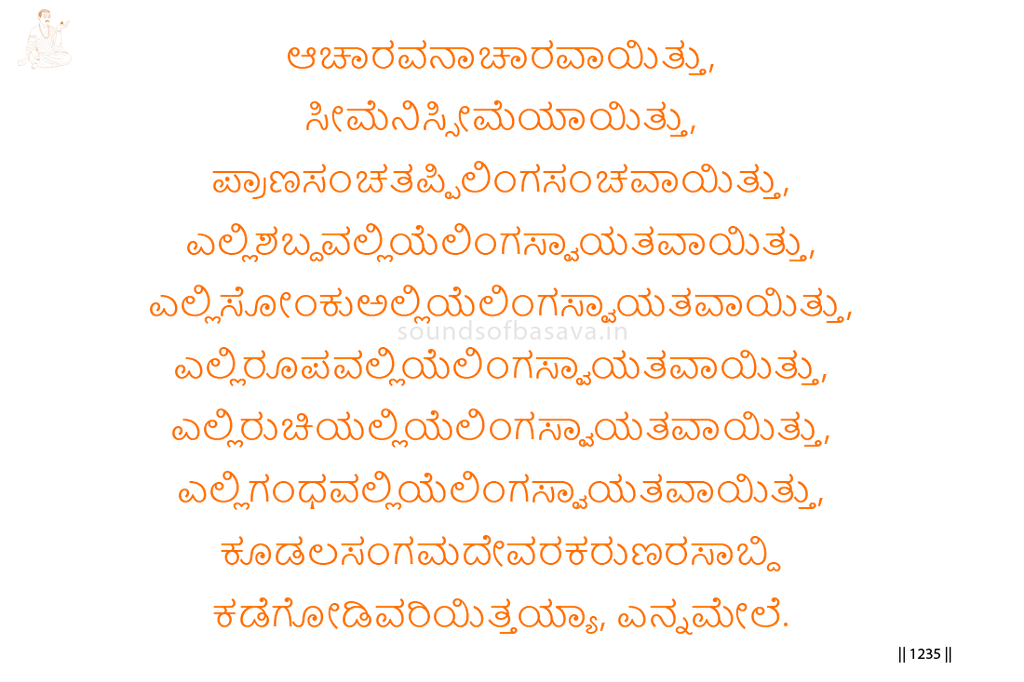
Achara and Anachara, boundary and boundlessness, cease to appear as separate fields. Personal life-movement gives way to Linga-movement.
Sound, touch, form, taste, and fragrance no longer draw awareness away from the Divine. Wherever each sensory experience occurs, Linga is present there.
Basavanna does not claim this transformation as his achievement. The ocean of Kudalasangama Deva’s compassion breaks its bounds and pours over him, filling his entire experience with Linga.
Imagery & Symbolic Relevance
The opening expression brings Achara and Anachara together.
Achara is conduct aligned with the sacred relation; Anachara is conduct outside that alignment. During spiritual discipline, this distinction is necessary because it guides the seeker’s actions.
Here Basavanna speaks from a state in which conduct no longer has to be externally divided and managed. The movement of Linga has become so complete that right conduct arises naturally.
This does not make right and wrong behaviour equal. It means that the separate person who repeatedly chooses between two opposing directions no longer governs the action. Life moves from within Linga-awareness.
The next pair is boundary and boundarylessness.
A boundary marks where one thing ends and another begins. Boundarylessness removes such separation. Basavanna says that the distinction itself has dissolved.
There is no longer one limited region called ordinary life and another unlimited region called the Divine. The whole field of experience is permeated by Linga.
The movement from Prana-sanchara to Linga-sanchara forms the centre of the vachana.
Prana-sanchara is life experienced as “my breath, my movement, and my existence.” When this personal claim falls away, breathing and living do not stop. Their meaning changes.
Life is no longer felt as an independent movement belonging to the individual. It is experienced as Linga-sanchara—the movement of Linga.
Basavanna then names the five sensory fields one by one.
Wherever there is sound, Linga is present. Hearing no longer leads awareness away into a separate object.
Wherever there is touch, Linga is present. Contact is no longer divided into the one who touches and something wholly outside.
Wherever there is form, Linga is present. What is seen is not treated as a world standing apart from the Divine.
Wherever there is taste, Linga is present. Even the intimate experience of receiving and tasting is included within Linga-awareness.
Wherever there is fragrance, Linga is present. The most subtle sensory contact is also gathered into the same recognition.
The repetition of “wherever” is important. Basavanna does not select only pleasant, sacred, or ritual experiences. No sensory field remains outside Linga-sanchara.
The final image is the ocean of compassion.
An ocean cannot be contained within a small measure. When it breaks its bounds, it covers everything before it.
Basavanna says that Kudalasangama Deva’s ocean of compassion has overflowed upon him. He does not rise through his own power and capture this realization. Compassion comes over him and fills the whole field of life.
The movement is therefore from the ending of divided categories, to the ending of personal life-claim, to Linga recognized through every sense, and finally to the flood of Divine compassion that makes this possible.
Lingayoga
In Lingayoga, the senses are first disciplined so that they do not scatter awareness.
This vachana reveals their fulfilled condition. Sound, touch, form, taste, and fragrance are no longer experienced apart from Linga.
The practical movement is not to chase sensory pleasure or reject sensory life. It is to remove the separate claim through which perception becomes “my experience of an outside object.”
When Prana is no longer privately possessed, ordinary living becomes Linga-sanchara. Perception then remains within the Divine relation instead of carrying awareness away from it.
Editorial Commentary
The joining of Achara and Anachara describes the end of divided action in the realized state. It does not erase ethical discernment in ordinary life.
Prana-sanchara and Linga-sanchara refer to two ways of experiencing the same living movement: first as personally owned life, and then as the movement of Linga.
The repeated sensory sequence must remain complete: sound, touch, form, taste, and fragrance. Together they show that no field of perception remains excluded.
The final transformation belongs to Kudalasangama Deva’s compassion, represented by the overflowing ocean.
Related Vachana
Supporting Vachana
Sharana Sthala Vachana 430 — The Consecration of Perception
Sharana Vachana 430 turns the senses deliberately toward Jangama. The eyes are nourished by seeing Jangama, the ears by hearing Jangama, the faculty of smell by receiving Jangama, and the tongue by speaking of Jangama.
The vachana then extends this consecration into protection, love, and the offering of all possessions to Kudalasangama Deva’s Sharanas.
This prepares Vachana 1035 directly.
In Sharana Sthala, the senses are consciously directed toward living sacred presence. Seeing, hearing, smelling, and speaking are trained not to remain private or scattered activities.
In Aikya Vachana 1035, this discipline reaches fulfilment. Linga is no longer known only when the senses are directed toward a particular sacred object. Wherever sound, touch, form, taste, or fragrance occurs, Linga is recognized there.
The Sharana consecrates perception; in Aikya, perception itself has become Linga-sanchara.
Advancing Vachana
Aikya Sthala Vachana 1036 — The Sharana as Living Worship
Vachana 1035 shows that every sensory field has become filled with Linga through Kudalasangama Deva’s compassion.
Vachana 1036 carries this recognition into the whole life of the Sharana. When the Sharana knows the truth of the Self and knows Linga as the Supreme Self, no separate worship remains to be performed.
Whatever the Sharana enjoys is Shivarpita; whatever he tastes is Prasada; whatever he knows is Parabrahman; and whatever he speaks is Paratattva. The vachana concludes that the Sharana himself is Kudalasangama Deva.
The continuation is immediate. Vachana 1035 transforms perception: everything heard, touched, seen, tasted, and smelled reveals Linga.
Vachana 1036 transforms the one who perceives. Enjoyment, reception, knowledge, and speech become sacred expressions, and the Sharana no longer stands apart as an individual worshipper.
Thus the Linga-sanchara revealed through all experience in Vachana 1035 matures into the Sharana’s entire life becoming living worship.
