

Summary
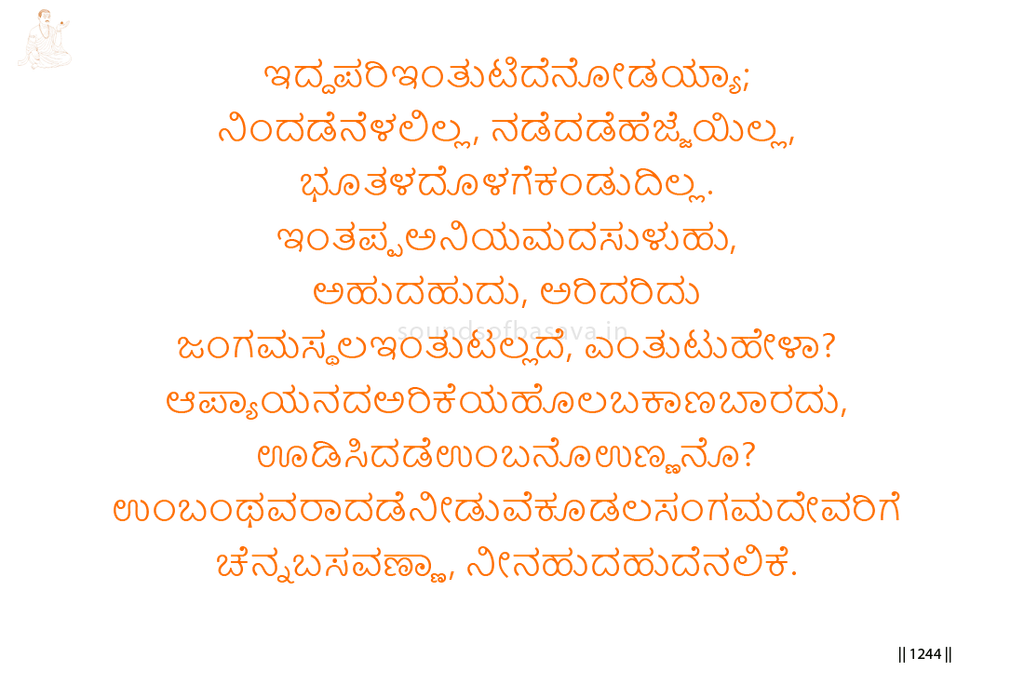
Basavanna describes Jangamasthala as a condition that cannot be identified through outward signs. When it stands, it casts no shadow; when it walks, it leaves no footprint; and nowhere on earth can it be pointed out as an object.
Yet this does not mean that it is absent. Its presence becomes known through living Dasoha—when one is nourished, another gives, and another receives. In that movement, Kudalasangama Deva is present.
Basavanna concludes by addressing Chennabasavanna as the one who has shown him this hidden truth: the traceless reality of Jangamasthala becomes evident through selfless giving and receiving.
Imagery & Symbolic Relevance
The vachana begins with the command, “Look, it is like this.”
Basavanna is pointing toward a condition that cannot be fully described. He therefore uses three simple images: standing, walking, and being seen upon the earth.
When it stands, there is no shadow. A shadow is an outward sign that something occupies a particular place. Here, no such sign is available.
When it walks, there is no footprint. A footprint allows someone to trace where another has travelled. Jangamasthala leaves no mark through which its movement can be followed or measured.
The statement that it cannot be seen anywhere upon the earth completes the sequence. It cannot be located as one visible object among other objects.
These images do not say that the Jangama is physically invisible. They show that the realized condition cannot be judged by appearance, movement, reputation, display, or other external evidence.
Basavanna calls this an extraordinary trace or sign. It appears to say both “it is” and “it is not.” Its reality is certain, but it cannot be contained within the usual means of recognition.
He therefore asks, “If this is not Jangamasthala, what else can it be? How else can it be spoken of?”
The questions acknowledge the limit of explanation. Jangamasthala can be lived and recognized, but it cannot be reduced to a fixed definition.
The vachana then turns from what cannot be seen to what can be experienced.
The sign of its fullness cannot be discovered through observation. Yet when nourishment passes from one to another—when one is fed, another feeds, and another receives—the hidden presence becomes evident.
This is the practical centre of the vachana. The traceless reality is not proved through miraculous signs. It becomes known through Dasoha, where nourishment is offered and received without division.
The giver does not stand separately as a benefactor, and the receiver is not treated as inferior. The act joins them in one movement of sustaining life.
Basavanna recognizes Kudalasangama Deva within this exchange. The Lord is not merely watching the act from elsewhere; His presence is known in the giving, feeding, and receiving.
The final address to Chennabasavanna is essential. Basavanna does not claim to have understood this mystery by reasoning alone. Chennabasavanna has shown him how the invisible truth of Jangamasthala becomes visible in living relationship.
The complete movement is therefore from the absence of shadow, footprint, and visible mark to the unmistakable presence of Kudalasangama Deva in Dasoha.
Lingayoga
In Lingayoga, the condition of a Sharana cannot be measured through appearance, claims, unusual behaviour, or public recognition.
The true measure is found in living conduct. Where giving and receiving occur without pride, possession, or separation, Jangama-presence becomes known.
The seeker must therefore avoid searching for external signs of realization. Attention should be given to whether awareness has become compassion, nourishment, service, and selfless participation.
Dasoha becomes more than the transfer of food or possessions. It is the field in which the distinction between giver and receiver begins to disappear.
Editorial Commentary
The absence of shadow and footprint expresses the absence of an outwardly measurable sign. The images should remain concrete and should not be enlarged into a physical claim about invisibility.
The phrases “it is” and “it is not” describe the difficulty of defining Jangamasthala. Its presence is real, though it cannot be treated as an object.
The final feeding sequence must remain central. The vachana moves from the untraceable condition to its practical recognition through nourishment, giving, and receiving.
Chennabasavanna is the person through whom this understanding is revealed and should not be reduced to a general symbol.
Related Vachana
Supporting Vachana
Sharana Sthala Vachana 1058 — Life Through the Presence of Chennabasavanna
Sharana Vachana 1058 says that even the realms and splendour associated with Indra, Upendra, and Chandramauli cannot free the seeker while the bondage of becoming remains. If that bondage is not broken, even the search for liberation may produce another identity or “another face.”
Basavanna then declares that he has truly lived through the presence of Chennabasavanna. Heavenly attainment is replaced by living nearness to the realized Sharana.
This directly prepares Vachana 1059. In the Sharana vachana, Chennabasavanna’s presence gives Basavanna true life beyond repeated becoming. In the Aikya vachana, Chennabasavanna reveals the deeper nature of that presence as traceless Jangamasthala.
What first appears as life received through the Sharana’s presence matures into recognition of Kudalasangama Deva within the living exchange of Dasoha.
Advancing Vachana
Aikya Sthala Vachana 1162 — The Giver and the Receiver Are Kudalasanga
Vachana 1059 shows that the unseen fullness of Jangamasthala becomes known when one is nourished, another gives, and another receives.
Vachana 1162 makes the meaning of that exchange explicit. The giver is Kudalasanga, the receiver is Kudalasanga, and Kudalasangayya alone gives throughout the three worlds. Human beings therefore cannot proudly claim, “We are the givers.”
The continuation is precise. Vachana 1059 reveals Divine presence within the act of nourishment. Vachana 1162 removes the remaining ownership of that act.
The traceless presence becomes fully understood when giver, receiver, and the power of giving are all recognized as Kudalasangama Deva’s own movement.
