

Summary
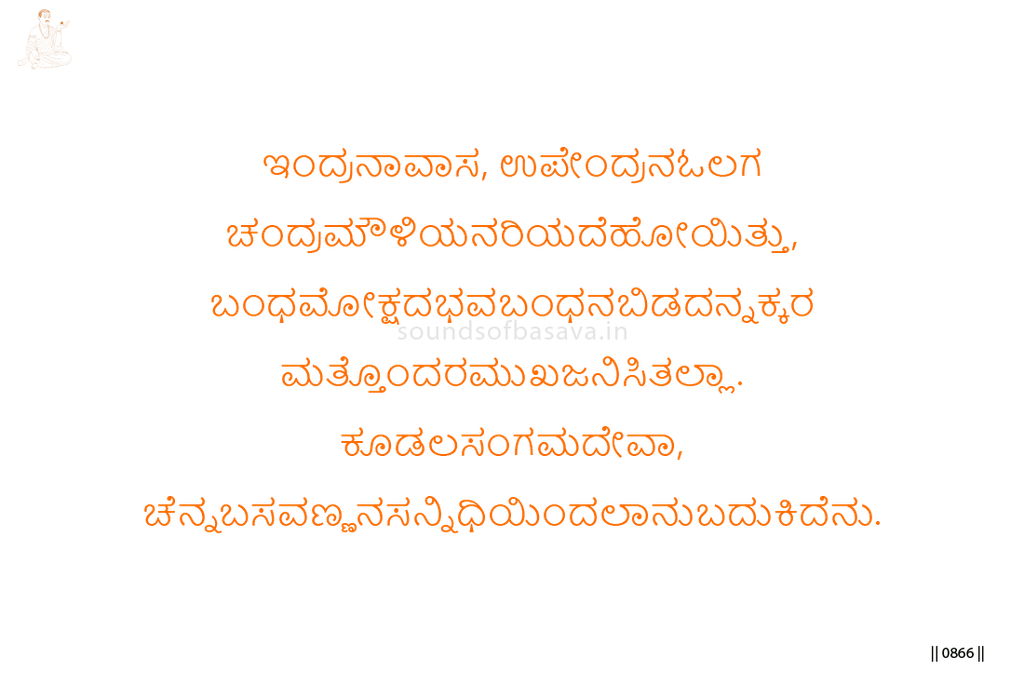
Basavanna sets aside even the highest celestial attainments. The dwelling of Indra, the glory of Upendra, and the splendor of Chandramauli pass away unrecognized when the deeper bondage of becoming remains unbroken. Heavenly greatness, divine status, and exalted worlds do not by themselves end bondage.
The central warning is that if bhava-bandhana is not cut, even the movement between bondage and liberation can give rise to another face, another birth, another form of becoming. The problem is not merely earthly life, but the continuing root of identity that seeks to become something.
Against this, Basavanna names the transforming presence of Chennabasavanna. He does not say that he truly lived through celestial attainment, ritual status, or conceptual knowledge. He says he lived through Chennabasavanna’s sannidhi.
Thus the vachana moves from heavenly insufficiency to living realization. What passes cannot be final refuge. What creates another face cannot be liberation. True life begins through the presence of the realized Sharana, fulfilled in Kudalasangama Deva.
Imagery & Symbolic Relevance
The first image is Indra’s dwelling. Indra represents celestial sovereignty and heavenly splendor. Basavanna names this high attainment only to show that even such greatness is not ultimate.
The second image is Upendra’s glory. Upendra evokes divine majesty and preservation. Yet this too is placed within what passes. Sacred grandeur itself does not break the root of becoming if it remains a state to be attained.
The third image is Chandramauli’s splendor. Chandramauli, Shiva adorned with the crescent moon, suggests luminous divine radiance. Basavanna does not deny its sanctity. He says that even such splendor becomes insufficient if bhava-bandhana is not broken.
The next image is the bondage of becoming. This is deeper than ordinary attachment. It is the tendency to continue through identity, state, form, and self-continuation. Even the language of liberation can become another face if the root of becoming remains active.
The phrase “another face” is important. It shows that bondage does not always return in the same form. It can reappear as a new identity, a new attainment, a new spiritual self-image, or another birth.
The final image is Chennabasavanna’s presence. Sannidhi is not mere physical nearness. It is living realized proximity, the field in which life becomes true. Basavanna’s declaration, “through Chennabasavanna’s presence I have lived,” gives the vachana its center.
Lingayoga
In Lingayoga, this vachana teaches that the seeker must not confuse exalted states with release from becoming. Heavenly realms, divine honors, and subtle spiritual attainments remain secondary if the root of bhava-bandhana is still intact.
Arivu appears as discrimination between passing attainment and living realization. The seeker learns that the measure is not celestial height, but whether bondage has actually loosened.
For Sharana Sthala, the practice-point is direct: seek the living presence that breaks the habit of becoming. Chennabasavanna’s sannidhi is not treated as optional companionship. It is the field through which Basavanna says he truly lived before Kudalasangama Deva.
Editorial Commentary
The divine names should be handled with restraint. Basavanna is not dismissing Indra, Upendra, or Chandramauli as meaningless. He is showing that even the highest sacred attainments cannot replace release from bhava-bandhana. The center of the vachana is Chennabasavanna’s living presence as the means through which true life begins.
Related Vachana
Supporting Vachana
Pranalingi Sthala Vachana 1004 — Chennabasavanna Revealed the Hidden Fire
Pranalingi Vachana 1004 supports this teaching by showing Chennabasavanna as the one who reveals the hidden fire, brings Sujñāna-Linga into living reception, establishes it throughout the whole being, shows the path of continuous true Linga-union, and gives meaning to Basavanna’s coming into the mortal world. This prepares Vachana 1058 directly. In Vachana 1004, Chennabasavanna awakens and establishes the living Linga within; in Vachana 1058, Basavanna says that through Chennabasavanna’s presence he has truly lived, beyond celestial attainments and the repeated faces of becoming.
Advancing Vachana
Aikya Sthala Vachana 1059 — The Trace That Cannot Be Traced
Aikya Vachana 1059 advances this teaching by showing the mystery of Jangamasthala beyond ordinary signs. It leaves no shadow, no footprint, and no visible mark, yet becomes known in the living movement of feeding, being fed, and receiving; Chennabasavanna alone is named as the one who showed that this is so. This is the natural Aikya fulfillment of Vachana 1058. In Sharana Vachana 1058, true life begins through Chennabasavanna’s presence; in Aikya Vachana 1059, that presence opens into the traceless fullness of Jangamasthala, where realization is no longer a heavenly state or another form of becoming, but the living flow of Kudalasangama Deva.
