

Summary
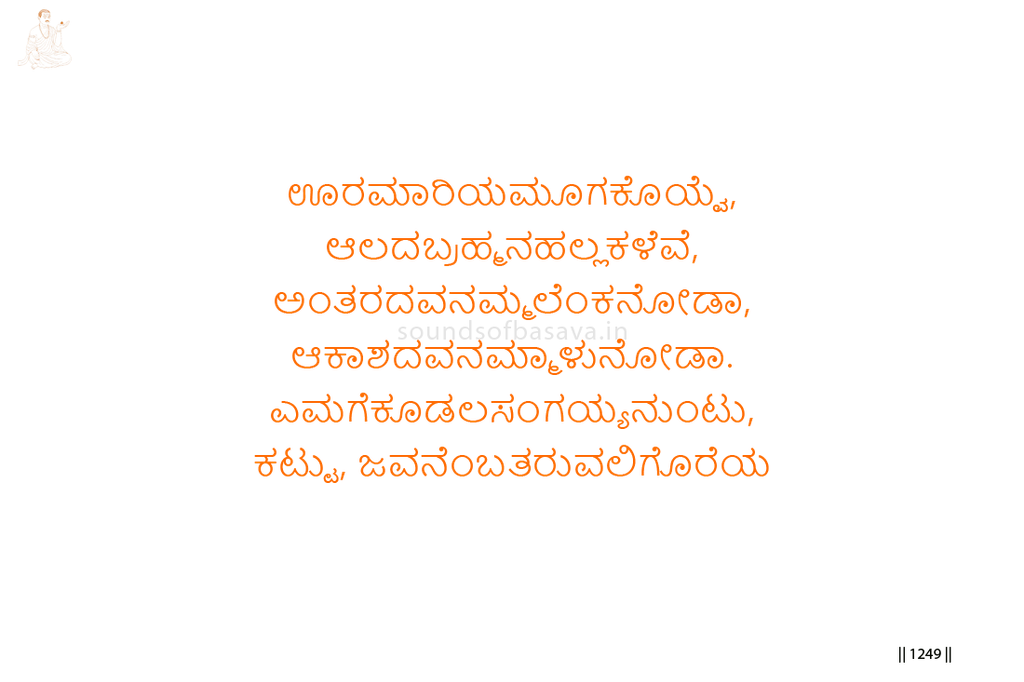
Basavanna speaks with fearless confidence because Kudalasangama Deva is both inwardly present and all-pervading.
He uses forceful language about Māri and Brahma to declare that no external deity or cosmic authority can stand above the Lord in whom the Sharana has taken refuge.
Kudalasangama Deva is the champion within and the sovereign who fills the sky. Therefore, the noose that binds and the staff that punishes cannot become the Sharana’s final fear.
The source of fearlessness is not personal strength. It is the certainty expressed in the words, “For us, there is Kudalasangama Deva.”
Imagery & Symbolic Relevance
The vachana opens with two deliberately forceful statements: Māri’s nose would be cut and Brahma’s teeth would be broken.
These expressions should not be read as instructions for literal violence. They challenge the fear and unquestioned authority attached to these figures.
Māri represents a powerful local or guardian deity before whom people may seek protection out of fear. Cutting the nose is an idiom of humbling pride and removing the power to intimidate.
Brahma represents great cosmic and religious authority. Breaking his teeth similarly declares that even the highest named power cannot threaten the one whose refuge is Kudalasangama Deva.
Basavanna is not simply replacing one deity with another in a contest of strength. He is exposing the devotee’s divided dependence. When fear arises, does the mind seek many powers, or does it remain established in Kudalasangama Deva?
The next image gives the inward answer: “Look at our champion within.”
A champion is one who stands ready to defend and overcome opposition. Yet this champion is not an external warrior who must be summoned. Kudalasangama Deva is already present within.
The word “our” is also important. Basavanna speaks from the shared confidence of the Sharanas. This is not an isolated boast about his own courage; it is the assurance of a community whose refuge is one.
The following line expands the same presence: “Look at our sovereign who fills the sky.”
The champion within shows intimate nearness. The sovereign filling the sky shows unlimited presence and authority.
Together, the two images remove every possible region of fear. Nothing can attack from within because the champion is there; nothing can rule from outside because the entire expanse belongs to the sovereign.
Basavanna then declares, “For us, there is Kudalasangama Deva.”
The statement is in the present. He does not say that the Lord may come later or protect them in the future. Kudalasangama Deva is already their sufficient refuge.
The noose and staff give the final images.
The noose binds and drags its victim. It can suggest death, fate, karma, or any force that seems to hold life helplessly.
The staff represents command and punishment. It may be the staff of a ruler, judge, or death itself—the power before which ordinary people tremble.
Basavanna asks why these should cause fear when both the inward champion and the all-pervading sovereign are already present.
The question does not deny that death, punishment, or hardship may occur. It denies that any of them possesses final authority over the one who belongs to Kudalasangama Deva.
The movement is therefore from challenging feared powers, to recognizing the champion within, to seeing the sovereign everywhere, and finally to the disappearance of fear before the noose and staff.
Lingayoga
In Lingayoga, the seeker must examine where the mind turns when danger arises.
Worship may be directed toward Linga during peaceful moments, while fear secretly depends upon other powers, social authority, fate, or personal control. This vachana asks that refuge become undivided.
Fearlessness does not mean recklessness or denial of danger. It means that no danger is allowed to become greater than Kudalasangama Deva’s presence.
The practical measure is simple: when threatened by loss, punishment, illness, or death, does awareness remain in the Lord, or does it abandon its declared refuge?
Editorial Commentary
The statements about Māri and Brahma are rhetorical expressions of spiritual fearlessness. They should not be presented as literal hostility toward other worshippers or sacred figures.
The “champion within” should not be turned into personal pride. The strength belongs to Kudalasangama Deva, not to an independent individual.
The noose and staff retain their concrete force as symbols of binding, punishment, and death. The vachana’s conclusion is not that these conditions cease to exist, but that they cease to be ultimate.
Related Vachana
Supporting Vachana
Sharana Sthala Vachana 1113 — The One Protected by the Lord Need Fear Nothing
Sharana Vachana 1113 says that one held by the Lord need not be governed by fear. Town and forest, normally regarded as safety and danger, become secondary. Even subjection to worldly authority cannot determine the devotee’s deepest belonging.
The Sharana does not become fearless because circumstances are under his control. He becomes fearless because his true refuge is Kudalasangama Deva.
This prepares Vachana 1070 directly.
Vachana 1113 removes fear arising from place, circumstance, and political authority. Vachana 1070 carries the same assurance further: even Māri, Brahma, the noose, and the staff cannot become final powers over the devotee.
What begins in Sharana Sthala as steadfast belonging becomes in Aikya the recognition that the Lord is both the champion within and the sovereign of the entire expanse.
Advancing Vachana
Aikya Sthala Vachana 1075 — The Eternal Fragrance
Vachana 1070 asks why the Sharana should fear the noose and staff when Kudalasangama Deva is already present.
Vachana 1075 carries this fearlessness beyond the threat of death. Basavanna says that he knows neither birth nor death as defining realities. If there is birth, it is for receiving the sacred water of the Lord’s feet; if there is death, it is for resting at those feet.
The vachana compares this continuity to a fragrant tree. Whether the tree grows in a village or in a forest, its fragrance remains unchanged. In the same way, the Sharana’s belonging to Kudalasangama Deva remains unchanged through birth, life, and death.
The continuation is precise. Vachana 1070 removes fear of the power that binds or kills. Vachana 1075 goes further by showing that birth and death themselves cannot alter the fragrance of Divine belonging.
Fearless refuge thus matures into uninterrupted nearness to Kudalasangama Deva through every condition.
