

Summary
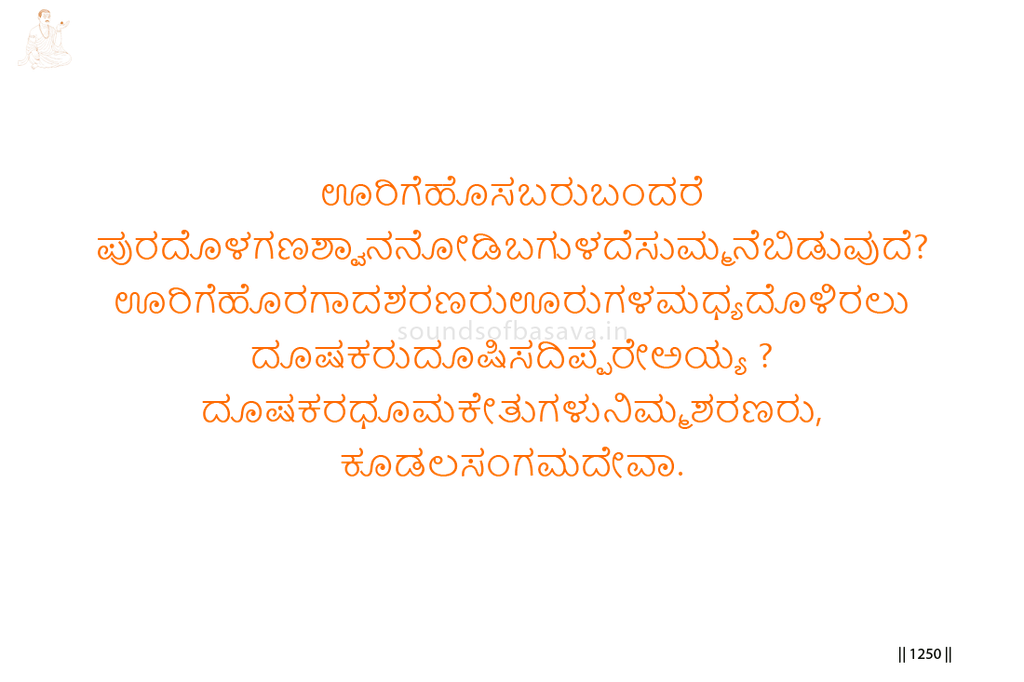
Basavanna compares society’s reaction to a Sharana with street dogs barking when strangers enter a town. The dogs react because the newcomers are unfamiliar.
In the same way, Sharanas who have gone beyond ordinary social habits and expectations are likely to be criticized when they live among conventional society.
Basavanna does not ask the Sharanas to argue with every critic. Criticism appears briefly, like a comet, attracts attention, and passes away. The Sharanas remain steady because their belonging is in Kudalasangama Deva.
Imagery & Symbolic Relevance
The vachana begins with an ordinary scene: newcomers enter a town, and the dogs inside the town begin to bark.
The barking is immediate. The dogs do not first examine whether the newcomers are good or bad. They react simply because something unfamiliar has entered their familiar territory.
Basavanna uses this image to explain the treatment of Sharanas.
The Sharana is described as one who is “outside the town.” This need not mean that the Sharana lives physically outside a settlement. It means that the Sharana has moved beyond the accepted habits, attachments, social measures, and expectations through which ordinary society judges people.
When such a Sharana lives among townspeople, his conduct may appear strange. He does not seek the same approval, possessions, status, or religious recognition that society values.
Fault-finders therefore criticize him. Basavanna’s question—“Will they not criticize?”—expects the answer that they certainly will.
The vachana does not present criticism as proof that the Sharana is wrong. Nor does it require him to silence every opposing voice. It treats criticism as a predictable response to a way of life that society does not understand.
The comparison with dogs should be read with restraint. Basavanna is describing instinctive noise before the unfamiliar; he is not giving the Sharana permission to insult or hate those who criticize him.
The final image is the comet, dhūmaketu.
A comet appears suddenly in the sky, attracts attention, and then disappears. It may be widely noticed for a time, but it does not remain.
The source uses this image to describe the temporary force of criticism. Accusations may become loud, disturb people, and draw public attention, but they do not change the truth of the Sharana’s life.
The Sharana remains because his steadiness does not depend upon public approval. Praise does not create his relation with Kudalasangama Deva, and criticism cannot destroy it.
The complete movement is therefore from the barking of dogs at newcomers, to society’s criticism of unfamiliar Sharanas, and finally to the contrast between passing criticism and the Sharana’s lasting belonging in Kudalasangama Deva.
Lingayoga
In Lingayoga, the seeker should not measure spiritual truth by praise or criticism.
Correction based on truth must be heard with humility. However, the seeker should not become unsettled merely because others misunderstand, mock, or condemn a sincere Linga-centred life.
The practical discipline is to examine one’s conduct honestly, correct what is wrong, and then remain steady without becoming consumed by every hostile voice.
Editorial Commentary
The Sharana being “outside the town” indicates freedom from conventional social conditioning, not necessarily physical separation from society.
The barking-dog image explains an instinctive reaction to what is unfamiliar. It should not be enlarged into contempt for critics.
The comet represents the brief visibility and passing nature of criticism. The central contrast is between temporary public noise and the Sharana’s enduring establishment in Kudalasangama Deva.
Related Vachana
Supporting Vachana
Sharana Sthala Vachana 324 — The Refuge of the Sharanas
In Sharana Vachana 324, Basavanna asks that his mind not be tested at every step and that he not be tormented by being called poor. He then declares that he is not without protection or dignity: the Sharanas of Kudalasangama are his masters.
This prepares Vachana 1071 directly.
In Vachana 324, repeated judgment and humiliation still press upon Basavanna’s mind. His strength comes from remembering that he belongs to Kudalasangama Deva’s Sharanas.
In Vachana 1071, that belonging has become steadiness. Criticism is expected, but it no longer becomes the final measure of the Sharana.
The Sharana teaching gives refuge amid humiliation; the Aikya teaching shows the matured state in which criticism flares and passes without uprooting Divine belonging.
Advancing Vachana
Aikya Sthala Vachana 1341 — Where There Is Slander, There Is No Linga
Vachana 1071 considers criticism directed toward the Sharanas. It teaches that fault-finders may speak loudly, but their criticism is temporary and cannot alter the Sharana’s establishment in Kudalasangama Deva.
Vachana 1341 turns the examination inward. It declares that where Linga is truly present, slander cannot remain; where slander remains, Linga is not established. Kudalasangama Deva’s Sharanas are therefore described as incomparable Lingavantas who do not live through blame and condemnation.
The progression is precise. Vachana 1071 teaches the Sharana not to be disturbed by criticism received from others. Vachana 1341 asks whether the Sharana has removed the tendency to criticize others.
Freedom from being wounded by blame thus matures into freedom from the desire to blame.
