

Summary
In this vachana, Basavanna asks whether one condition can become another merely by remembering it.
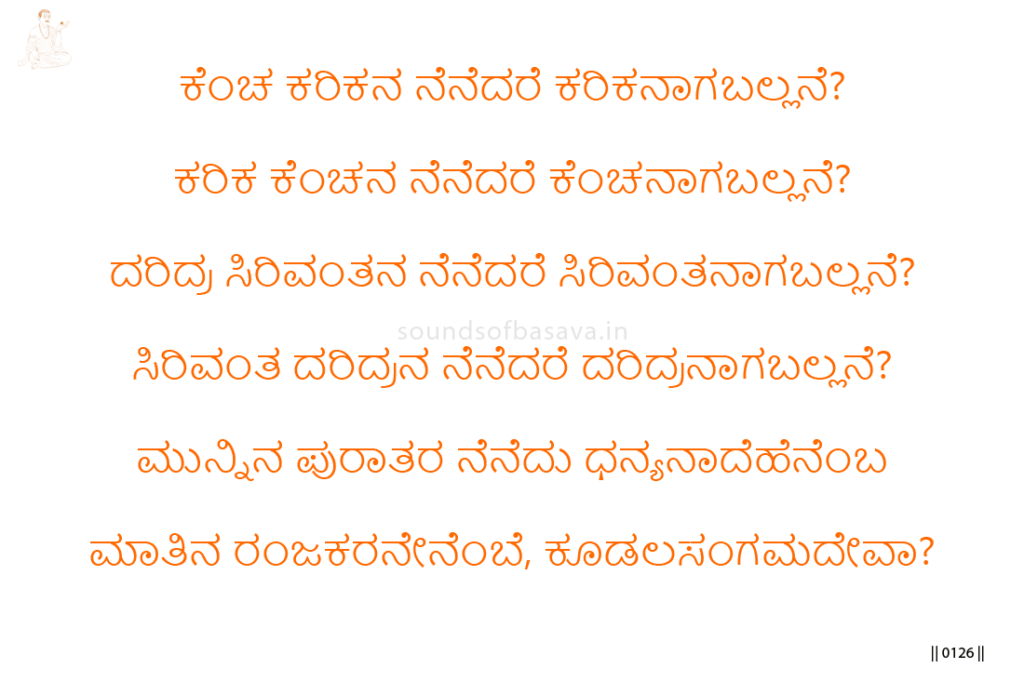
If the black remembers the red, does it become red? If the red remembers the black, does it become black? If the poor remember the wealthy, do they become wealthy? If the wealthy remember the poor, do they become poor?
He then applies the same principle to spiritual identity. Merely remembering the ancient ones and saying, “I am blessed,” does not make one blessed. Basavanna rejects speech that decorates itself with borrowed greatness but lacks real transformation before Kudalasangama Deva.
Imagery & Symbolic Relevance
The contrast between black and red is the first image. One does not become the other by thought or recollection.
Basavanna uses color to show the limits of imagination. A condition is not changed merely because the mind turns toward another condition.
The contrast between poverty and wealth deepens the teaching. A poor person does not become wealthy by thinking of the rich. A wealthy person does not become poor by thinking of the poor.
This shows that remembrance is not attainment.
Basavanna then turns to the ancient ones. To remember earlier greatness, former Sharanas, or revered lineage may have value, but it does not by itself make the present person realized.
The final phrase exposes verbal ornament. Words may claim blessing, tradition, and greatness, but if life has not changed, speech becomes decoration without truth.
The vachana therefore teaches that authenticity cannot be borrowed. What is remembered must become realized; otherwise, it remains only speech.
Lingayoga
In Lingayoga, the Anga must undergo real transformation.
The seeker cannot become established by merely remembering the realized, repeating their names, or claiming relation to them.
Memory may inspire practice, but it cannot replace inner change.
The condition of the seeker must be altered through living relation to Linga. Without that, speech about past greatness remains external.
Practice matures when remembrance becomes realization, and when the seeker’s own life becomes true before Kudalasangama Deva.
Editorial Commentary
This vachana corrects borrowed spiritual identity.
Basavanna does not reject memory, tradition, or reverence for the ancient ones; he rejects the claim that remembering them makes one inwardly transformed.
Related Vachana
Supporting Vachana
Vachana 632 — The Unseen Sun
Vachana 632 teaches that light and sacred sound remain unavailable when the faculty of perception is absent. Vachana 637 continues by showing that memory, thought, and inherited association cannot substitute for actual transformation.
Advancing Vachana
Maheshwara Vachana 634 — The Ancient Path and the Adorned Outsiders
Vachana 637 rejects borrowed identity and speech that claims greatness without inner truth. Maheshwara Vachana 634 advances this into the undefended heart, where the seeker can no longer hide behind memory, lineage, or verbal ornament before Kudalasangama Deva.
