

Summary
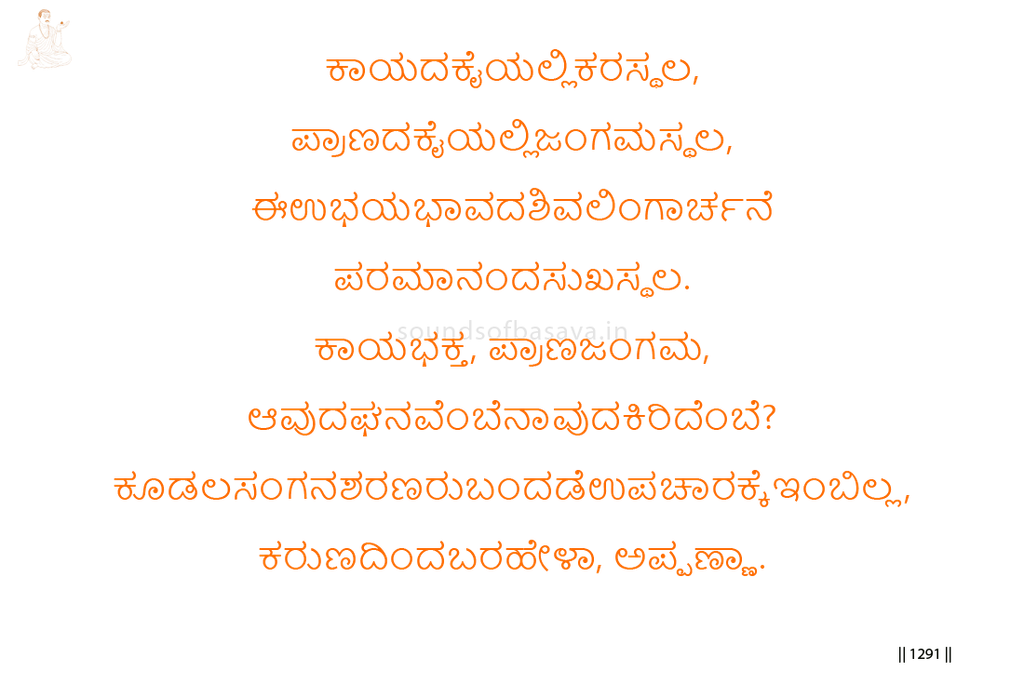
The body bears the Karasthala, while Prana bears the Jangamasthala. Shiva-Linga worship arising through this twofold relation becomes the abode of supreme bliss.
The body is Bhakta and Prana is Jangama; neither can be called greater or lesser. When Kudalasangama Deva’s Sharanas come, formal hospitality has no independent value. Basavanna asks Appanna to invite them through compassion.
Imagery & Symbolic Relevance
The opening line places Karasthala in the hand of the body. Karasthala is the field in which the Linga is held and worshipped directly. The body is therefore not dismissed as an obstruction; it becomes the embodied Bhakta through whom worship is performed.
Jangamasthala is placed in the hand of Prana. Prana is presented as Jangama—the living and moving sacred presence. The vachana joins bodily worship with living inward presence without reducing one to the other.
The phrase ubhaya-bhava refers to this twofold relation: the body as Bhakta and Prana as Jangama. Their distinction of function remains, but they do not stand in opposition.
Shiva-Linga worship arising through this relation is called Paramananda-sukhasthala, the state of supreme bliss. The bliss does not belong to bodily worship alone or to Prana alone. It arises where Karasthala and Jangamasthala participate in one living worship.
The declaration “the body is Bhakta; Prana is Jangama” makes the relation explicit. Bhakta is the embodied one who worships, while Jangama is the living sacred presence. Basavanna immediately asks which can be called greater and which lesser. The question removes hierarchy between them.
The arrival of Kudalasangama Deva’s Sharanas brings the teaching into lived conduct. Basavanna says there is no relish in upachara—formal reception, courtesy, or ceremonial hospitality—as something sufficient in itself.
The final appeal to Appanna gives the true mode of reception: ask the Sharanas to come through compassion. Their coming is not to be governed by display, social formality, or rank, but by karuna, the living relation of compassion.
Thus the vachana moves from Karasthala and Jangamasthala, to Bhakta and Jangama, and finally to the compassionate reception of the Sharanas. Inner worship and outward relation are held within one teaching.
Lingayoga
In Lingayoga, bodily worship and living Prana-awareness must not remain separate practices. The hand that bears the Linga, the body that serves as Bhakta, and the Prana recognized as Jangama must participate in one undivided worship.
Neither embodied devotion nor living realization may claim superiority. The question of greater and lesser ends when both are understood as necessary to the Shiva-Linga relation.
The same unity must appear in conduct. The Sharana is not truly received through ceremony alone. Compassion is the living Achara through which the inward recognition of Jangama becomes outward fellowship.
Editorial Commentary
Karasthala refers to the field of the Linga held in the hand. Jangamasthala refers here to the living Jangama-condition established in relation to Prana.
Ubhaya-bhava means the twofold condition of Bhakta and Jangama. It does not imply hostile duality; it names two functions participating in one Shiva-Linga worship.
The question of greater and lesser is rhetorical. Basavanna refuses to place the body-Bhakta below Prana-Jangama or Prana-Jangama below the body-Bhakta.
Upachara means formal service, reception, courtesy, or hospitality. The vachana does not condemn considerate reception. It states that outward formality has no independent spiritual value without compassion.
Appanna is the person directly addressed. Basavanna instructs him to ask or invite Kudalasangama Deva’s Sharanas to come through compassion.
Related Vachana
Supporting Vachana
Sharana Sthala Vachana 1289 — The Mutual Indwelling of Bhakta and Jangama
Sharana Vachana 1289 teaches that Jangama dwells in the body of the Bhakta and that the Bhakta is held within the Prana of the Jangama. Their relation is mutual rather than one-sided. The true Jangama accepts responsibility for the devotee’s life, enters the Bhakta’s house, receives body, mind, and wealth, and sanctifies the devotee. The Bhakta, in turn, receives and bears that living relation with humility.
This prepares Vachana 1144 directly. The Sharana vachana establishes Bhakta and Jangama as mutually indwelling and joined through sacred responsibility. In Aikya Vachana 1144, that relation becomes the twofold worship of body-Bhakta and Prana-Jangama, in which neither is greater or lesser.
The reception of the Jangama in Vachana 1289 also prepares the final instruction to Appanna. What first appears as readiness, surrender, and sanctification matures in Aikya as the compassionate reception of Kudalasangama Deva’s Sharanas.
Advancing Vachana
Aikya Sthala Vachana 1344 — When Linga Is Anga and Anga Is Linga
Aikya Vachana 1344 declares that Linga is Anga and Anga is Linga; Linga is Prana and Prana is Linga. Nothing remains separately present to be displayed, and nothing remains absent to be sought. Uninterrupted Linga alone abides.
Vachana 1144 establishes the harmonious twofold relation: the body is Bhakta, Prana is Jangama, and their joined Shiva-Linga worship is supreme bliss. Although neither is greater or lesser, their distinct functions are still named.
Vachana 1344 carries this further. The body or Anga is no longer merely the Bhakta related to Linga, and Prana is no longer merely the Jangama participating in worship. Anga is known as Linga, and Prana is known as Linga.
The twofold relation of Vachana 1144 therefore advances into uninterrupted Linga-presence. What is first realized as equality and living union becomes explicit non-separation among Anga, Prana, and Linga before Kudalasangama Deva.
