

Summary
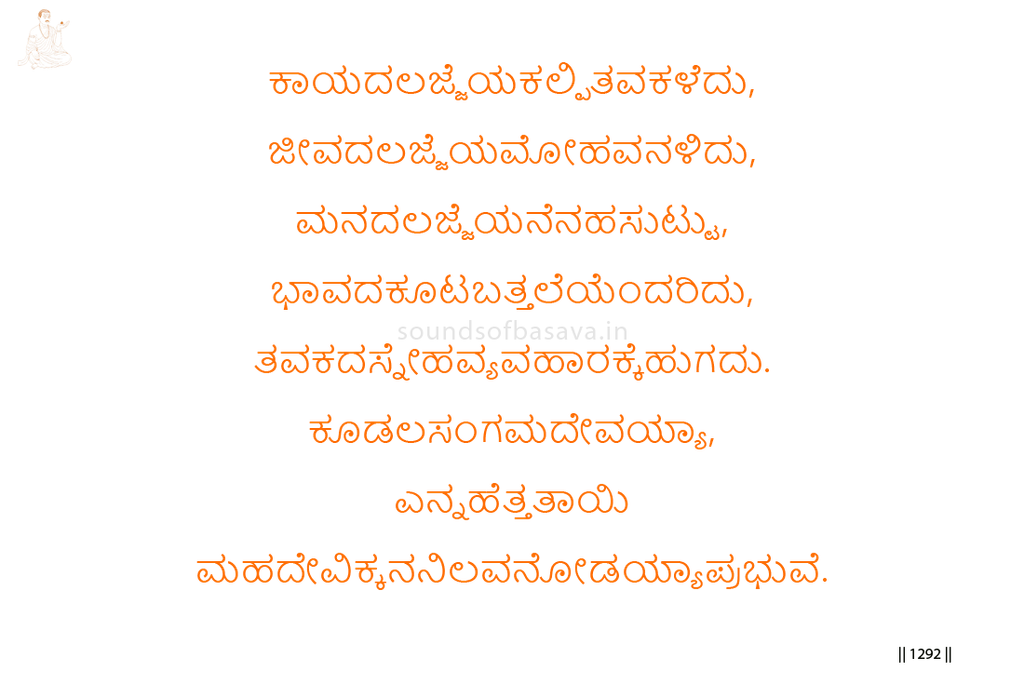
Basavanna presents Mahadeviyakka’s realized state. The imagined shame associated with the body has fallen away, the delusive attachment of the individual life has dissolved, and the memory that sustains the mind’s self-consciousness has been burned.
Recognizing the gathering of bhava as bare and without lasting support, she does not enter the dealings of craving and possessive affection. Basavanna asks Kudalasangama Deva to behold the state of Mahadeviyakka, whom he reverently calls his mother.
Imagery & Symbolic Relevance
The imagined shame of the body is the first layer removed. The body continues to exist, but social self-consciousness and the need to define oneself through bodily appearance no longer govern Mahadeviyakka.
The next movement concerns the jīva. Its moha—delusive attachment—has dissolved. The separate life no longer seeks security through personal belonging, possession, or self-importance.
The mind’s shame is sustained through memory. Earlier judgments, impressions, and self-conscious recollections repeatedly renew the sense of limitation. These memories are said to be burned, indicating that they no longer return as the ground of identity.
The gathering of bhava is then known as bare. The inward field in which emotion, attachment, self-image, and possessive thought assemble is seen without covering. Once its unsupported nature is recognized, it can no longer command her.
The final inward action follows naturally: she does not enter the vyavahāra of craving and possessive affection. This does not deny compassion, relationship, or genuine love. It removes the exchange in which affection becomes longing, claim, expectation, and “mine.”
The concluding appeal identifies the state being described. Basavanna does not claim these attainments for himself. He points to Mahadeviyakka as the living Sharana in whom bodily shame, individual attachment, binding memory, and possessive relation have lost their hold.
Lingayoga
In Lingayoga, freedom must reach the body, jīva, mind, memory, and bhava. Merely restraining outward conduct is insufficient while inward self-consciousness and possessive attachment remain active.
Mahadeviyakka’s state shows that the body need not be rejected; its power to define the Anga must fall away. The mind need not be forcibly emptied; the memories through which it repeatedly rebuilds attachment must cease to govern.
The practical movement is non-entry into possessive relation. Affection remains pure only when it does not become craving, ownership, or self-establishment.
Editorial Commentary
The successive actions describe Mahadeviyakka’s state, which Basavanna asks the Lord to behold. They should not be presented as Basavanna’s own personal declaration.
Lajjē here carries the sense of shame, modesty, or self-consciousness. The vachana does not reject humility, moral restraint, or dignity. It concerns the bodily, individual, and mental self-consciousness that sustains separate identity and attachment.
The three movements must remain distinct:
bodily shame is an imagined construction that falls away;
the jīva’s moha is delusive attachment that dissolves;
the mind’s remembered shame is burned.
Prabhuve means “O Lord” and directly addresses Kudalasangama Deva. It does not refer to Allama Prabhudeva.
Related Vachana
Supporting Vachana
Sharana Sthala Vachana 153 — The Threefold Wisdom
Sharana Vachana 153 says that wisdom does not lie merely in singing or skilful speech. The truly wise one trusts the Linga firmly, spends oneself in service to the Jangama, and cuts away the trailing bond of attachment even while its force is strong. Such a one is Kudalasangama Deva’s Sharana.
This prepares Vachana 1145 by establishing freedom from attachment as an essential mark of the Sharana. In the Sharana vachana, the bond is deliberately cut through Linga-trust and Jangama-service. In Aikya Vachana 1145, that freedom is shown in Mahadeviyakka as a complete condition: bodily self-consciousness, individual delusion, binding memory, craving, and possessive affection no longer provide a place in which identity can take root.
Advancing Vachana
Aikya Sthala Vachana 1329 — What Need Remains for One Who Is Truly Enamoured?
Aikya Vachana 1329 asks what attachment to the body can remain for one who has fallen in love with the Formless; what pride can remain when the heart has been wholly captured; and what need even for a covering can remain for one enamoured of the Digambara. It concludes that the devotee Mahadeviyakka bears no burden.
This directly advances Vachana 1145. Vachana 1145 describes what has fallen away in Mahadeviyakka: bodily shame, the jīva’s attachment, the mind’s binding memory, craving, and possessive affection. Vachana 1329 reveals the positive ground of that freedom: her complete love for the Formless and the Digambara has left no bodily attachment, pride, covering, or burden to maintain.
What is described in Vachana 1145 through removal is fulfilled in Vachana 1329 through total Divine love.
