

Summary
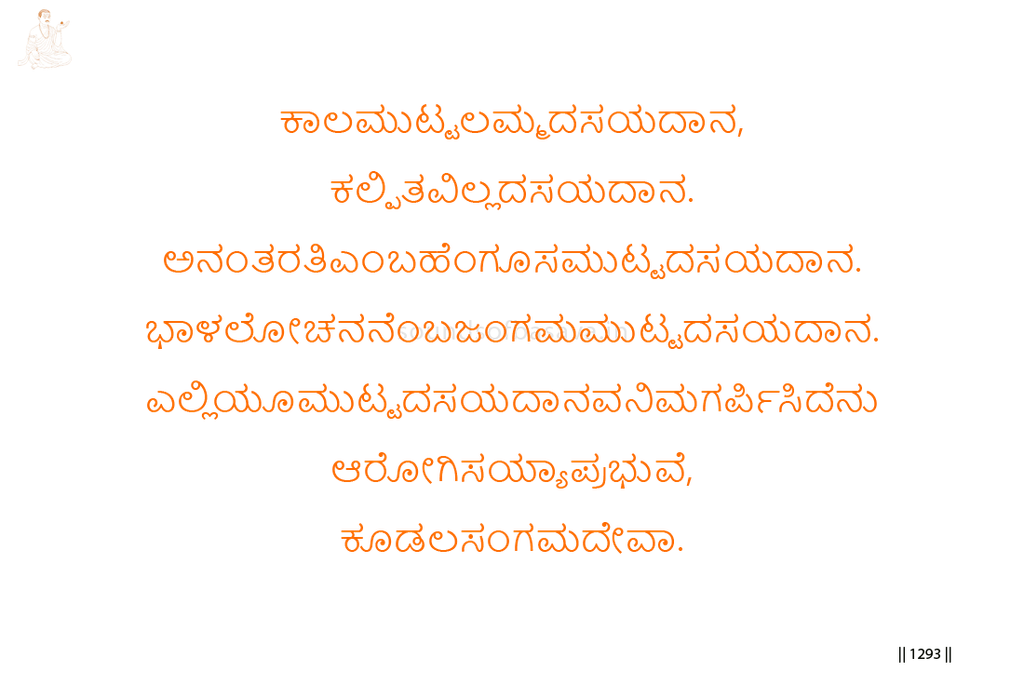
Basavanna presents an offering untouched by Time, free from fabrication, untouched by the woman called Anantarati, untouched by the Jangama called Bhālalochana, and untouched anywhere.
Having preserved it from every prior contact and claim, he offers it directly to Kudalasangama Deva and asks Him to partake: “O Lord.” The complete movement is from untainted preservation to direct surrender before the Lord.
Imagery & Symbolic Relevance
The offering untouched by Time is the first image. Time has neither consumed nor altered it. It has not entered the ordinary movement through which things are handled, changed, exhausted, or claimed.
The offering without kalpita is free from fabrication or contrivance. It has not been artificially fashioned to create an appearance of purity or devotion.
The woman called Anantarati has not touched it. The Kannada retains her as a female figure named Anantarati. Conventionally, the name may suggest unending rati—attraction, desire, or attachment—but the primary image is that even her touch has not entered the offering.
The Jangama called Bhālalochana has also not touched it. This line must remain in the negative: the offering is untouched by Bhālalochana Jangama. It does not say that he alone has touched it or that only he is permitted to touch it.
The statement that it is “untouched anywhere” gathers the preceding lines. Time, fabrication, Anantarati, Bhālalochana Jangama, and every other prior contact have left no claim upon it.
Basavanna then places this untouched offering before Kudalasangama Deva. Its purity is not retained for display or possession. It is preserved so that it may be surrendered wholly to the Lord.
The final plea, ārogisayya, asks Kudalasangama Deva to partake of or receive the offering. The untouched condition reaches fulfilment only in its direct presentation to Him.
Lingayoga
In Lingayoga, offering must be free from manipulation, attachment, and personal ownership before it is placed before the Linga.
The seeker must examine whether what is offered has already been shaped by self-interest, expectation, desire, or the wish for recognition. An offering remains whole when no earlier claimant has appropriated it and no personal demand is attached to it.
The practical movement is direct: preserve the offering from self-claim and place it completely before Kudalasangama Deva.
Editorial Commentary
The repeated Kannada word muṭṭada means “not touched” or “untouched.” Therefore, the line concerning Bhālalochana Jangama cannot be interpreted as “touched only by him.” It states that the offering has not been touched even by that named Jangama.
Bhālalochana means “one with an eye upon the forehead,” and in sacred texts it refers to Shiva with the third eye. He is identified in the vachana as a Jangama. The Kannada does not merge him with Kudalasangama Deva.
Prabhuve here is the direct address “O Lord.” It refers to Kudalasangama Deva, not to Allama Prabhudeva.
Ārogisayya carries the sense “please partake,” “please consume,” or “please receive,” appropriate to an offering placed before the Lord.
Related Vachana
Supporting Vachana
Sharana Sthala Vachana 1199 — The Offering of Body and Mind
Sharana Vachana 1199 says that when Bhakti touches the body, the body itself becomes offered; when Bhakti touches the mind, the mind itself becomes offered. Basavanna places both at Kudalasangama Deva’s feet, asks for protection, and leaves the truth of his surrender for the Lord alone to know.
This prepares Vachana 1147 by removing personal ownership from the act of offering. In the Sharana vachana, body and mind are surrendered rather than retained as possessions. In Aikya Vachana 1147, the offering is preserved from every prior touch, fabrication, attachment, and claim before being placed directly before Kudalasangama Deva.
Advancing Vachana
Aikya Sthala Vachana 1190 — The Prasada of Jangama and the Prasada of Linga Are One
Aikya Vachana 1190 declares that the true devotee knows Jangama as Prana-Linga. Without Jangama-Prasada, Linga-Prasada cannot be received, and the Prasada of Jangama cannot be doubted as separate from that of Linga. Both abide as one in Prana-bhava.
Vachana 1147 concerns the condition of the offering before Divine reception: it is untouched, unappropriated, and placed wholly before Kudalasangama Deva. Vachana 1190 reveals the completed sacred relation after reception: Prasada cannot be divided between Linga and Jangama.
The untouched offering of Vachana 1147 thus advances into undivided Prasada in Vachana 1190. What is first surrendered without any prior claim returns within the inseparable living relation of Linga, Jangama, and Prasada.
