

Summary
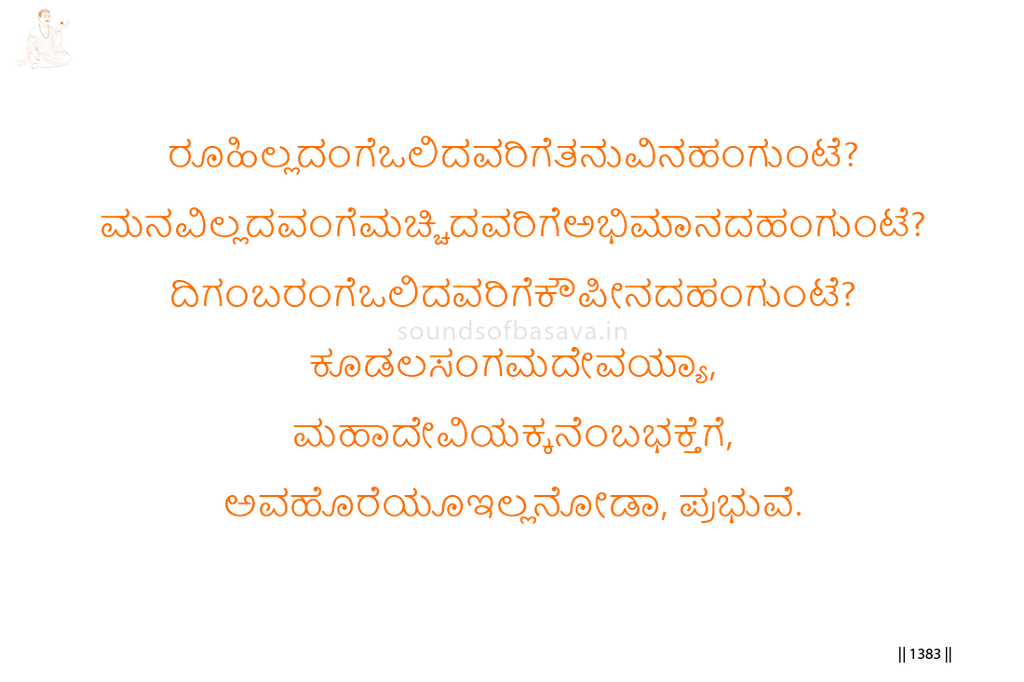
Basavanna asks three rhetorical questions about one wholly enamoured of the Divine.
What attachment to the body can remain for one who loves the Formless? What need for self-regard can remain when the heart has been completely captured? What need even for a loincloth can remain for one enamoured of the Digambara?
The questions reveal Mahadeviyakka’s realized condition. Her love has not destroyed the body; it has removed the body’s power to bind her through attachment, pride, and self-consciousness.
Basavanna presents her before Kudalasangama Deva as the devotee for whom no such burden remains and addresses the Lord directly: “Behold, O Lord.”
Imagery & Symbolic Relevance
The vachana moves through three parallel rhetorical questions and culminates in Mahadeviyakka as their living embodiment.
Love of the Formless and the Body
The first question asks what bodily attachment can remain for one enamoured of the Formless.
The body is not said to disappear, nor is embodied life rejected. What falls away is tanuvina hangu—dependence upon, attachment to, or anxious concern for the body as the ground of identity.
Love of the Formless has become so complete that the body no longer demands to be protected, displayed, concealed, or treated as “mine.” It remains present but no longer governs the devotee through self-consciousness.
The rhetorical force is precise: when love rests wholly in that which cannot be confined by form, bodily form loses its power to become a burden.
The Captured Heart and Abhimāna
The second question asks what need for abhimāna remains when the heart has been wholly captured.
Abhimāna includes pride, self-regard, possessive identity, and the inward insistence upon one’s own importance. It depends upon a separate centre that continually thinks of itself—its appearance, honour, status, and recognition.
When the heart has been taken completely by the Divine, there is no remaining inner space in which such self-regard can establish itself.
Pride is not forcibly suppressed. It becomes unnecessary because Divine love has displaced the self-centred claim from which pride arose.
The Digambara and the Loincloth
The third question gives the vachana its most concrete image.
The Digambara is the One clothed in the directions or in space—the Divine whose reality requires no covering. Basavanna asks what need even for a kaupīna, the most minimal garment or loincloth, can remain for one enamoured of that Digambara.
The question does not condemn clothing or prescribe outward nakedness as a spiritual discipline. The loincloth represents the last covering retained through bodily self-consciousness.
For Mahadeviyakka, love has removed even that compulsion. Her condition is not an act of protest, deliberate display, or rejection of dignity. The covering has ceased to carry spiritual necessity because bodily identity no longer stands as a burden.
Mahadeviyakka as the Living Example
The conclusion names Mahadeviyakka directly.
Basavanna does not present an abstract teaching and then leave it unembodied. He points to the devotee in whom the three freedoms have become visible:
freedom from bodily attachment;
freedom from self-regard;
freedom from covering as a burden.
Mahadeviyakka is not described as one who achieved freedom through outward nakedness. Her outward condition arises from inward love so complete that attachment, pride, and bodily self-consciousness no longer claim her.
She remains the devotee; Kudalasangama Deva remains the Lord before whom Basavanna presents her.
“She Has No Burden”
The closing declaration gathers the three questions into one recognition: Mahadeviyakka bears no such burden.
The burden is not the physical body itself. It is the weight created when the body becomes personal possession, when the heart sustains self-regard, and when covering becomes necessary for maintaining a separate identity.
Divine love has removed that weight without denying embodied life.
Lingayoga
Lingayoga must free the practitioner from bodily self-claim rather than produce hostility toward the body.
The body may remain active, clothed, and engaged in life while ceasing to function as the centre of pride and possession. The inward discipline is to see where bodily concern, reputation, or self-consciousness still governs one’s relation to Linga.
Mahadeviyakka’s state is fulfilled realization, not an outward practice to imitate. Removing clothing cannot produce the freedom described here. The freedom arises when love of the Divine has become so complete that the body and its coverings no longer establish a separate identity.
Editorial Commentary
Tanuvina hangu indicates attachment to, dependence upon, or burdensome concern for the body. It does not mean the disappearance of the body.
Abhimāna includes pride, self-regard, possessive identity, and personal importance.
Digambara means the One clothed in space or the directions. Here it indicates Divine reality beyond dependence upon covering.
Kaupīna is a loincloth or minimal bodily covering. Its use in the vachana concerns the ending of bodily self-consciousness, not a general rejection of clothing.
Mahadeviyakka is the devotee whose condition Basavanna asks the Lord to behold. Prabhuve means “O Lord” and directly addresses Kudalasangama Deva; it does not refer to Allama Prabhudeva.
Related Vachana
Supporting Vachana
Sharana Sthala Vachana 829 — The Algebra of Surrender
Sharana Vachana 829 declares that once the body, mind, and wealth are known as belonging to Kudalasangama Deva, no separate body, mind, wealth, or private concern remains.
It prepares Vachana 1329 by removing ownership at its root. What is first recognized in Sharana Sthala as “not mine” ripens in Mahadeviyakka into burdenless love: the body no longer binds, self-regard has no ground, and covering no longer sustains a separate identity.
Advancing Vachana
Aikya Sthala Vachana 875 — The Sharana Who Is Not Two
Vachana 1329 shows Mahadeviyakka free from bodily attachment, pride, and the burden of covering through complete Divine love.
Vachana 875 deepens this freedom by showing the realized Sharana as confined neither to form nor to formlessness and as one who deceives neither the body nor life.
The continuation preserves embodied integrity. Freedom from bodily burden does not become rejection of the body; it becomes a state in which body and life continue without division, deception, or separate self-claim.
