

Summary
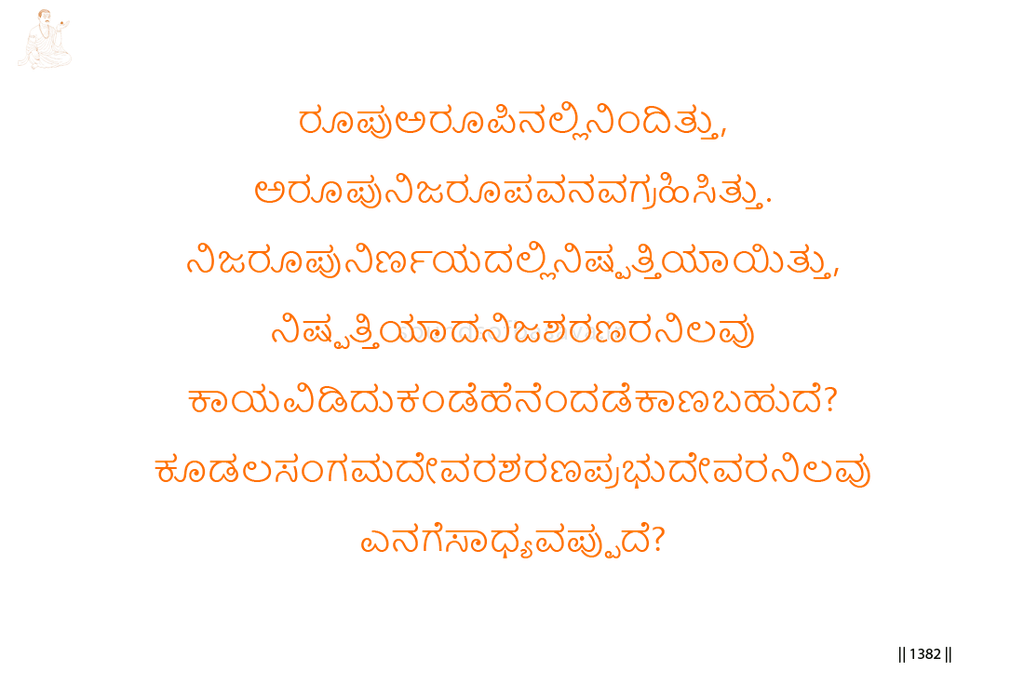
Form abided within the Formless, and the Formless apprehended the True Form. In the certainty of True Form, Nishpatti—consummated fulfilment—arose.
Basavanna then turns from description to questioning. Can the fulfilled state of Nijashankara be seen while holding to the body as the means of seeing?
He asks further whether the state of Allama Prabhudeva, the Sharana of Kudalasangama Deva, can become possible for him.
The vachana does not answer either question. Its culmination is reverent honesty: Nishpatti may be described, but it cannot be claimed as personal attainment merely through bodily perception or conceptual understanding.
Imagery & Symbolic Relevance
The vachana contains no material image. Its movement proceeds through form, formlessness, True Form, Nishpatti, bodily seeing, and the realized state of Allama Prabhudeva.
Form Abiding in the Formless
The opening statement does not place form and formlessness as enemies.
Form abides within the Formless. Form is not destroyed, rejected, or made spiritually inferior. Its separate standing is absorbed within a reality that cannot be confined by visible shape.
The movement is therefore from apparent difference toward a relation in which form is held within the Formless.
The Formless Apprehending True Form
The second movement reverses the direction: the Formless apprehends or embraces True Form.
True Form is not merely another visible shape. It is form no longer understood as separate from the Formless.
The two clauses belong together:
form abides in the Formless;
the Formless apprehends True Form.
Neither is complete without the other. The vachana does not escape from form into a separate formless realm; it reveals their fulfilled relation.
Nishpatti in the Certainty of True Form
Nishpatti arises in the determination or certainty of True Form.
This certainty is not merely intellectual agreement. The Kannada states a consummated condition in which uncertainty regarding form, formlessness, and True Form has ended.
Nishpatti therefore indicates fulfilment or consummation. Yet Basavanna does not immediately claim that condition as his own.
Can It Be Seen Through the Body?
The first question introduces the limit of embodied seeing.
Basavanna asks whether the state of Nijashankara established in Nishpatti can be seen by holding to the body.
The question does not condemn the body or declare that the body disappears. It asks whether bodily perception, which ordinarily encounters forms and distinctions, is sufficient to behold a state in which form and formlessness have reached consummation.
The Kannada leaves the question open. It must not be changed into either a confident affirmation or a categorical denial.
The State of Allama Prabhudeva
The final question names Allama Prabhudeva precisely as the Sharana of Kudalasangama Deva.
Kudalasangama Deva is the Lord. Allama Prabhudeva is the realized Sharana whose state Basavanna reveres and seeks. They must not be merged or interchanged.
Basavanna does not say that he already possesses Prabhudeva’s state. He asks whether that state can become possible for him.
The question gives the vachana its humility. Description of Nishpatti does not become a claim of Nishpatti. Reverence for Prabhudeva does not become self-identification with Prabhudeva.
Lingayoga
Lingayoga must not mistake bodily perception, conceptual knowledge, or the ability to describe Aikya for realized Nishpatti.
Form and formlessness must not be held as competing spiritual choices. Their fulfilled relation becomes known only when True Form is established beyond their apparent opposition.
The practitioner’s proper position is therefore truthful inquiry. One may recognize the direction shown by the vachana and revere the realized state embodied by Prabhudeva, but one must not claim that state before it becomes actual.
Editorial Commentary
Avagrahisitu indicates apprehending, receiving, taking hold of, or embracing. Here it describes the Formless apprehending True Form.
Nijarūpa is True Form—the reality of form known without separation from the Formless.
Nishpatti means consummation, complete fulfilment, or ripened completion. It must not be reduced to an intellectual conclusion.
Nijashankara refers to Shankara in the fulfilled truth of that state.
The expression concerning the body questions whether such a state can be seen through bodily means. It does not state bodily disappearance.
Prabhudeva here explicitly means Allama Prabhudeva, the Sharana of Kudalasangama Deva.
Related Vachana
Supporting Vachana
Sharana Sthala Vachana 892 — Where the Mind and Body Find Their True Abode
In Sharana Vachana 892, Basavanna’s body is drawn into Allama and his mind into Chennabasavanna. When body and mind no longer provide him with a separate place to stand, he asks where he himself can remain before Kudalasangama Deva.
It prepares Vachana 1328 by unsettling reliance upon body and mind as sufficient grounds of realization. Vachana 1328 deepens the question: even when Nishpatti can be described, can that state be seen through the body, and can Prabhudeva’s realized state truly become possible for Basavanna?
Advancing Vachana
Aikya Sthala Vachana 1119 — The Stainless Vision Beyond the Mind
Vachana 1328 remains in the honest question of whether the state beyond the ordinary reach of bodily seeing is attainable.
Vachana 1119 shows that question fulfilled as inward experience. The gaze turns inward through Karasthala, bodily limitation no longer governs vision, and Anubhava rises beyond the mind’s furthest reach. Basavanna then declares that he lives in Kudalasangama Deva through Prabhudeva and calls Chennabasavanna to witness.
Thus Vachana 1328 asks whether Prabhudeva’s state is possible; Vachana 1119 reveals life established through Prabhudeva in Kudalasangama Deva.
