

Summary
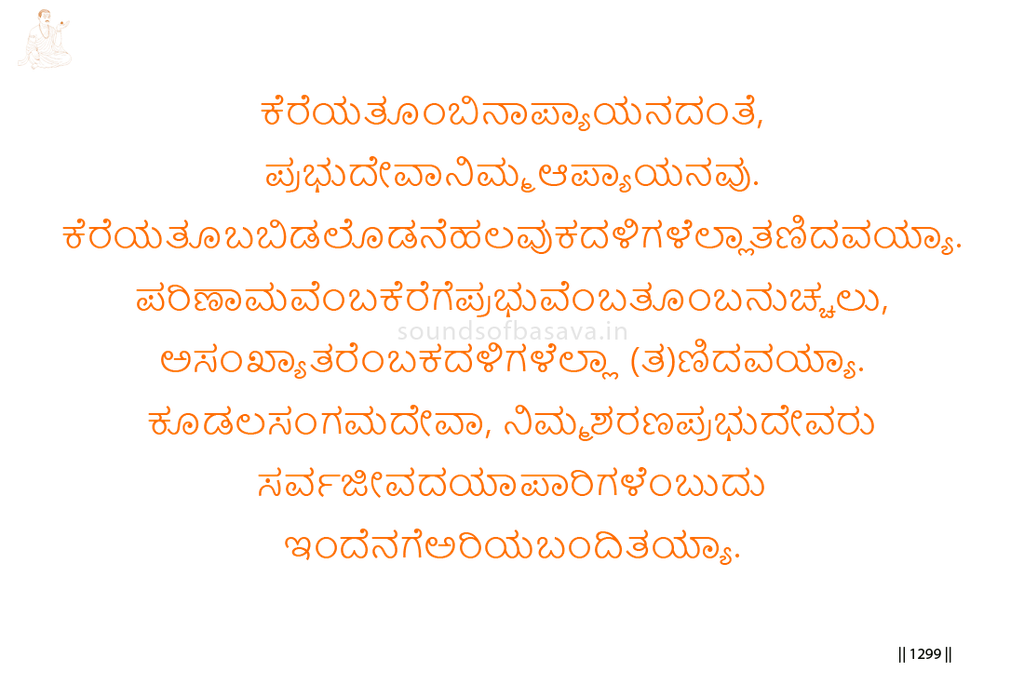
Basavanna compares Prabhudeva’s nourishing presence to a reservoir filled to abundance. When its waters are released, the surrounding plantain groves are refreshed. In the same way, when Prabhudeva opens the fullness of ripened Anubhava, countless beings receive nourishment and relief.
Turning to Kudalasangama Deva, Basavanna declares that he has now directly recognized Prabhudeva, the Lord’s Sharana, as one whose compassion extends to all living beings. Realization in Prabhudeva does not remain contained within him; it flows outward as universal care.
Imagery & Symbolic Relevance
The full reservoir is the governing image. Its abundance is known not merely by the water it contains, but by its capacity to nourish the life around it.
Basavanna directly addresses Prabhudeva in the opening. Prabhudeva’s āpyāyana—his nourishing, refreshing, and sustaining presence—is compared to the replenishing fullness of the reservoir.
The plantain groves depend upon water from the reservoir. When its stored abundance is released, many groves are refreshed together. The water does not select one plant while withholding itself from another.
The image then moves from a physical reservoir to the reservoir called pariṇāma. Here pariṇāma indicates ripening, maturation, or the fulfilled condition of Anubhava. It is realization that has reached the fullness from which it can nourish others.
Prabhudeva functions as the opening through which that ripened fullness becomes available. His realization is not kept enclosed as personal spiritual possession. It flows toward innumerable beings.
The countless plantain groves therefore represent the many lives that receive the benefit of this compassion. The image should remain restrained: Basavanna’s emphasis is upon nourishment, refreshment, and satisfaction reaching many beings through the realized Sharana.
The phrase “today I have come to know” gives the vachana its personal culmination. Basavanna is not repeating a reputation attached to Prabhudeva. He has recognized universal compassion through what Prabhudeva’s realized presence actually does.
The final line names the quality revealed through this action: sarva-jīva-dayā, compassion toward all living beings. Compassion is not presented as an additional virtue placed beside realization. It is the natural overflow of realization that has become full.
Lingayoga
In Lingayoga, realization cannot remain enclosed within the practitioner as private attainment. When the relation of Anga and Linga ripens, its fruit must become nourishment within the living Jangama-field.
Prabhudeva shows the fulfilled function of Jangama. He does not hoard Anubhava, but allows its sustaining force to reach countless lives.
The measure is therefore not spiritual claim, exceptional experience, or personal distinction. Ripened realization is known by the compassion through which others are refreshed, supported, and relieved.
Editorial Commentary
The opening Prabhudeva is a direct address to Allama Prabhudeva. In the conclusion, Basavanna identifies him as Kudalasangama Deva’s Sharana.
The roles must remain distinct:
Prabhudeva is the realized Sharana whose nourishing compassion flows toward all beings.
Kudalasangama Deva is Basavanna’s Lord, before whom Prabhudeva’s universal compassion is acknowledged.
Basavanna is the one who comes to recognize and declare this truth.
Āpyāyana carries the sense of nourishment, refreshment, replenishment, and sustaining fulfilment. It is more than emotional comfort.
Pariṇāma refers to ripening or fulfilled maturation. The “reservoir of pariṇāma” is therefore the fullness of realized Anubhava, not merely intellectual understanding.
The vachana does not claim that all beings automatically attain identical realization through Prabhudeva. Its exact assertion is that his compassion reaches and nourishes all living beings without distinction.
Related Vachana
Supporting Vachana
Sharana Sthala Vachana 1385 — The Bliss of Linga-Aikya
In Sharana Vachana 1385, Basavanna acknowledges that the harmony, inward union, and bliss of Linga-Aikya became possible only through Kudalasangama Deva. He asks who else could have shown him its way and confesses that, had the Lord not placed him in the refuge of Prabhudeva, he could not have known it.
This prepares Vachana 1156 by establishing Prabhudeva as the living Sharana through whom Linga-Aikya becomes knowable. Basavanna first receives the way of union through Prabhudeva; he then recognizes the fruit of that fulfilled state.
In Vachana 1156, the realization revealed through Prabhudeva is seen overflowing as compassion. The one who showed Basavanna the way of Linga-Aikya becomes the full reservoir through whose opened abundance countless lives are refreshed.
Advancing Vachana
Aikya Sthala Vachana 1210 — The Satisfaction of the Whole
Aikya Vachana 1210 says that when a lake becomes completely full, all moving and unmoving beings dependent upon its water are satisfied. In the same way, when Prabhudeva becomes fulfilled, countless hosts of beings share in that fulfilment. The vachana adds the image of a pregnant mother whose nourishment also sustains the child within her and concludes by bowing before the greatness of Prabhudeva’s Prasada.
Vachana 1156 recognizes Prabhudeva as universally compassionate: his ripened Anubhava opens like a reservoir and refreshes innumerable beings.
Vachana 1210 carries this further. Prabhudeva’s fulfilment does not merely produce compassionate action toward separate recipients; his very Prasada becomes nourishment for the whole moving and unmoving field.
The movement is exact: the overflowing compassion recognized in Vachana 1156 deepens in Vachana 1210 into collective fulfilment through the realized Sharana’s Prasada.
