

Summary
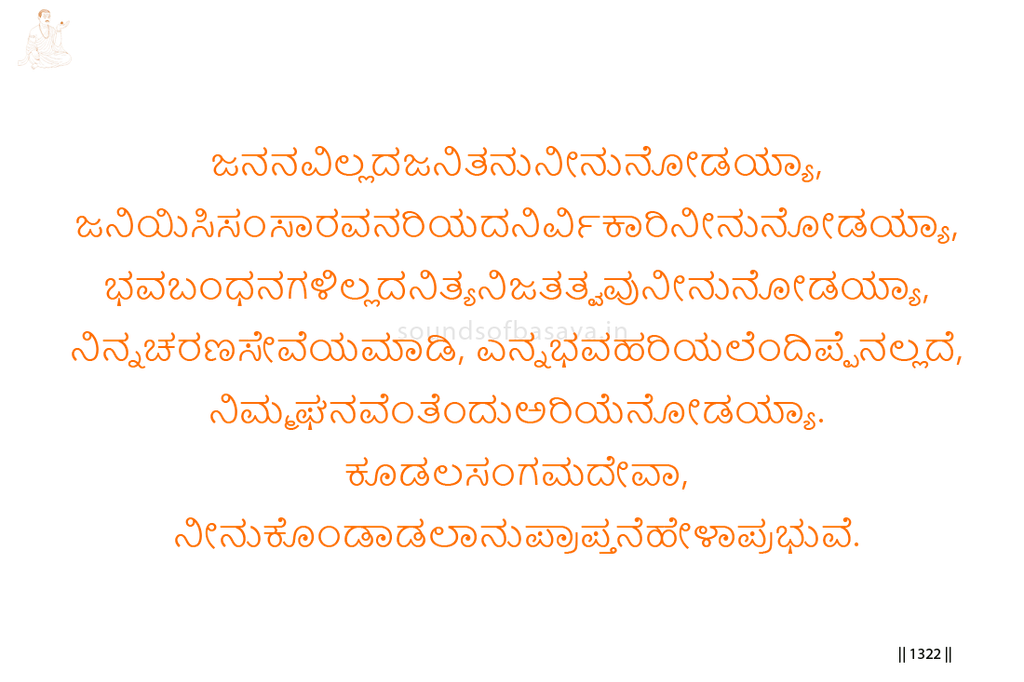
Basavanna addresses Kudalasangama Deva as the birthless Progenitor who brings beings forth yet remains changeless and untouched by samsara. He is the eternal true Reality, free from every bond of Bhava.
Basavanna serves the Lord’s feet so that his own becoming may end. He does not claim to comprehend the Lord’s immeasurable fullness.
The vachana concludes in humility: Basavanna asks whether he is even capable of praising Kudalasangama Deva.
Imagery & Symbolic Relevance
The opening description, “the Progenitor without birth,” establishes the central contrast. Kudalasangama Deva gives rise to birth but is not Himself subject to birth.
The next line continues the same distinction. The Lord causes beings to arise, yet does not enter the samsara that follows embodied birth. Creative action does not bind or alter Him.
Basavanna therefore calls Him nirvikari—changeless and unaffected. Birth, manifestation, and worldly movement occur, but they do not produce modification in Kudalasangama Deva.
The Lord is then named the eternal true Reality without the bonds of Bhava. Bhava-bandhana includes the conditions through which arising becomes continued bondage. None of these adheres to the Lord.
The repeated “see, Ayya” gives the declarations the force of direct devotional recognition. Basavanna is not constructing a distant philosophical definition; he speaks before the Lord whose condition exceeds his own.
The movement then turns from the Lord’s freedom to Basavanna’s bondage. He serves the Lord’s feet so that his own Bhava may be removed.
The sacred feet signify refuge, service, and surrender. Basavanna does not claim that service gives him mastery over the Lord’s nature. Its purpose is the ending of his own becoming.
He therefore admits that he does not know the measure of Kudalasangama Deva’s ghana—His fullness, greatness, and immeasurable being.
The final question completes the humility of the vachana. Basavanna does not assume that he is qualified to praise the Lord. Even praise requires a capacity he does not claim to possess.
Lingayoga
In Lingayoga, the distinction between Linga and the bound Anga must first be understood correctly. Kudalasangama Deva brings forth manifestation without becoming bound by it, while the seeker remains subject to Bhava.
Service at the sacred feet is therefore not a means of measuring or possessing the Divine. It is the surrender through which the seeker asks that the movement of becoming within himself be brought to an end.
The practitioner must not mistake worship, knowledge, or praise for complete comprehension. The Lord’s fullness is not mastered through speech or spiritual learning.
The practical movement is restrained: serve, surrender Bhava, and remain humble before what cannot be fully measured or praised.
Editorial Commentary
Janita here means progenitor, begetter, or the one who brings forth. The opening does not describe Kudalasangama Deva as an ordinary being who was born.
Nirvikari means changeless or unaffected by modification. The Lord brings beings into manifestation without becoming bound by their samsara.
Nitya-nija-tattva means the eternal true Reality. It is free from Bhava-bandhana and is not produced through the seeker’s practice.
Basavanna’s service is directed toward the ending of his own Bhava. The line does not say that service produces or alters the Lord.
The final “Prabhuve” addresses Kudalasangama Deva as O Lord. It does not refer to Allama Prabhudeva in this vachana.
Related Vachana
Supporting Vachana
Sharana Sthala Vachana 880 — The Unseen Within All That Comes and Goes
Sharana Vachana 880 states that present formations do not know where Shiva abides, former formations do not know His beginning and end, and time-bound formations remain within the wheel of time.
Basavanna therefore asks to be released from doubt-bound formations and kept in the service of Kudalasangama Deva’s Sharanas.
This prepares Vachana 1195 directly. Sharana Vachana 880 establishes that formations belonging to body, past, and time cannot comprehend Shiva. Service becomes the refuge from their limitation.
In Vachana 1195, Basavanna recognizes Kudalasangama Deva as birthless, changeless, and beyond Bhava, while serving His feet so that his own becoming may end. He also admits that he cannot know or adequately praise the Lord’s fullness.
What Sharana Vachana 880 presents as service beyond time-bound formation becomes, in Aikya Vachana 1195, surrender before the eternal Reality untouched by birth and becoming.
Advancing Vachana
Aikya Sthala Vachana 874 — Beyond Word, Beyond Cause, Beyond Becoming
Aikya Vachana 874 declares that Kudalasangama Deva’s Sharanas are beyond comparison, free from the bonds of time and karma, and without Bhava.
Vachana 1195 first reveals these qualities in the Lord: He is birthless, changeless, eternal, and free from Bhava-bandhana. Basavanna serves His feet so that his own Bhava may end.
Vachana 874 advances the teaching by showing that this freedom becomes established in Kudalasangama Deva’s Sharanas. Those who abide in Him are no longer measured by comparison, time, karma, or becoming.
The Lord’s freedom from Bhava in Vachana 1195 thus becomes the realized condition of His Sharanas in Vachana 874.
