

Summary
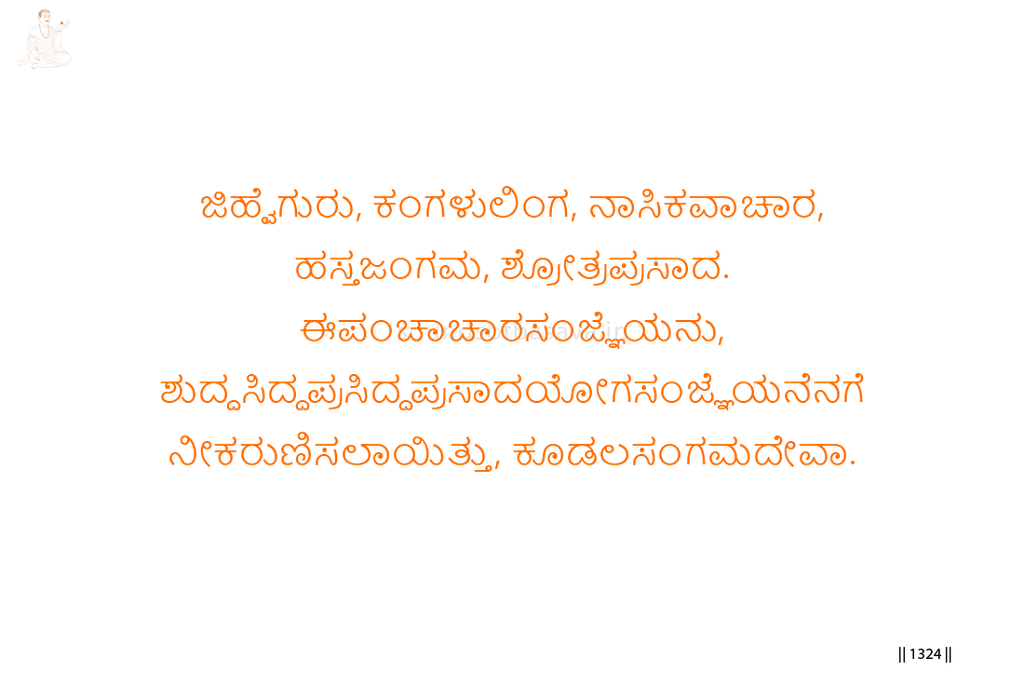
Basavanna identifies five bodily faculties with the fivefold sacred relation: the tongue as Guru, the eyes as Linga, the nose as Achara, the hands as Jangama, and the ears as Prasada.
These are the signs of Panchachara functioning within embodied life. Basavanna does not claim to have created this awareness; Kudalasangama Deva grants him the recognition of pure, perfected, and established Prasada-yoga through grace.
Imagery & Symbolic Relevance
The vachana consists of five direct correspondences.
The tongue is Guru. The faculty of speech becomes the field through which guidance, instruction, and truth are expressed. The tongue does not replace the Guru; it carries the sign of Guru when speech is governed by sacred awareness.
The eyes are Linga. Seeing is no longer treated as ordinary outward perception alone. The eyes become the field through which Linga is recognized.
The nose is Achara. Basavanna directly assigns Achara to this faculty. The correspondence must be preserved without inventing an unsupported system of breath-control or subtle-body practice.
The hands are Jangama. Hands are the faculties of action, service, receiving, and giving. Jangama-awareness therefore becomes active through embodied conduct rather than remaining only an inward idea.
The ears are Prasada. Hearing is presented as sacred reception. What is heard is not merely acquired as information; it is received within the awareness of Prasada.
These five together form the sign or recognition of Panchachara. Guru, Linga, Achara, Jangama, and Prasada are not presented as disconnected observances. They function through the devotee’s own embodied faculties.
The conclusion names this as the recognition of shuddha, siddha, prasiddha Prasada-yoga:
shuddha — pure;
siddha — perfected or fulfilled;
prasiddha — manifest, established, or clearly realized.
Basavanna attributes this recognition entirely to Kudalasangama Deva’s compassion. The fivefold awareness is received through grace, not claimed as self-produced attainment.
Lingayoga
In Lingayoga, sacred practice must enter speech, sight, conduct, action, and reception.
The practitioner cannot confine Guru, Linga, Jangama, Achara, and Prasada to separate ritual occasions. Their relation must become active throughout embodied life.
The practical movement is:
let speech remain accountable to Guru;
let sight remain centred in Linga;
let conduct remain Achara;
let action serve as Jangama-relation;
let hearing become receptive to Prasada.
The faculties continue to function naturally, but they no longer operate as unrelated instruments of a separate self.
This does not mean that the physical organs independently produce realization. The governing point is the grace-given awareness through which Panchachara becomes embodied.
Editorial Commentary
The word sanjne carries the sense of sign, designation, recognition, or awakened awareness. The five faculties are presented as the signs through which Panchachara becomes known within life.
The correspondences should not be expanded beyond the Kannada:
the tongue must not be declared a substitute for the living Guru;
the eyes do not replace the Ishtalinga;
the nose–Achara relation does not authorize an unsupported breath system;
the hands do not reduce Jangama to action alone;
the ears do not reduce Prasada merely to hearing.
The emphasis is integration. Each faculty participates in a sacred relation, and all five are gathered through Kudalasangama Deva’s grace.
Prasada-yoga here indicates establishment in the sacred relation of Prasada. It is not merely the physical reception of a ritual substance.
Related Vachana
Supporting Vachana
Sharana Sthala Vachana 1165 — Without Achara, Nothing Sacred Remains
Sharana Vachana 1165 makes Kriyachara the test of sacred validity. Without right conduct, initiation cannot rightly be received from Guru, Linga cannot be properly worshipped, Jangama cannot be recognized, and Padodaka and Prasada cannot be rightly accepted.
This prepares Vachana 1197 directly. Sharana Vachana 1165 first establishes that Guru, Linga, Jangama, and Prasada cannot remain sacred when separated from Achara.
Aikya Vachana 1197 shows this relation established within embodied awareness:
Guru functions through the tongue;
Linga through the eyes;
Achara through the nose;
Jangama through the hands;
Prasada through the ears.
What Sharana Vachana 1165 protects through disciplined conduct becomes, in Vachana 1197, the grace-given sign of Panchachara functioning throughout life.
Advancing Vachana
Aikya Sthala Vachana 1214 — The Radiance of the Tenfold Padodaka
Aikya Vachana 1214 gathers Guru, Linga, Jangama, Padodaka, Prasada, Vibhuti, Rudrakshi, Panchakshari, Gana-vrata and Nema, Achara, and Shila into inward and outward completeness.
Vachana 1197 establishes fivefold sacred awareness through the bodily faculties. Vachana 1214 advances this into a wider integrated field in which sacred relations, observances, conduct, and character stand together.
The movement is precise:
Vachana 1197 shows Panchachara functioning within embodied faculties.
Vachana 1214 joins this inward awareness with outward observance and conduct.
The fivefold recognition expands into complete sacred integration.
What is received as Prasada-yoga in Vachana 1197 becomes established as eternal Padodaka in Vachana 1214.
