

Summary
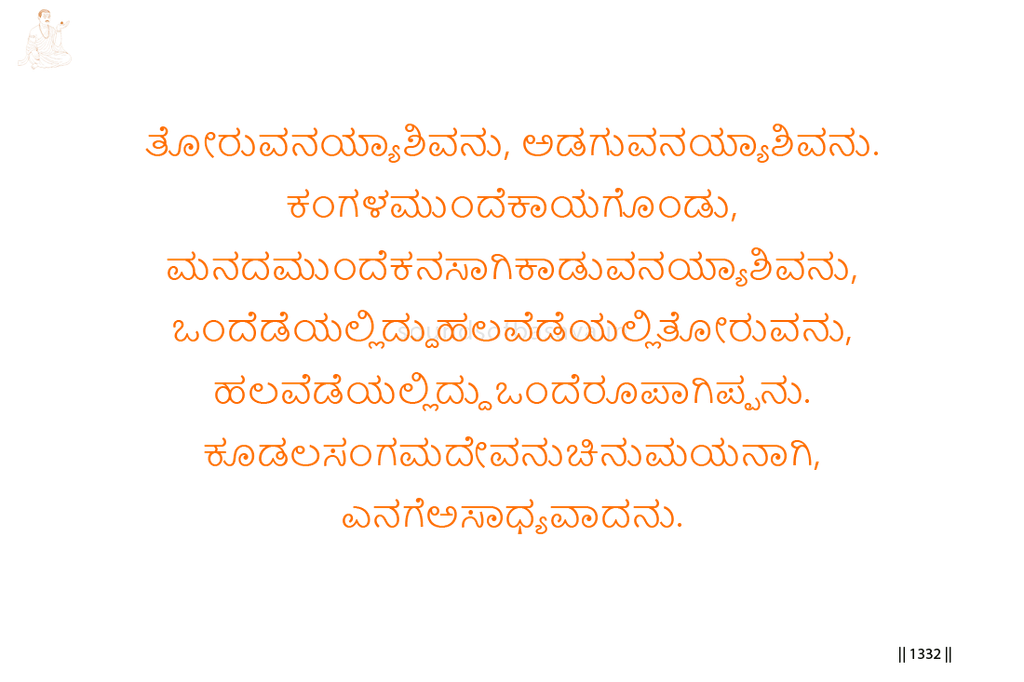
Shiva is the one who appears, and Shiva Himself is the one who hides. He takes form before the eyes, yet before the mind He remains elusive, troubling it like a dream.
Abiding in one place, He appears in many places; abiding in many places, He remains one form. Multiplicity does not divide Him, and unity does not prevent His many appearances.
Kudalasangama Deva is of the nature of consciousness and remains impossible for Basavanna to grasp fully.
Imagery & Symbolic Relevance
The vachana opens with two apparently opposing actions:
Shiva appears;
Shiva hides.
The agent does not change. The same Shiva who makes Himself visible also withdraws from complete perception. Appearance and concealment are therefore not the actions of two different realities.
The next contrast is between the eyes and the mind.
Before the eyes, Shiva assumes form. The Divine may be encountered visibly through Linga, Jangama, Sharana, worship, and embodied presence. The appearance is real within the vachana; it is not dismissed as illusion.
Yet before the mind, Shiva becomes like a dream that continues to trouble or haunt it. Although the eyes may see a form, the mind cannot contain the fullness of the One who appears through that form.
The dream-image does not mean that Shiva is unreal. A dream can remain powerfully present while resisting fixed possession. In the same way, Kudalasangama Deva comes near to awareness but cannot be confined within a mental definition.
The vachana then presents a twofold spatial movement:
remaining in one place, He appears in many places;
remaining in many places, He abides as one form.
The first movement shows that unity is capable of manifold appearance. Shiva does not have to become divided in order to be present in many places.
The second movement prevents multiplicity from becoming many independent Divine centres. Though He is present in many places, He remains One.
Both statements must be retained. The vachana neither confines Shiva to one visible location nor fragments Him into separate beings.
The final declaration—Kudalasangama Deva is cinmaya, of the nature of consciousness—brings the limitation into Basavanna’s own experience. The Lord is present as the awareness through which seeing and knowing occur, yet He cannot be fully seized as an object of seeing or thought.
Basavanna therefore says that the Lord has become impossible for him. This is not denial of Divine presence. It is the admission that the appearing and concealing Lord exceeds his power of comprehension.
Lingayoga
In Lingayoga, the visible Linga must be honoured without assuming that its visible form exhausts the nature of the Linga.
The practitioner may experience presence clearly at one moment and concealment at another. The disappearance of a recognizable experience must not immediately be treated as Divine absence. The same Shiva both reveals and withdraws.
The practical movement is restrained:
receive the form that appears before the eyes;
do not claim to have contained the Lord through that appearance;
do not reject concealment as absence;
recognize the One through many sacred manifestations;
do not turn those manifestations into separate ultimate realities.
The mind naturally attempts to fix, define, and possess what has been seen. This vachana removes that claim. Seeing is possible, relationship is possible, and worship is possible, but complete mental possession is not.
Lingayoga therefore becomes steadiness before both revelation and concealment. The seeker remains with Kudalasangama Deva whether the Lord appears distinctly or remains beyond the mind’s reach.
Editorial Commentary
Tōruvanu means the one who appears, reveals Himself, or becomes visible.
Aḍaguvanu means the one who hides, withdraws, or remains concealed. It does not mean that Shiva ceases to exist.
Kāyagoṇḍu indicates taking embodied form or becoming visible in form. It should not automatically be expanded into a separate doctrine of incarnation.
Kanasāgi kāḍuvanu means that Shiva troubles or haunts the mind like a dream. The emphasis is elusiveness, not unreality.
“One place” and “many places” should not be reduced to a general statement about omnipresence. The Kannada gives a precise reciprocal movement: the One appears as many, and within the many He remains One.
Cinmaya means of the nature of consciousness or awareness. It does not refer to an imagined subtle body.
Enage asādhyavādanu means that Kudalasangama Deva has become impossible for Basavanna to grasp, contain, or comprehend fully. It does not mean that the Lord is absent or spiritually inaccessible.
The concluding name is Kudalasangama Deva. No reference to Allama Prabhudeva occurs in this vachana.
Related Vachana
Supporting Vachana
Sharana Sthala Vachana 3 — The Divine Vehicles
Sharana Vachana 3 presents Kudalasangama Deva through different modes of presence. When the Lord is formless, the speaker becomes Knowledge; when He dances, the speaker becomes Consciousness; when He takes form, the speaker becomes the bull that bears Him; and when He comes as Jangama, the speaker becomes His servant.
The form of the speaker’s response changes according to the Lord’s manifestation, but Kudalasangama Deva is not divided.
This prepares Vachana 1212 directly. Sharana Vachana 3 teaches responsiveness to the Lord in His different modes. Aikya Vachana 1212 reveals the deeper principle: the same Shiva appears and hides, becomes visible in form, remains elusive to the mind, and appears in many places without ceasing to be One.
What is lived in Sharana Sthala as responsive service becomes, in Aikya, recognition of the ungraspable unity within every manifestation.
Advancing Vachana
Aikya Sthala Vachana 1219 — The Mirror of Infinite Reflections
Aikya Vachana 1219 asks whether a reflection in a mirror can exist separately from the face it reflects. It declares that within the countless signs and manifestations Kudalasangama Deva alone abides, while countless signs remain concealed within Him.
This advances Vachana 1212 precisely.
Vachana 1212 says that the One appears in many places and, while present in many, remains one form. Vachana 1219 carries that paradox into the mirror-image:
the many reflections do not exist independently of their source;
the source is not exhausted by any one reflection;
countless manifestations appear within the One;
countless further signs remain concealed within Him.
The appearing and hiding of Vachana 1212 thus deepens into explicit non-separation in Vachana 1219. Manifestations are real as reflections of the source, but none possesses an existence apart from Kudalasangama Deva.
