

Summary
Basavanna addresses Kudalasangama Deva as Deva of Devas and Mahaprasada and asks Him to receive his supplication.
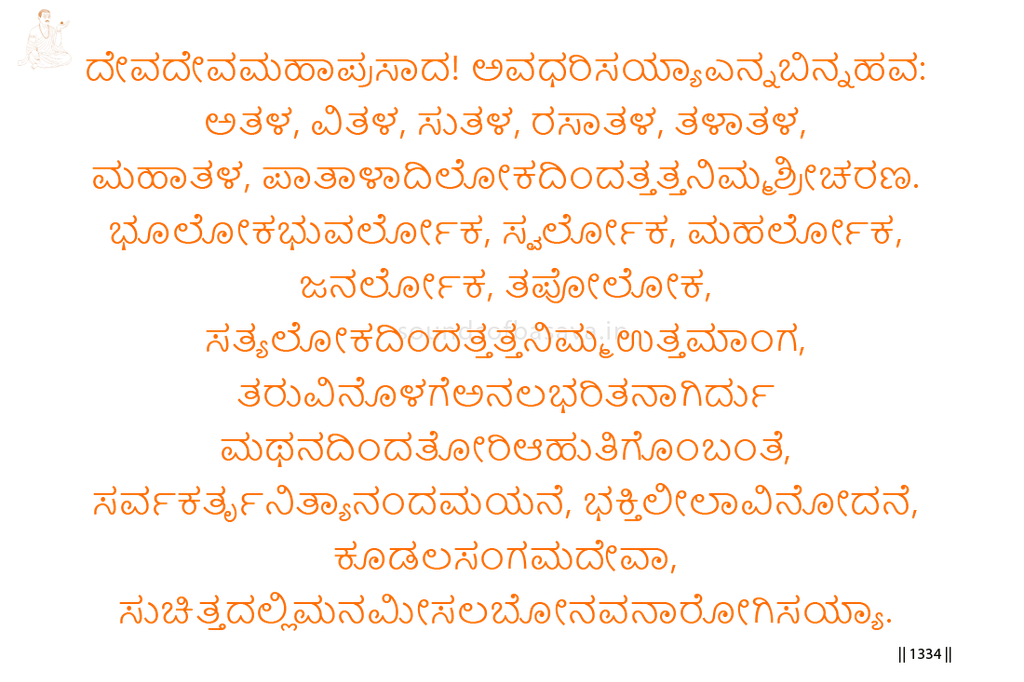
The Lord’s sacred feet extend beyond the seven lower worlds, and His supreme head extends beyond the seven upper worlds. Having revealed the immeasurable Divine form, Basavanna turns to the image of fire hidden within wood: through churning, the concealed fire appears and receives the oblation.
In the same way, he asks the all-doing Lord—eternal Bliss and the One who delights in the play of Bhakti—to manifest and partake of the food inwardly dedicated with a pure mind.
Imagery & Symbolic Relevance
The vachana opens as a direct supplication: “Deva of Devas, Mahaprasada, attend to my appeal.”
Mahaprasada is not introduced as an object separate from Kudalasangama Deva. The Lord Himself is addressed as Mahaprasada—the supreme sacred fulfilment from whom offering and reception obtain their meaning.
Basavanna first names the seven lower worlds:
Atala;
Vitala;
Sutala;
Rasatala;
Talatala;
Mahatala;
Patala.
Beyond these lower realms extend the Lord’s sacred feet. The feet, ordinarily the lowest part of the body, already exceed the lowest reaches of the worlds.
He then names the seven upper worlds:
Bhuloka;
Bhuvarloka;
Svarloka;
Maharloka;
Janaloka;
Tapoloka;
Satyaloka.
Beyond these extends the Lord’s uttamanga, the supreme head or crown.
The lower and upper worlds are thus gathered within the immeasurable span of Kudalasangama Deva. No realm can contain the Lord whose feet reach beyond the depths and whose crown surpasses the highest worlds.
The vachana then changes scale abruptly—from the fourteen worlds to fire concealed within wood.
Although fire fills the wood as a hidden possibility, it is not immediately visible. Through mathana—churning or friction—it becomes manifest.
Once revealed, the fire receives the ahuti, the sacrificial offering. The offering can be consumed because the hidden fire has appeared.
This image governs Basavanna’s final prayer. Kudalasangama Deva is immeasurable and all-pervading, yet Basavanna asks Him to become present within the intimate act of offering.
The movement is therefore not merely from smallness to vastness. It is from cosmic immeasurability to immediate reception:
the Lord extends beyond every world;
the Lord remains hidden like fire in wood;
the hidden presence becomes manifest;
the manifested fire receives the offering.
Basavanna finally offers not merely external food, but food inwardly set apart in a pure mind. The purity and dedication of the mind belong to the offering itself.
Lingayoga
In Lingayoga, the Linga must not be confined either to one physical location or to an abstract cosmic idea.
Kudalasangama Deva exceeds the entire structure of the worlds, yet the same Lord may become immediately present within worship and offering.
The fire-and-wood image gives the practical movement. The Divine presence is not manufactured by the practitioner. It is already concealed, as fire is concealed within wood. Disciplined devotion makes that presence manifest within experience.
The practitioner must therefore bring together:
awareness of the Lord’s immeasurable vastness;
inward preparation through a pure mind;
dedication free from personal ownership;
offering made in the confidence that the hidden Lord receives.
The offering does not nourish a deficient deity. The Lord is Sarvakarta, the doer of all, and Nityanandamaya, the fullness of eternal bliss.
The devotee offers because Bhakti itself is the Lord’s sacred play. The prayer is not, “I sustain You,” but, “Manifest within this offering and graciously receive what has been inwardly dedicated.”
Editorial Commentary
The lower and upper worlds form a complete cosmological enumeration. They establish the immeasurable extent of Kudalasangama Deva and should not be automatically converted into bodily centres or subtle channels.
Sri-charana means the sacred feet.
Uttamanga means the supreme part of the body—the head or crown.
Mathana is churning or friction through which the fire hidden in wood becomes visible.
Ahuti is the oblation received by the manifested fire.
Sarvakarta means the agent or doer of all.
Nityanandamaya means filled with or constituted by eternal bliss.
Bhakti-lila-vinoda identifies Kudalasangama Deva as the One who delights in the Divine play of Bhakti.
The concluding request concerns food inwardly reserved or dedicated within a su-chitta, a pure and rightly directed mind. Basavanna asks the Lord to accept and partake of it.
Related Vachana
Supporting Vachana
Sharana Sthala Vachana 1159 — Who Truly Feeds the Lord?
Sharana Vachana 1159 removes the pride that may arise in sacred offering.
Basavanna observes that hand, eye, and tongue enter into intimate participation with what they touch, see, and taste. Yet bodily service does not by itself reveal who truly receives the offering.
He rejects the thought, “I have fed the Lord who contains the entire universe.” The finite servant cannot claim to nourish the One within whom the Brahmanda itself abides.
Basavanna therefore asks Madivala Machayya to explain the manner in which Kudalasangama Deva is truly satisfied.
This directly prepares Vachana 1217. Sharana Vachana 1159 removes the giver’s arrogance; Aikya Vachana 1217 reveals the immeasurable Lord whose feet and crown extend beyond all worlds.
Having acknowledged that vastness, Basavanna does not claim to feed the Lord. He humbly asks Kudalasangama Deva to manifest like fire from wood and receive the offering dedicated through a pure mind.
Advancing Vachana
Aikya Sthala Vachana 1218 — The Shatsthala of Divine Transformation
Aikya Vachana 1218 turns the vastness revealed in Vachana 1217 into complete inward transformation.
Through the revered Guru’s compassion, the bodily illusion is cut through. The greatness of threefold Bhakti—Guru, Linga, and Jangama—is revealed. Padodaka and Prasada protect Basavanna and cleanse the impurity of his mind.
Kudalasangama Deva then manifests upon the throne of Shunya, reveals His true greatness before the Pramathas, sanctifies Basavanna, and establishes Shatsthala throughout his whole being.
The movement advances precisely:
Vachana 1217 reveals the Lord extending beyond the fourteen worlds.
The hidden fire becomes manifest to receive the inward offering.
Vachana 1218 shows that Divine manifestation entering and transforming the devotee.
Mahaprasada becomes protection, purification, sanctification, and the establishment of Shatsthala throughout the entire being.
The Lord who receives the pure-minded offering in Vachana 1217 becomes, in Vachana 1218, the active transformer who makes Basavanna like Himself and draws him toward complete absorption.
