

Summary
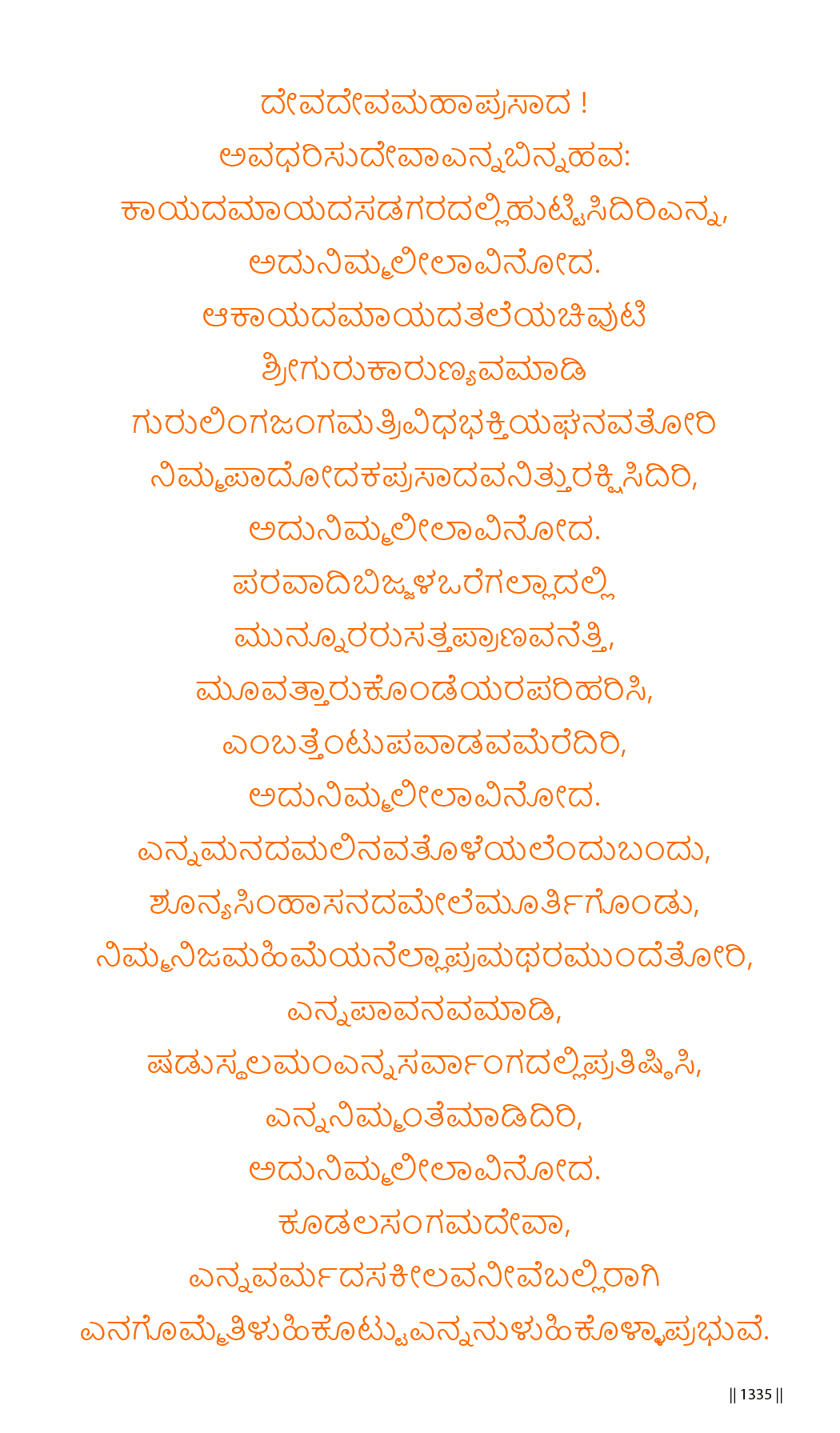
Basavanna addresses Kudalasangama Deva as Deva of Devas and Mahaprasada and asks Him to hear his supplication.
The Lord caused him to be born amid the bustle of bodily Maya; Basavanna recognizes even this as the Lord’s play. Through the compassion of Sri Guru, the ruling force of that bodily illusion was decisively removed. The greatness of threefold Bhakti—Guru, Linga, and Jangama—was revealed, and Basavanna was protected through Padodaka and Prasada.
Kudalasangama Deva came to cleanse the impurity of his mind, manifested upon the throne of Shunya, revealed His true glory before the Pramathas, sanctified Basavanna, established Shatsthala throughout his entire being, and made him like Himself. This transformation too is the Lord’s play.
Yet Basavanna makes no independent claim of completion. He says that the Lord alone knows the hidden key to his innermost being and asks Him to reveal it once and preserve him.
Imagery & Symbolic Relevance
The opening image is the bustle of bodily Maya. Basavanna describes embodied existence as a field of activity, attraction, confusion, and outward involvement into which he was born.
He does not say that he entered this condition through independent choice. Kudalasangama Deva remains the governing agent: “You caused me to be born.”
Basavanna calls this the Lord’s Lila-vinoda, Divine play. This does not make bodily Maya identical with realization. It places even the beginning of his condition within the wider movement governed by the Lord.
The next image is severe: the head of bodily Maya is pinched off or decisively cut down. The head signifies the governing force of that illusion. What had ruled Basavanna’s embodied awareness is deprived of its authority.
This occurs through Sri Guru’s compassion. Guru’s grace is not a secondary ornament added to the transformation; it is the means through which bodily Maya is overcome.
The Lord then reveals the greatness of threefold Bhakti:
Guru;
Linga;
Jangama.
These are not three competing devotions. Guru gives living direction, Linga is the sacred centre, and Jangama is the moving sacred presence. Their greatness is revealed as an integrated field.
Basavanna is then protected through Padodaka and Prasada. Protection and purification are joined: the sacred reception does not remain external but enters the condition of the devotee.
The Lord comes specifically to wash away the impurity of Basavanna’s mind. The movement therefore passes from bodily Maya to inward cleansing.
Kudalasangama Deva then manifests upon the throne of Shunya. The Lord, not Basavanna, assumes form upon that throne. Shunya forms the seat of Divine manifestation beyond ordinary worldly placement.
The Lord reveals His true glory before the Pramathas. The revelation is not a private claim made by Basavanna; it occurs before the sacred assembly.
Basavanna is then:
made pure;
filled throughout with Shatsthala;
transformed into the Lord’s likeness.
The phrase “throughout my entire being” is essential. Shatsthala is no longer merely recited, remembered, or externally observed. It is established throughout embodied life.
The statement “You made me like Yourself” expresses Divine transformation, not Basavanna’s self-deification. The grammar assigns every decisive action to Kudalasangama Deva.
The final prayer confirms this humility. Although transformed, Basavanna still says that the Lord alone knows the hidden key to his inward being. He asks for that inner truth to be revealed and for himself to be preserved by the Lord.
Lingayoga
In Lingayoga, the spiritual path cannot remain an external sequence of teachings. Guru, Linga, Jangama, Padodaka, Prasada, and Shatsthala must become operative throughout the seeker’s life.
The movement given by the vachana is exact:
bodily Maya is recognized;
Guru’s compassion intervenes;
Guru–Linga–Jangama Bhakti is revealed;
Padodaka and Prasada protect;
mental impurity is cleansed;
the Lord manifests;
Shatsthala is established throughout the whole being;
the devotee is transformed into Divine likeness.
None of these movements is claimed as self-produced attainment. Kudalasangama Deva causes, reveals, protects, cleanses, manifests, sanctifies, establishes, and transforms.
The practitioner must therefore not reduce Shatsthala to intellectual knowledge of six stages. Its fulfilment is known when the whole embodied life is reordered through Guru’s compassion and Divine grace.
Even after transformation, vigilance and surrender remain. Basavanna does not say, “I now know myself completely.” He places his hidden inward condition before Kudalasangama Deva and asks to be preserved.
Editorial Commentary
Kāyada māyada saḍagara means the bustle, display, or tumult of bodily Maya. It describes embodied involvement without declaring the body itself evil.
Taleya chivuṭi carries the force of pinching off, nipping, or decisively breaking the head of bodily illusion. It should not be expanded into bodily violence or an unsupported subtle-body doctrine.
Sri-Guru-kāruṇya is the compassion of the revered Guru through which the transformation occurs. Kudalasangama Deva remains the governing agent of the complete movement.
Trividha Bhakti is explicitly Guru, Linga, and Jangama Bhakti.
Shunya-simhasana is the throne of Shunya upon which Kudalasangama Deva manifests. The Kannada does not place Basavanna upon that throne.
Pramathas are the sacred assembly before whom the Lord reveals His true glory.
Sarvanga means the entire body or whole being. Shatsthala is established throughout Basavanna, not merely understood as doctrine.
“Made me like Yourself” must remain under Divine agency. It does not authorize an independent claim that Basavanna has become a separate deity.
The final expression concerning Basavanna’s marma points to the hidden key or inward secret of his being, fully known only to Kudalasangama Deva.
Ennanuluhikollā means save me, preserve me, or keep me under Your protection. It should not be translated as “absorb me.”
The concluding Prabhuve means O Lord, addressing Kudalasangama Deva. It does not refer to Allama Prabhudeva.
Related Vachana
Supporting Vachana
Sharana Sthala Vachana 833 — Who Revealed This Path?
Sharana Vachana 833 asks who revealed the paths of Guru, Linga, Jangama, Padodaka, and Prasada.
Basavanna finally recognizes that the mind which shows these sacred paths is itself illumined by Kudalasangama Deva. Once the revealer is known and the sacred path is no longer fragmented, he declares that no further Bhava remains.
This prepares Vachana 1218 directly.
In Sharana Vachana 833, the path of Guru, Linga, Jangama, Padodaka, and Prasada is revealed. In Aikya Vachana 1218, those revealed relations become active transformative powers:
Guru’s compassion removes bodily Maya;
Guru–Linga–Jangama Bhakti is established;
Padodaka and Prasada protect and purify;
Shatsthala is installed throughout the entire being.
What is first revealed as the sacred path in Sharana Sthala becomes complete embodied transformation in Aikya.
Advancing Vachana
Aikya Sthala Vachana 1161 — Neither Bound Nor Separate
Aikya Vachana 1161 declares that there is neither taking nor giving, neither joining nor separation. Between Basavanna and Kudalasangama Deva, no relationship remains that depends upon two separate participants, and no difference of Bhava remains.
Vachana 1218 says that Kudalasangama Deva established Shatsthala throughout Basavanna and made him like Himself. The transformed devotee nevertheless continues to pray for inward revelation and preservation.
Vachana 1161 advances this into complete non-difference:
Divine likeness is no longer described as transformation from one condition into another;
joining and separation both lose their basis;
the distinction required for an ordinary relationship disappears;
no Bhava-difference remains between Basavanna and Kudalasangama Deva.
Thus the Divine transformation of Vachana 1218 deepens into the condition where even the distinction between the transformed and the Transformer can no longer be established.
