

Summary
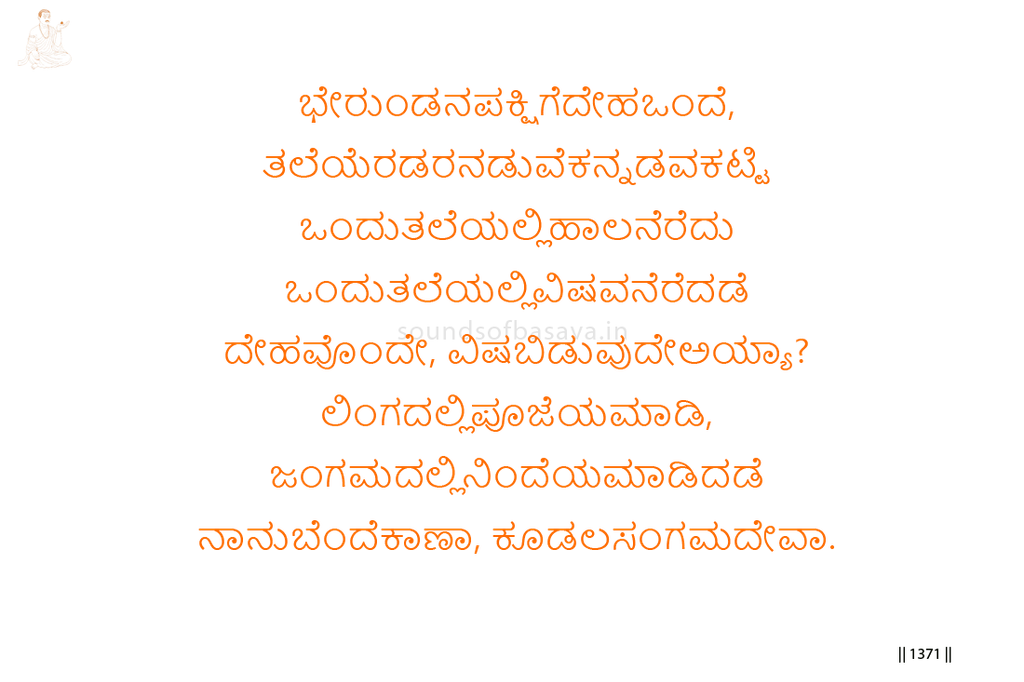
The Bhēruṇḍa bird has two heads but only one body. Even if a partition is placed between the heads, milk given to one and poison to the other enter the same shared life. The partition cannot protect the body from the poison.
Likewise, worshipping the Linga while condemning the Jangama creates an imagined division within one sacred reality. The contradiction returns upon the worshipper: Basavanna says that he himself is the one who burns before Kudalasangama Deva.
Imagery & Symbolic Relevance
Two Heads, One Body
The two heads appear distinct, but neither has an independent body. Their perceptions and actions may differ, yet both participate in one life.
Linga and Jangama are presented through this relation. They have distinct sacred functions, but they cannot be treated as unrelated realities.
The Partition
The partition creates the appearance that what happens on one side will not affect the other. It represents the worshipper’s mistaken division between reverence offered to Linga and conduct shown toward Jangama.
The division exists only in perception. It does not divide the shared body.
Milk and Poison
Milk signifies the honour and nourishment of worship offered to Linga. Poison signifies ninde—condemnation, reviling, or slander directed toward Jangama.
The vachana does not ask whether milk is good or poison is harmful; that is already evident. Its question is whether opposite treatment can remain separated when the body is one.
The milk offered to one head cannot neutralize the poison poured into the other. In the same way, ritual worship cannot compensate for the condemnation of living sacred presence.
“I Am the One Who Burns”
Basavanna does not say that the contradiction harms only the Jangama. The poison returns through the shared sacred relation and burns the one who created the division.
The consequence is therefore inward and self-caused. Worship loses integrity when conduct denies the same presence it claims to honour.
Lingayoga
Lingayoga must unite Linga-puja with reverence toward Jangama.
The practitioner must examine whether devotion before the Ishtalinga continues in speech, conduct, hospitality, and service when Jangama is encountered. Where worship and conduct oppose each other, the division itself becomes the poison.
Editorial Commentary
Bhēruṇḍa is the mythical two-headed bird sharing one body.
The partition does not establish real separation; it only prevents one head from seeing what is given to the other.
Ninde is stronger than ordinary disagreement. It includes condemnation, reviling, and fault-finding.
Nānu bende retains the direct force “I burned” or “I am the one who burns.” Basavanna places the consequence upon himself rather than presenting it as punishment imposed upon another.
Related Vachana
Supporting Vachana
Sharana Sthala Vachana 398 — The Living Altar
Sharana Vachana 398 compares Linga-archane without Jangama to water poured into a broken vessel. It establishes that worship becomes fruitful only within Jangama-presence and that receiving Jangama-Prasada is itself Linga-archane.
It prepares Vachana 1299 by showing that Linga-worship cannot remain complete when its living relation with Jangama is broken.
Advancing Vachana
Aikya Sthala Vachana 393 — No Greater, No Lesser
Aikya Vachana 393 places touching the Linga and bowing before Jangama beyond comparison and concludes directly that Jangama itself is Linga.
Vachana 1299 reveals the destructive consequence of dividing them; Vachana 393 advances into the realized vision in which no hierarchy or difference remains between them.
