

Summary
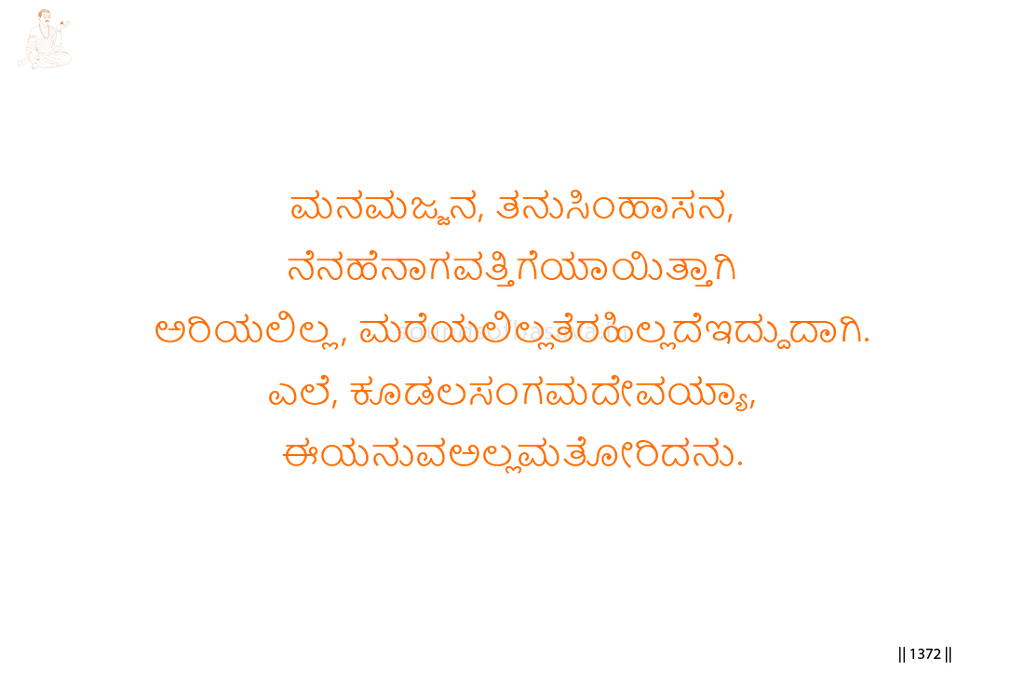
The mind becomes the sacred ablution, the body becomes the throne, and remembrance becomes the casket that bears the Linga.
In this condition, there is neither a separate act of knowing nor forgetting; the relation remains without interruption.
Addressing Kudalasangama Deva, Basavanna says that this natural and accessible way was shown by Allama Prabhudeva.
Imagery & Symbolic Relevance
The Mind as Majjana
Majjana is the sacred bathing of the Linga. Here, the mind does not merely perform the ablution; the mind itself becomes the ablution.
Worship has entered the inward condition. The quality of the mind—cleansed of distraction and wholly directed toward Linga—becomes the offering.
The Body as Simhasana
The body becomes the throne upon which Linga is established.
Embodiment is neither rejected nor treated as an obstacle. The body becomes the seat of Divine presence, and daily life becomes the place in which that presence abides.
Remembrance as Nagavattige
Nenehe—remembrance or sustained awareness—becomes the Nagavattige, the casket that holds the Linga.
The Linga is therefore not remembered only at appointed moments. Remembrance itself becomes the enduring receptacle.
The following negatives complete the image: there is no separate knowing, no forgetting, and no interval in the abiding. Knowing is no longer retained as the achievement of a knower, while forgetfulness cannot displace the Linga-presence.
The Way Shown by Allama
Allama Prabhudeva is the agent who reveals this way.
He does not add another elaborate ritual. He shows how mind, body, and remembrance themselves become the complete field of worship.
Basavanna receives this teaching and places it before Kudalasangama Deva.
Lingayoga
Lingayoga becomes continuous when worship is no longer confined to a particular act.
The mind must become fit for offering, the body must bear Linga-presence, and remembrance must remain unbroken. The discipline is not the rejection of outward worship, but the ending of the gap between worship and the rest of life.
Editorial Commentary
Majjana means sacred ablution or ritual bathing.
Simhasana is the throne or sovereign seat.
Nenehe means remembrance, recollection, or sustained inward awareness.
Nagavattige is the casket or receptacle in which the Linga is held.
The paired expressions concerning knowing and forgetting should both be preserved. The vachana points beyond their alternation into uninterrupted abiding.
Anuva indicates the natural, easy, gracious, or directly accessible way revealed by Allama.
Related Vachana
Supporting Vachana
Sharana Sthala Vachana 302 — The Unceasing Remembrance of Sharanas
Sharana Vachana 302 distinguishes the true Sharanas, who remember Kudalasangama Deva continuously, from partial Bhakti that cannot sustain remembrance.
It prepares Vachana 1303 by establishing uninterrupted remembrance as the Sharana’s measure. Here that remembrance has ripened into the very casket of the Linga.
Advancing Vachana
Aikya Sthala Vachana 490 — When Time Dissolves
Aikya Vachana 490 asks what week, day, night, or daylight can mean when only the worship of Kudalasangama Deva remains.
Vachana 1303 removes interruption within remembrance; Vachana 490 carries this further by removing the divisions of time that ordinarily separate worship from non-worship.
