

Summary
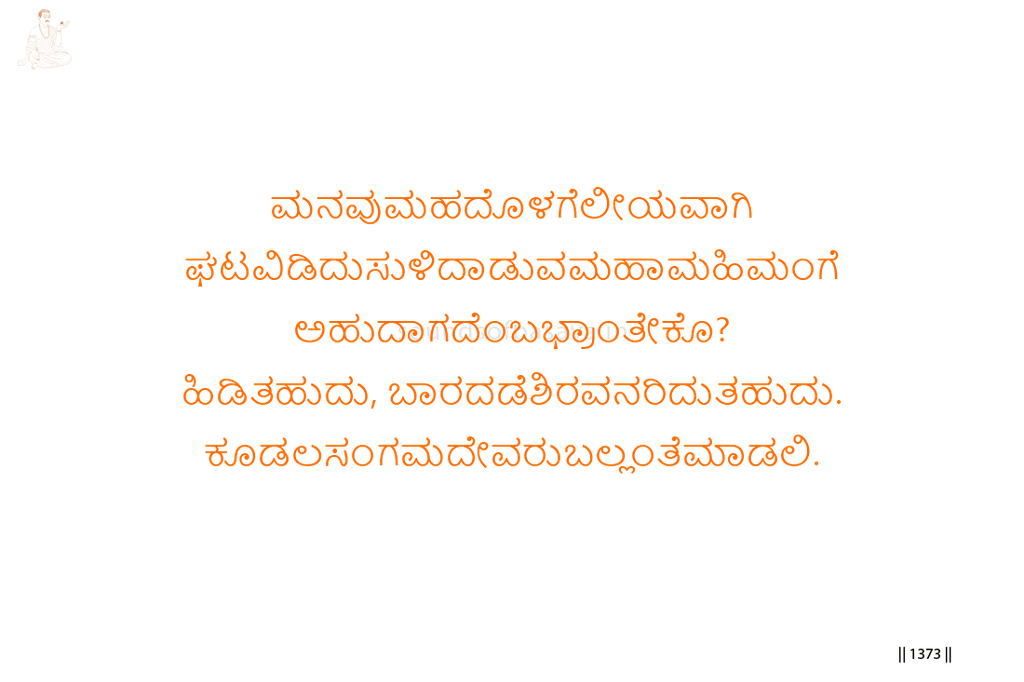
When the mind has merged into Maha, the Great Reality, it is delusion to imagine that embodied life can still move as an independent existence.
True realization must be actual: what has been grasped must truly be grasped. The severe reference to severing the head rejects the contradiction of claiming union while continuing to stand separately.
Basavanna does not certify his own state. He leaves its truth and completion entirely to Kudalasangama Deva, asking the Lord to act as He knows best.
Imagery & Symbolic Relevance
The Mind Merging into Maha
The opening image is complete absorption: the mind becomes līya within Maha, the Great Reality.
This is not intellectual knowledge about the Divine. The mind that ordinarily compares, separates, and claims has entered the Reality greater than itself.
The Moving Ghata
Ghata, the vessel, signifies embodied form. The body may continue to move and act, but after true merger it cannot remain the ground of an independently wandering self.
The delusion lies not in bodily movement, but in supposing that the body still possesses a separate centre after the mind has merged into Maha.
What Is Grasped
The statement that what is grasped must actually be grasped tests the truth of realization.
A verbal claim, passing experience, or inward idea is insufficient. Genuine realization must enter the whole life and remove contradiction between inward awareness and embodied existence.
Severing the Head
The reference to severing the head is an emphatic rejection of false spiritual claim, not an instruction to physical violence.
The image exposes the absurdity of declaring merger while preserving the very self-position that claims to have merged.
The Lord Knows
The final line withdraws judgment from the claimant. Kudalasangama Deva alone knows whether the merger is genuine and may act according to that knowledge.
The vachana therefore ends not in self-certification, but surrender.
Lingayoga
Lingayoga must unite inward realization with embodied conduct.
The seeker should not announce merger on the strength of an experience while the body, speech, and action continue from a separately claiming centre. The test of realization is whether the former division still governs life.
Final judgment belongs to Kudalasangama Deva, not to the practitioner.
Editorial Commentary
Maha indicates the Great or Supreme Reality.
Ghata is the vessel or embodied form. The Kannada does not require the physical body to disappear; it rejects its continuation as an independent identity.
Bhrānti means delusion or mistaken perception.
The head-severing expression is deliberate spiritual severity. It denies pretended or divided realization without prescribing bodily harm.
“Let Kudalasangama Deva do as He knows” preserves the Lord as the sole knower and determining agent.
Related Vachana
Supporting Vachana
Sharana Sthala Vachana 182 — The Unity of Body and Mind in Action
Sharana Vachana 182 teaches that action must touch both mind and body. Bodily performance without inward participation remains divided and is not accepted before Kudalasangama Deva.
It prepares Vachana 1305 by demanding integrity between inward condition and outward life. The Aikya vachana carries that integrity into the stricter test of genuine merger.
Advancing Vachana
Aikya Sthala Vachana 1100 — When Head and Feet Become One
In Aikya Vachana 1100, Basavanna’s head joins Kudalasangama Deva’s sacred feet until no distinction remains. Bodily deceit and mental distortion are removed, and inward darkness flees before the radiance of those feet.
Vachana 1305 tests whether merger has become real; Vachana 1100 reveals that merger as direct transformation of both body and mind.
