

Summary
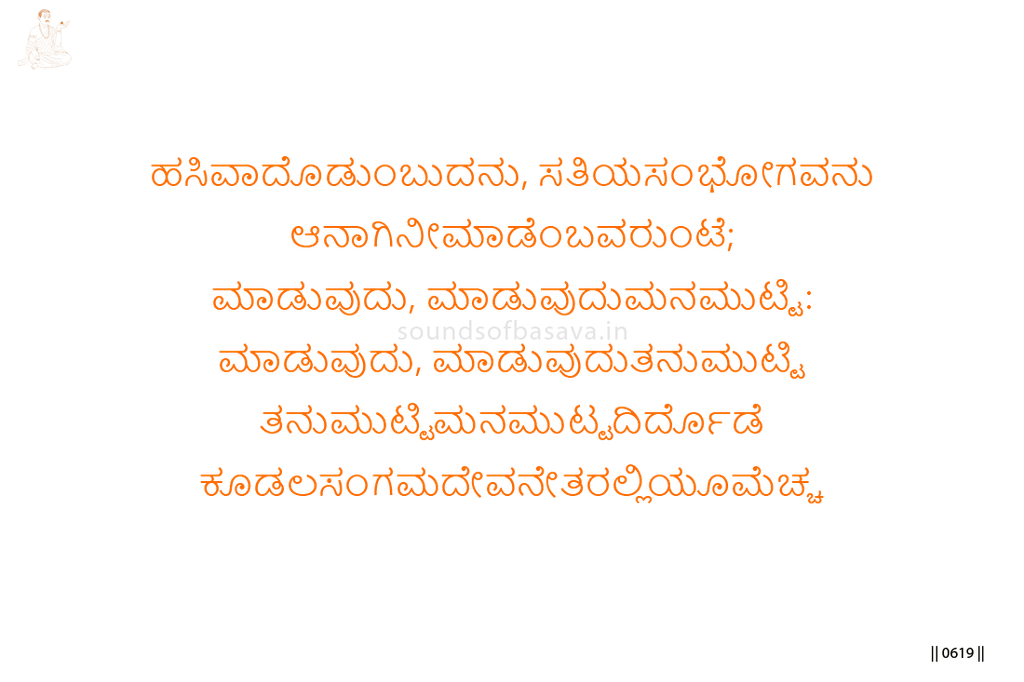
Basavanna asks whether hunger, eating, and conjugal union can be treated as if someone else performs them for the person. These are not distant acts. They involve the person directly.
He then turns to action itself. Doing must touch the mind; doing must touch the body. If the body is touched but the mind is not touched, such action is not approved by Kudalasangama Deva. The teaching is direct: action must not remain bodily movement alone. Body and mind must meet in the act.
Imagery & Symbolic Relevance
Hunger is the first example. When hunger arises and food is taken, the experience is immediate. It cannot be shifted away from the one who undergoes it.
Conjugal union is the second example. Basavanna uses another direct human experience to show that certain acts involve the whole person and cannot be treated as external or separate.
The repeated phrase “doing, doing” gives force to the vachana. Basavanna is not speaking of thought alone, or of body alone, but of the act as a lived whole.
Mind-touch is the first requirement. The mind must be present in what is done. Without this, action becomes divided.
Body-touch is the second requirement. Action must also be embodied. It cannot remain only intention, thought, or inner claim.
The warning comes when the body is touched but the mind is not touched. This is outward action without inward participation. Such doing may appear complete externally, but it does not receive approval before Kudalasangama Deva.
Lingayoga
In Lingayoga, the relevance of this vachana lies in the unity of action. The body must not move while the mind stands apart. The mind must not claim an act that the body does not embody.
The practice-point is direct: let action be whole. What is done must touch both body and mind; otherwise, it remains divided and unworthy before Kudalasangama Deva.
Editorial Commentary
This vachana should be read as a correction of divided action. Basavanna does not reject ordinary bodily experience. He uses hunger and union to show that action is real only when it involves the person directly. The final measure is strict: if the body acts but the mind does not participate, Kudalasangama Deva does not approve. The source therefore asks for integrity between inward attention and outward doing.
Related Vachana
Supporting Vachana
Maheshwara Sthala Vachana 71 — The Unacceptable Vows
Maheshwara Vachana 71 supports this vachana by warning that vows performed outwardly by the body while the mind moves elsewhere do not stand. Sharana Vachana 182 gives the same principle through the language of doing: action must touch both body and mind. Where the body acts without the mind, the act remains divided and lacks acceptance before Kudalasangama Deva.
Advancing Vachana
Aikya Sthala Vachana 1166 — Kriya Is the Body, Jnana the Life-Breath
Aikya Vachana 1166 advances this teaching by carrying body-mind integrity into the union of Kriya and Jnana. In Sharana Vachana 182, Basavanna warns that bodily action without mental participation is incomplete. In Aikya Vachana 1166, Kriya itself becomes the body, Jnana becomes the life-breath, the body is made Linga, and the life-breath is offered to Linga and Jangama. Thus the Sharana-stage demand for unified action advances into Aikya as fully integrated action, knowledge, body, and offering before Kudalasangama Deva.
