

Summary
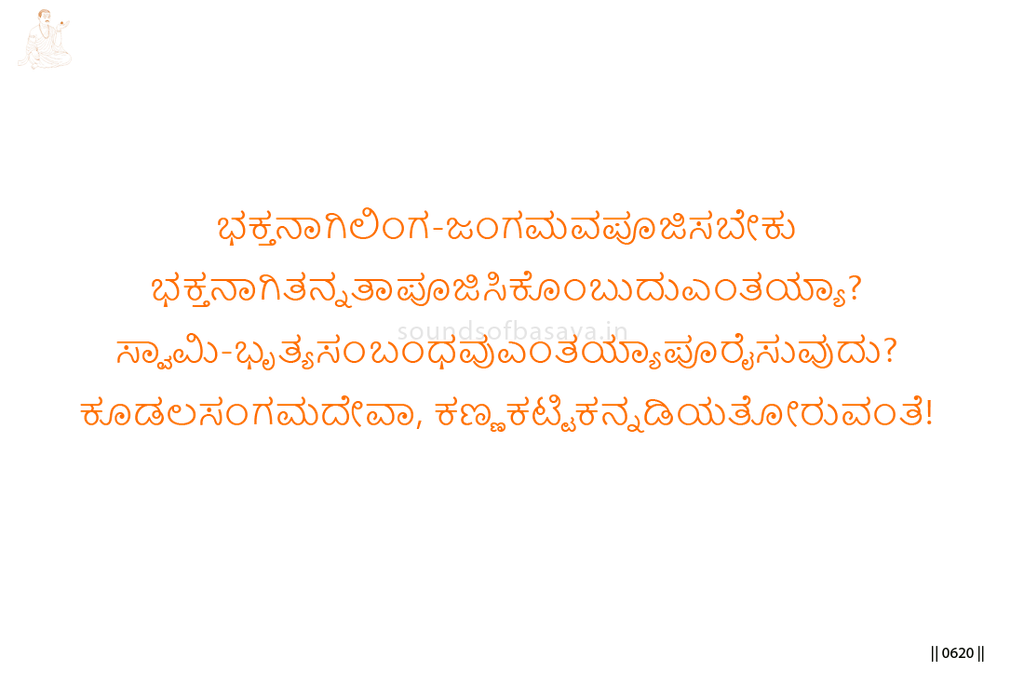
Basavanna says that a Bhakta must worship Linga and Jangama. This is the proper direction of devotion.
He then asks what it means for a Bhakta to worship himself. If devotion turns back upon oneself as its own object, how can the Lord-servant relation be fulfilled? Basavanna compares this to showing a mirror to one whose eyes are blindfolded. The mirror may be present, but sight cannot happen.
The teaching is direct: worship must not become self-reference. The Bhakta must remain rightly oriented toward Linga and Jangama before Kudalasangama Deva.
Imagery & Symbolic Relevance
The Bhakta is the central figure of the vachana. Basavanna first establishes what the Bhakta must do: worship Linga and Jangama.
Linga and Jangama are named together. The worship of the Bhakta is not to be narrowed into self-regard. It must remain directed toward the sacred presence and its living manifestation.
The question about worshipping oneself introduces the distortion. Basavanna does not present this as realization. He questions it sharply: what is this?
The Lord-servant relation gives the inner measure. A Bhakta stands before the Lord in devotion and service. If the Bhakta turns himself into the object of worship, that relation loses its order.
The blindfolded mirror completes the vachana. A mirror can reflect only when the eyes are open. If the eyes are covered, showing the mirror is useless. In the same way, self-directed worship does not produce true seeing when the proper relation to Linga and Jangama has been obscured.
Lingayoga
In Lingayoga, the relevance of this vachana lies in the correct direction of worship. The seeker must worship Linga and Jangama, not convert devotion into self-worship.
The practice-point is direct: keep the relation clear. Let devotion move toward Linga and Jangama, and do not mistake self-reference for realization.
Editorial Commentary
This vachana should be read as a warning against misplaced worship. Basavanna does not deny the dignity of the Bhakta. He corrects the confusion that arises when the Bhakta makes himself the object of worship while the Lord-servant relation remains unfulfilled. The blindfolded mirror image keeps the teaching exact: the instrument of seeing is useless when sight itself is covered.
Related Vachana
Supporting Vachana
Prasadi Sthala Vachana 197 — The Offering That Fulfills
Prasadi Vachana 197 supports this teaching by showing how worship reaches completion: when Jangama is nourished, Linga is satisfied. It does not allow worship to remain self-contained. Sharana Vachana 185 carries the same concern into sharper correction. The Bhakta must worship Linga and Jangama; if he turns worship toward himself, the relation is distorted. Prasadi shows the right completion of worship through Jangama, while Sharana warns against its self-directed misuse.
Advancing Vachana
Aikya Sthala Vachana 418 — Awareness in Act and Thought
Aikya Vachana 418 advances this teaching by clarifying what mature non-difference truly means. In Sharana Vachana 185, Basavanna warns that the Bhakta must not worship himself and call that devotion. In Aikya Vachana 418, the relation ripens into the recognition that there is no difference between the devotee and Linga, and no difference between the devotee and Jangama. This is not self-worship. It is realized unity in which Guru, Linga, Jangama, and the devotee partake as one.
Thus the Sharana-stage warning protects the path from confusion, while the Aikya-stage teaching shows its fulfilled state. The Bhakta must first keep worship rightly directed; only then can non-difference be realized without distortion before Kudalasangama Deva.
