

Summary
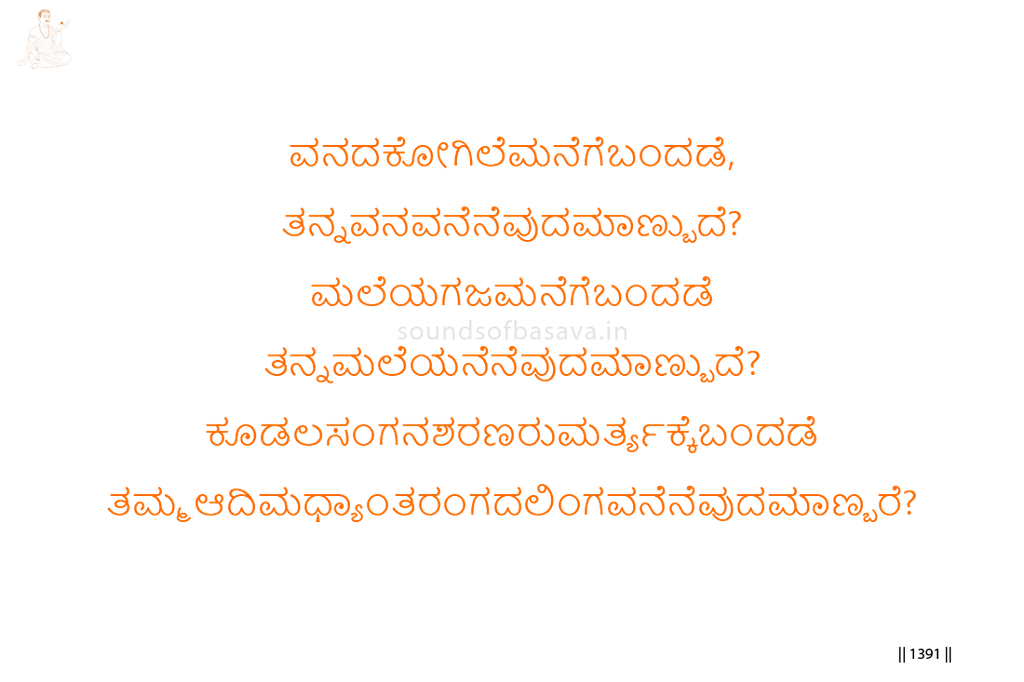
When a forest cuckoo enters a house, can it cease remembering its forest? When a mountain elephant enters a house, can it cease remembering its mountain?
In the same way, when the Sharanas of Kudalasangama come into the mortal world, can they ever cease remembering the Linga within them—the Reality without beginning, middle, or end?
The three questions carry the same implied answer: no. For the realized Sharana, remembrance is no longer an occasional practice. Neither altered surroundings nor mortal embodiment can separate him from the Linga abiding within.
Imagery & Symbolic Relevance
The vachana is formed through three parallel rhetorical questions. The cuckoo and elephant prepare the final recognition concerning Kudalasangama’s Sharanas.
The Forest Cuckoo in the House
The cuckoo belongs to the forest. When brought into a house, its outward surroundings change, but its inward orientation does not.
The house cannot erase the forest from the bird’s nature. Though it now inhabits another setting, it continues to remember the ground to which it belongs.
Basavanna’s question is not about an effort made by the cuckoo. The bird does not discipline itself to remember. Its remembrance arises naturally from what it is.
The Mountain Elephant in the House
The second image increases the scale.
The elephant belongs to the mountain. Bringing it into a house changes its location but cannot remove the strength, memory, and nature formed in the mountain.
The house does not become its true measure merely because it is presently there. Its relation to the mountain remains intrinsic.
As with the cuckoo, the question implies that such remembrance cannot simply be abandoned.
The Sharanas in the Mortal World
The third question reveals the spiritual purpose of the first two images.
Kudalasangama’s Sharanas enter martya, the mortal world of embodied life. Birth into this world changes their outward condition, but it does not erase the Linga abiding within them.
The Linga remembered by the Sharanas is not a distant object recalled only at appointed times. It is the beginningless, middleless, and endless Reality established within their own being.
Mortal embodiment therefore does not create forgetfulness. Just as the cuckoo remains inwardly related to the forest and the elephant to the mountain, the Sharana remains inseparably established in Linga.
The Three Rhetorical Questions
Each question asks whether remembrance can cease:
can the cuckoo forget its forest?
can the elephant forget its mountain?
can the Sharana forget the indwelling Linga?
The Kannada does not state the answer separately because the answer is inherent in the images.
The first two forms of remembrance arise from natural belonging. The third reveals their fulfilment: the Sharana does not merely remember Linga through repeated effort; Linga-remembrance has become intrinsic to his realized condition.
Lingayoga
Lingayoga begins with deliberate remembrance, worship, and the repeated return of attention to Linga.
The practitioner must cultivate continuity and recognise every lapse into forgetfulness. Yet disciplined remembrance should not be confused with the fulfilled Aikya condition described here.
In the Sharana of this vachana, remembrance has ripened into nature. Embodied life continues, but no circumstance becomes capable of displacing the indwelling Linga.
Editorial Commentary
The house indicates a changed dwelling or circumstance. It should not be expanded into an independent doctrinal symbol.
Martya means the mortal or embodied world. The vachana does not reject embodiment; it shows that embodiment cannot erase established Linga-remembrance.
The description of Linga as without beginning, middle, or end indicates the Reality that does not depend upon temporal sequence.
The repeated questions are rhetorical and preserve the force of impossibility: the realized Sharana cannot forget the Linga abiding within.
Related Vachana
Supporting Vachana
Sharana Sthala Vachana 174 — The Eternal Now of Devotion
Sharana Vachana 174 refuses postponement into yesterday or tomorrow. It calls the seeker to become Shiva’s Sharana and Hara’s Sharana in the present day and to remember Kudalasangama without lapse.
It prepares Vachana 1351 by establishing immediate and continuous remembrance as the Sharana’s discipline. In Vachana 1351, that disciplined continuity has ripened into intrinsic remembrance that mortal embodiment cannot interrupt.
Advancing Vachana
Aikya Sthala Vachana 1057 — Where Invocation Ends
Vachana 1351 shows that the Sharana cannot forget the Linga abiding within.
Vachana 1057 deepens this into uninterrupted presence. Because Pranalinga is inseparable from life, there is no need to invoke it as absent or dismiss it as though it could depart. Anga’s communion is Linga, and the mind remains established in Linga-communion.
What appears in Vachana 1351 as remembrance that cannot cease thus advances into a life in which Divine presence has neither beginning nor ending.
