

Summary
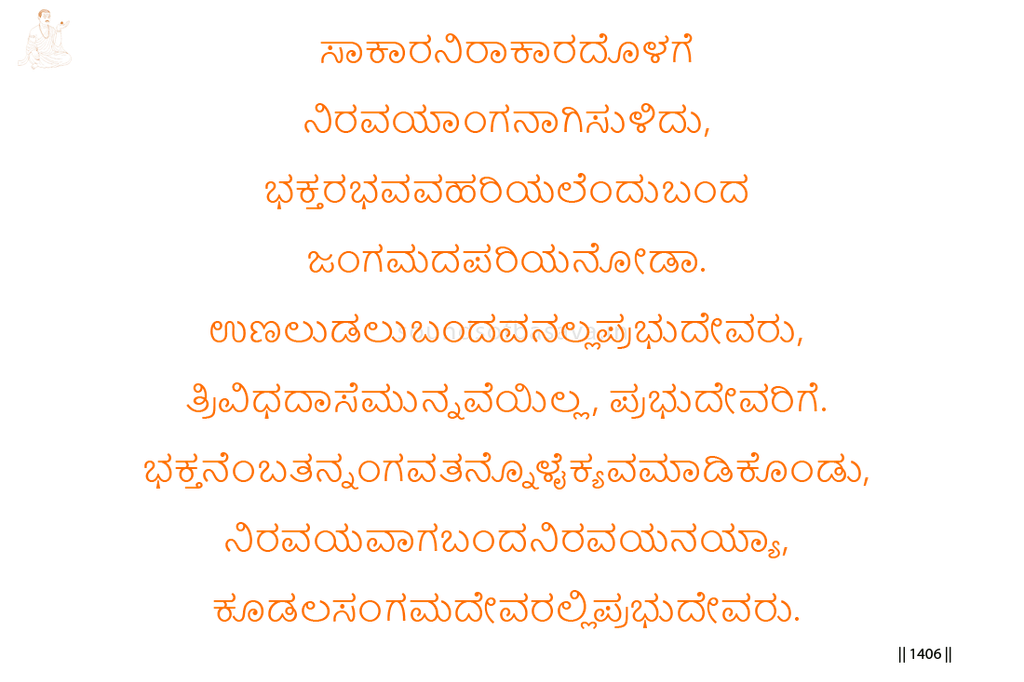
Basavanna asks us to behold the nature of the Jangama who moves through form and formlessness while remaining Niravaya—whole, unfragmented, and beyond limiting division.
Prabhudeva comes among the Bhaktas to end their Bhava, the condition of separate becoming. He does not come seeking food, bodily comfort, or personal benefit. The threefold desire has already vanished in him.
He receives the Bhakta as his own Anga and establishes that Anga in Aikya within himself. Thus Prabhudeva appears in visible Jangama form while abiding in the limitless state of Kudalasangama Deva.
The Formless does not remain distant from embodied life. Through Prabhudeva, it moves as the living Jangama and draws the Bhakta beyond separation.
Imagery & Symbolic Relevance
The Vachana moves through form and formlessness, the coming of Jangama, the ending of Bhava, freedom from threefold desire, the receiving of the Bhakta as Anga, and Prabhudeva’s Niravaya state in Kudalasangama Deva.
Moving Through Form and Formlessness
Prabhudeva appears in visible form as Jangama, yet his being is not confined to that form.
He moves within both Sākāra and Nirākāra:
Sākāra is the visible and embodied presence through which the Bhakta encounters him;
Nirākāra is the formless Divine reality in which he remains established.
These are not two disconnected conditions. The visible Jangama carries the presence of the Formless.
Prabhudeva’s form therefore does not conceal the Formless. It makes the Formless approachable through living presence.
Niravaya-Anga
Basavanna describes Prabhudeva as Niravaya-Anga.
His Anga is no longer governed by fragmentation, fear, incompleteness, or separation from Linga. He bears embodied form, yet his embodied presence does not stand as an independent centre.
Niravaya indicates wholeness without division. Prabhudeva moves through the world without becoming limited by the bodily form through which he is seen.
His Anga has become transparent to the limitless Divine state in which he abides.
“Behold the Nature of the Jangama”
Basavanna directs the listener to behold the pari, the manner or true nature, of this Jangama.
The Jangama is known through why he comes, how he lives, and what happens in his presence.
Prabhudeva’s movement is not toward acquisition. He comes toward the Bhakta so that the Bhakta’s Bhava may end.
The true nature of Jangama is therefore revealed through compassionate Divine movement.
Coming to End the Bhakta’s Bhava
The Jangama comes to remove the Bhava of the Bhaktas.
Bhava here is the continuing formation of separate identity—the condition in which the Bhakta experiences himself as standing apart from Linga and Jangama.
Prabhudeva does not merely comfort this separate condition. His presence brings it toward cessation.
The Bhakta is not left as an isolated worshipper facing an external sacred teacher. Through the Jangama, the very ground of separation is transformed.
Prabhudeva Did Not Come to Eat
Basavanna states that Prabhudeva did not come for food or bodily maintenance.
The line distinguishes the purpose of his arrival. His coming is not driven by hunger, need, possession, or expectation of hospitality.
Food may be offered to Jangama within sacred relationship, but Prabhudeva’s presence cannot be measured as that of a recipient seeking material benefit.
He comes to give freedom from Bhava, not to fulfil a personal lack.
Freedom from the Threefold Desire
The threefold desire has already vanished in Prabhudeva.
The threefold desire gathers the principal movements through which the separate self seeks continuation—desire for possession, sensual fulfilment, and worldly acquisition or recognition.
These have not been temporarily suppressed in him. They no longer form the motive of his movement.
Prabhudeva’s compassion is therefore free from transaction. He does not approach the Bhakta in order to receive something in return.
His presence is Dasoha in its deepest form: the realised being offers his very presence for the freedom of others.
The Bhakta as Prabhudeva’s Own Anga
Basavanna says that Prabhudeva receives the one called Bhakta as his own Anga.
The Bhakta is no longer treated as an unrelated person standing outside the Jangama. Prabhudeva takes the Bhakta’s condition into his own realised presence.
This is an intimate sacred relationship. The Jangama does not merely give instruction from a distance; he receives the Bhakta into the field of his own realization.
The Bhakta’s Anga becomes related to Prabhudeva’s Anga without opposition or spiritual distance.
Establishing the Bhakta in Aikya Within Himself
Prabhudeva makes the Bhakta’s Anga Aikya within himself.
The movement is more than intellectual teaching. The Bhakta is drawn from separate Bhava into realised relationship.
Prabhudeva does not merely tell the Bhakta that unity exists. Through his Niravaya presence, he makes the Bhakta’s Anga participate in that unity.
The Jangama therefore becomes the living passage through which Bhakti matures into Aikya.
The Niravaya One Who Came
Prabhudeva comes as the Niravaya One.
His coming into form does not reduce his wholeness. He enters embodied relationship while remaining free from the division ordinarily created by embodiment.
This gives the Vachana its central wonder: the limitless appears and moves through a visible human form.
The Jangama is therefore neither merely a physical person nor an abstract formless principle. Prabhudeva is the living meeting of embodied presence and limitless realization.
Prabhudeva in Kudalasangama Deva
The Vachana concludes by placing Prabhudeva in Kudalasangama Deva.
Kudalasangama Deva is the Divine ground in whom Prabhudeva’s Niravaya state abides. Prabhudeva is the realised Jangama through whom that state becomes present to the Bhakta.
Their sacred roles remain clear:
Kudalasangama Deva is the Lord and limitless Divine ground;
Prabhudeva is the realised Jangama established in Him;
the Bhakta is received as Anga and drawn beyond Bhava into Aikya.
Basavanna beholds in Prabhudeva the Formless moving compassionately through form.
Lingayoga
Lingayoga requires the practitioner to recognise Jangama as the living presence through whom the Linga-relation becomes active and transformative.
The practitioner must move beyond a transactional approach in which Jangama is valued only as one who receives food, offerings, or service. Sacred giving becomes meaningful when it expresses recognition of the realised presence that has come to end Bhava.
The threefold desire must also be examined within the practitioner. Possession, enjoyment, recognition, and expectation keep Anga enclosed within its separate centre.
Prabhudeva reveals the fulfilled state: embodied life remains, yet desire no longer directs its movement. The practitioner prepares for this through Linga-remembrance, Jangama-reverence, Dasoha, and surrender of personal claim.
The Aikya described here is established through living relationship. The Bhakta’s Anga becomes receptive to the Jangama until the division between seeker and sacred presence loses its authority.
Editorial Commentary
Sākāra means visible or embodied form.
Nirākāra means the formless Divine reality.
Niravaya indicates wholeness beyond fragmentation, limiting division, and separate dependence.
Bhava is the continuing formation of separate identity and becoming.
Threefold desire gathers the principal desires through which the separate self seeks possession, enjoyment, and continuation.
“The Bhakta as his own Anga” expresses Prabhudeva’s intimate receiving of the devotee within his realised presence.
Aikya within himself indicates that the Bhakta is drawn into non-separate sacred relationship through the living Jangama.
Related Vachana
Supporting Vachana
Sharana Sthala Vachana 3 — The Divine Vehicles
Sharana Vachana 3 presents the seeker as entirely responsive to Kudalasangama Deva’s mode of presence. When the Lord is formless, he becomes knowledge; when the Lord dances, he becomes consciousness; when the Lord takes form, he becomes the bull that bears Him; and when the Lord comes as Jangama to end Bhava, he becomes servant.
This prepares Vachana 1389 directly.
In Sharana Sthala, the seeker recognises the Jangama who comes to end becoming and responds through service. In Vachana 1389, that Jangama is revealed as Prabhudeva himself—the Niravaya One who moves through form and formlessness and receives the Bhakta’s Anga into Aikya.
The servanthood of the Supporting Vachana therefore opens into the transformative relationship of the present Vachana.
Advancing Vachana
Aikya Sthala Vachana 1106 — The Hidden Essence Within
Vachana 1389 reveals Prabhudeva as the Formless moving in Jangama form. He bears Anga without division, comes without threefold desire, and draws the Bhakta beyond Bhava.
Vachana 1106 deepens this mystery through the images of potency hidden within a seed, rasa within flowing sap, and nectar within milk. In each image, the essential reality is present within visible form without being separable from it.
Prabhudeva likewise comes bearing a body, yet Bhava finds no ground in him. His embodied form remains, but conditioned becoming does not define his state.
The Vachana concludes that Prabhudeva’s mode of being in Kudalasangama Deva is unfathomable.
Thus Vachana 1389 reveals what Prabhudeva does as Jangama: he comes to end the Bhakta’s Bhava and establish the Bhakta’s Anga in Aikya. Vachana 1106 advances into the hidden nature of the one who performs that work: embodied yet free from Bhava, visible yet immeasurable, and established beyond comprehension in Kudalasangama Deva.
