

Summary
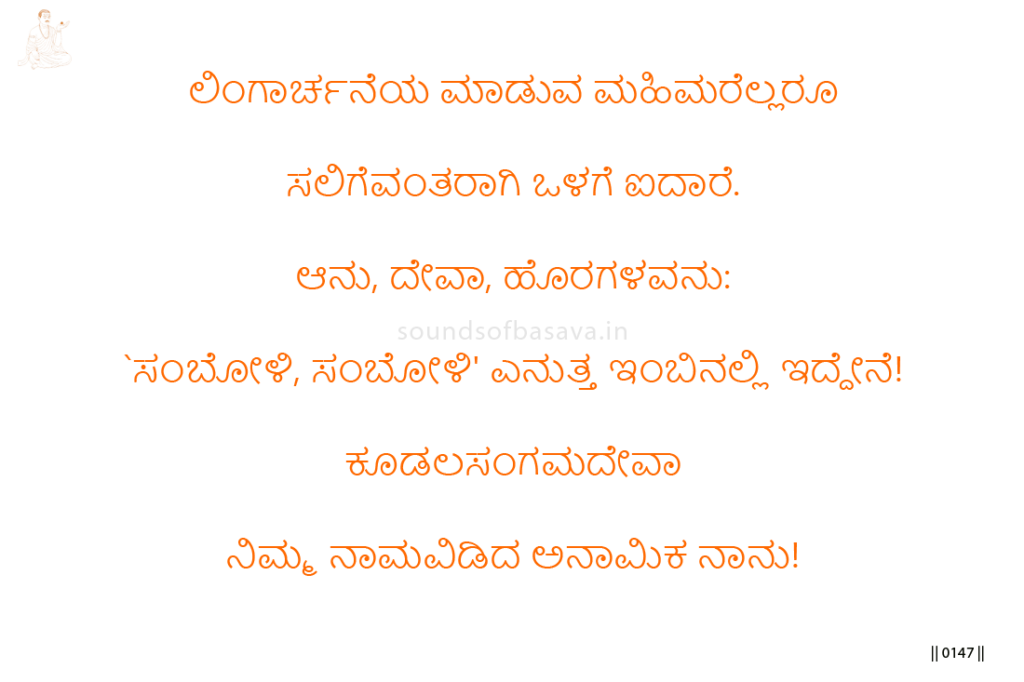
In this vachana, Basavanna speaks from deep humility. The great ones who perform Linga-worship have entered within, but he says that he remains outside.
He does not make a claim of attainment. He stands at the threshold, crying “Samboli, Samboli,” absorbed in remembrance of Kudalasangama Deva.
The vachana culminates in the phrase “I am the nameless one who bears Your Name.” Basavanna lets personal identity fall away. What remains is not his own name, status, or achievement, but the Name of Kudalasangama Deva.
Imagery & Symbolic Relevance
Linga-archane is the first image. The great worshippers of the Linga have entered within. Basavanna acknowledges their inward attainment without rivalry or comparison.
The contrast between inside and outside gives the vachana its force. “Inside” suggests entry into the living presence. “Outside” suggests the threshold, the place of waiting, humility, and longing.
Basavanna’s “outside” should not be read as mere exclusion. It is the humility of one who refuses to claim spiritual greatness for himself.
The repeated cry “Samboli, Samboli” is the sound of devotional invocation. It is not elaborate doctrine or self-presentation. It is direct remembrance.
The word “Anāmika,” the nameless one, is the central image. To become nameless is to give up self-importance, reputation, and spiritual identity.
Yet he is not empty of meaning. He bears the Name of Kudalasangama Deva. The devotee’s own name fades, and the Divine Name becomes his true identity.
The imagery therefore moves from threshold to remembrance, and from personal name to Divine Name.
Lingayoga
In Lingayoga, Linga-worship must not become a claim of superiority. Even when others appear inwardly advanced, the seeker must remain humble before the Linga.
This vachana shows the discipline of standing at the threshold without self-deception. The seeker does not pretend to have entered. He remains in remembrance.
The cry “Samboli, Samboli” becomes a form of gathered attention. It keeps the mind turned toward Kudalasangama Deva without the need for spiritual display.
The nameless one bearing the Divine Name shows the inward movement of Lingayoga. The Anga does not preserve its own name before the Linga; it becomes marked by the Name it remembers.
Editorial Commentary
This vachana should be read as a teaching on humility at the threshold. Basavanna does not compete with the great Linga-worshippers; he stands outside, emptied of claim, holding only the Name.
The teaching is direct: the devotee becomes nameless before Kudalasangama Deva, and the Divine Name becomes his true identity.
Related Vachana
Supporting Vachana
Vachana 888 — The Futility of Hollow Offering
Vachana 888 warns against sacred acts that remain external because the seeker has not entered the living state of the Sharanas. Vachana 934 continues this threshold theme by showing Basavanna standing outside without false claim, bearing only the Name of Kudalasangama Deva.
Advancing Vachana
Maheshwara Vachana 993 — Blessed by the Sight of the Sharana
Vachana 934 shows the devotee as nameless, standing at the threshold and bearing only the Name of Kudalasangama Deva. Maheshwara Vachana 993 advances this into the last question, where even the final forms of identity and claim must be examined. What is expressed here as nameless humility becomes, in the next movement, the final inquiry before deeper abidance.
